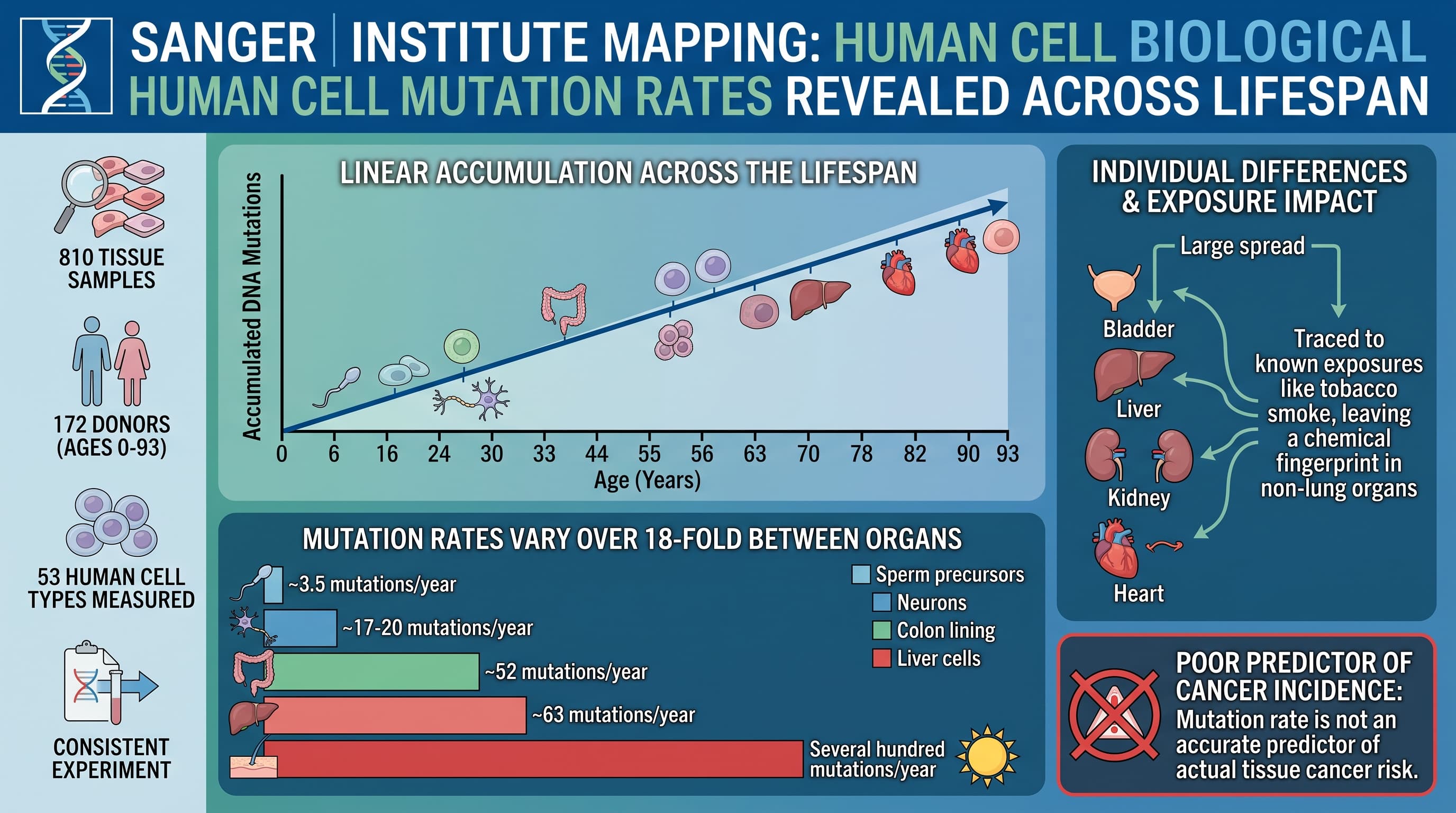
A Wellcome Sanger Institute team sequenced 810 tissue samples from 172 donors aged 0 to 93 and measured, for the first time in one consistent experiment, how fast DNA errors accumulate in 53 different human cell types. The headline result is that mutations pile up in a straight line across the entire lifespan in almost every tissue, including cells that never divide, but the speed of that line varies more than 18-fold between organs. Sperm precursors accrue about 3.5 mutations per year, neurons about 17 to 20, colon lining cells about 52, liver cells about 63, and sun-exposed skin several hundred.
For thirty years the study of somatic mutation has been hampered by a technical embarrassment: DNA sequencers make more errors than cells do. A method called duplex sequencing solved that by reading both strands of every DNA molecule separately and accepting a mutation only when both strands agree. The Sanger group has now applied it at scale, and the result is the closest thing biology has to a speedometer reading for every major cell type in the human body.
The big idea is that ageing at the genome level is not one process running at one speed. It is dozens of processes running at different speeds in different rooms of the same house, and we can now read every dial.
Three findings stand out. The first is that accumulation is linear. Mutations do not snowball late in life; they arrive at a steady rate from birth to death in most tissues. The team tested curved and exponential models explicitly and the straight line won. That is what you would see if the rate of DNA damage, the efficiency of repair and the accuracy of copying all held roughly constant across eighty years. It is a quietly deflating result for anyone hoping a late-life intervention could slam the brakes on a runaway process, because there is no runaway to stop.
The second is that cell division is not the main engine. Neurons and heart muscle cells, which essentially stop dividing in early life, still accumulate around 17 to 37 mutations a year, comparable to many tissues that renew constantly. Whatever damages DNA does not need the cell to be copying its genome to do it. That points instead at slow chemical decay of the DNA molecule itself, running in the background of every cell whether or not it is doing anything.
The third, and the most consequential for public health, is that tobacco smoke mutates organs far from the lung. The study finds smoking signatures in liver cells, heart muscle, kidney tubules and bladder lining. Smoke chemicals enter the bloodstream and mutate tissue systemically. Cardiac muscle cells, which barely divide and cannot be replaced, carry the mark, and the affected heart samples came from the left side, which receives blood directly from the lung.
There is also a genuine puzzle at the centre of the dataset. The single largest contributor to the body’s total mutation burden is a pattern called SBS5, present in every cell type in every person, found in every mammal studied, and with no known cause. It runs at ten times the normal rate in liver cells and is almost switched off in sperm precursors, and nobody can say why. The authors name identifying its mechanism as the top priority coming out of the work, a striking admission for a field this mature.
Finally, the result the field will argue about. If mutations cause cancer, tissues with higher mutation rates should be more cancer-prone. Outside skin, they largely are not. Something other than raw mutation count, most likely how many cells a tissue has, how much they can still divide, and when in life the mutations land, is setting cancer risk.
Actionable Insights
Do not smoke, and if you have smoked, understand the scope. This paper shows tobacco mutating the liver, heart, kidney and bladder, not just the lung. Bladder lining cells vary between people by an amount equal to roughly 33 years of average mutation accumulation, and the paper attributes most of that spread to a smoking-linked pattern. In liver cells the equivalent figure is about 25 years, in heart muscle about 31 years. For comparison, brain and naive immune cells vary by only 4 to 5 years between individuals. Smoking is not a modest contributor to this variance; it is the dominant one the study could identify.
Protect skin from ultraviolet light. Skin epidermis has the highest mutation rate of any cell type measured, several hundred per year against a body-wide median near 25, and its person-to-person variation is driven almost entirely by ultraviolet signatures.
Alcohol leaves a distinct mutational signature in mouth and oesophageal lining in some individuals.
Context and Source
- Open Access Paper: A comprehensive atlas of somatic mutation rates and mutational signatures in normal human cells
- Lead institution: Somatic Genomics Programme, Wellcome Sanger Institute, Cambridge, United Kingdom
- Contributing countries: United Kingdom, Netherlands, Japan, United States
- Journal: bioRxiv preprint, posted 29 August 2026
- Journal Impact Evaluation This is a preprint server deposit, not a journal article, so the requested metric cannot be applied as specified. Stated in the required format for completeness: