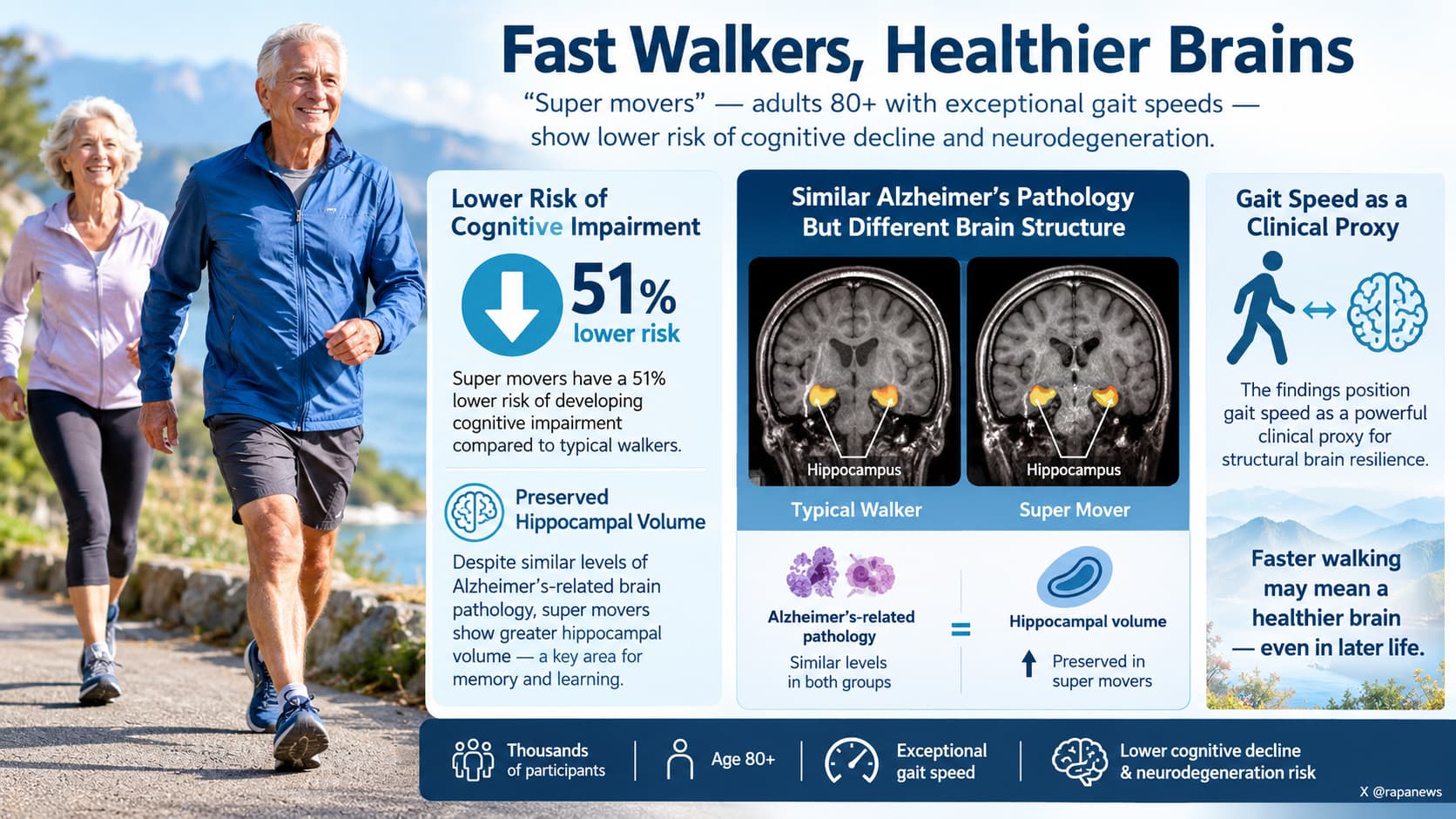
This retrospective multicohort study investigates “super movers,” defined as adults 80 years and older with exceptional gait speeds, to determine their risk of cognitive decline and neurodegeneration. Across thousands of participants, researchers found that these fast walkers possess a 51 percent lower risk of developing cognitive impairment and exhibit preserved hippocampal volume, despite having similar levels of Alzheimer’s-related brain pathology as typical walkers. The findings position gait speed as a powerful clinical proxy for structural brain resilience.
This retrospective multicohort study investigates a demographic termed “super movers,” defined as adults 80 years and older who maintain gait speeds at least 1.5 standard deviations above their age and sex adjusted peers. By analyzing data from 4,878 participants across the Health and Retirement Study International Network, the LonGenity cohort, and the RUSH Memory Aging Project, researchers evaluated whether extraordinary physical mobility corresponds with neurological protection. The findings reveal a profound divergence between functional cognitive health and underlying neuropathology.
Super movers demonstrated a vastly superior cognitive trajectory compared to average older adults. Across a 3.4 to 5.4 year follow up, the super mover group exhibited a hazard ratio of 0.49 for incident cognitive impairment. This equates to a 51 percent reduction in the relative risk of developing significant cognitive deficits. The protection extended to specific cognitive domains, with super movers showing significantly slower rates of decline in both memory and executive function tasks. Structural imaging data provided a physiological basis for this durability. MRI scans revealed that super movers possess significantly greater hippocampal volume, particularly in the right hemisphere and specific subfields such as the CA1 and presubiculum. These regions are critical for spatial navigation and memory consolidation.
However, the study’s most critical revelation emerged from the postmortem autopsy data. When researchers examined the brains of deceased super movers from the RUSH cohort, they found no significant reduction in Alzheimer’s disease pathology. Super movers harbored the same density of amyloid-beta plaques, tau tangles, Lewy bodies, and cerebrovascular infarcts as their cognitively impaired, slower moving peers. This data strongly suggests that exceptional physical mobility does not immunize the brain against the molecular insults of aging. Instead, maintaining high locomotor capacity acts as a marker of advanced cognitive resilience. The brains of super movers build sufficient structural reserve to maintain operational integrity despite the accumulation of neurodegenerative pathology. The multinational scope of the data confirms this is a universal biological phenomenon rather than a localized artifact. These findings shift the therapeutic target from exclusively clearing brain pathology to enhancing systemic physical vitality to buffer against it.
Actionable Insights
Maintaining top tier walking speed into advanced age is a highly reliable proxy for neurological durability. For an 80 year old, achieving “super mover” status requires a walking pace of approximately 1.29 meters per second for men and 1.27 meters per second for women. Individuals reaching this threshold experience a 51 percent relative risk reduction in clinical cognitive impairment (Hazard Ratio 0.49) and a 60 percent reduction in self reported Alzheimer’s disease diagnoses (Hazard Ratio 0.40).
The primary biological takeaway is that cognitive lifespan can be uncoupled from Alzheimer’s pathology through physical reserve. Interventions should prioritize maximizing lower body neuromuscular power and cardiovascular output to preserve hippocampal volume. Structural brain reserve allows individuals to maintain sharp memory and executive function despite the inevitable accumulation of amyloid plaques and tau tangles. Training protocols should explicitly target walking speed, explosive power, and spatial navigation under physical load, as these capacities share overlapping neural architecture with memory processing in the hippocampal subfields.
Context and Source Evaluation
- Paywalled Paper: Cognitive Aging and Brain Health: A Comparison of Super Movers vs Nonsuper Movers.
- Institution: Albert Einstein College of Medicine.
- Country: United States.
- Journal: Neurology.
- Impact Evaluation: The impact score of this journal is 9.9, evaluated against a typical high-end range of 0–60+ for top general science, therefore this is a High impact journal.