https://onlinelibrary.wiley.com/doi/epdf/10.1111/acel.70516
chatGPT:
Summary
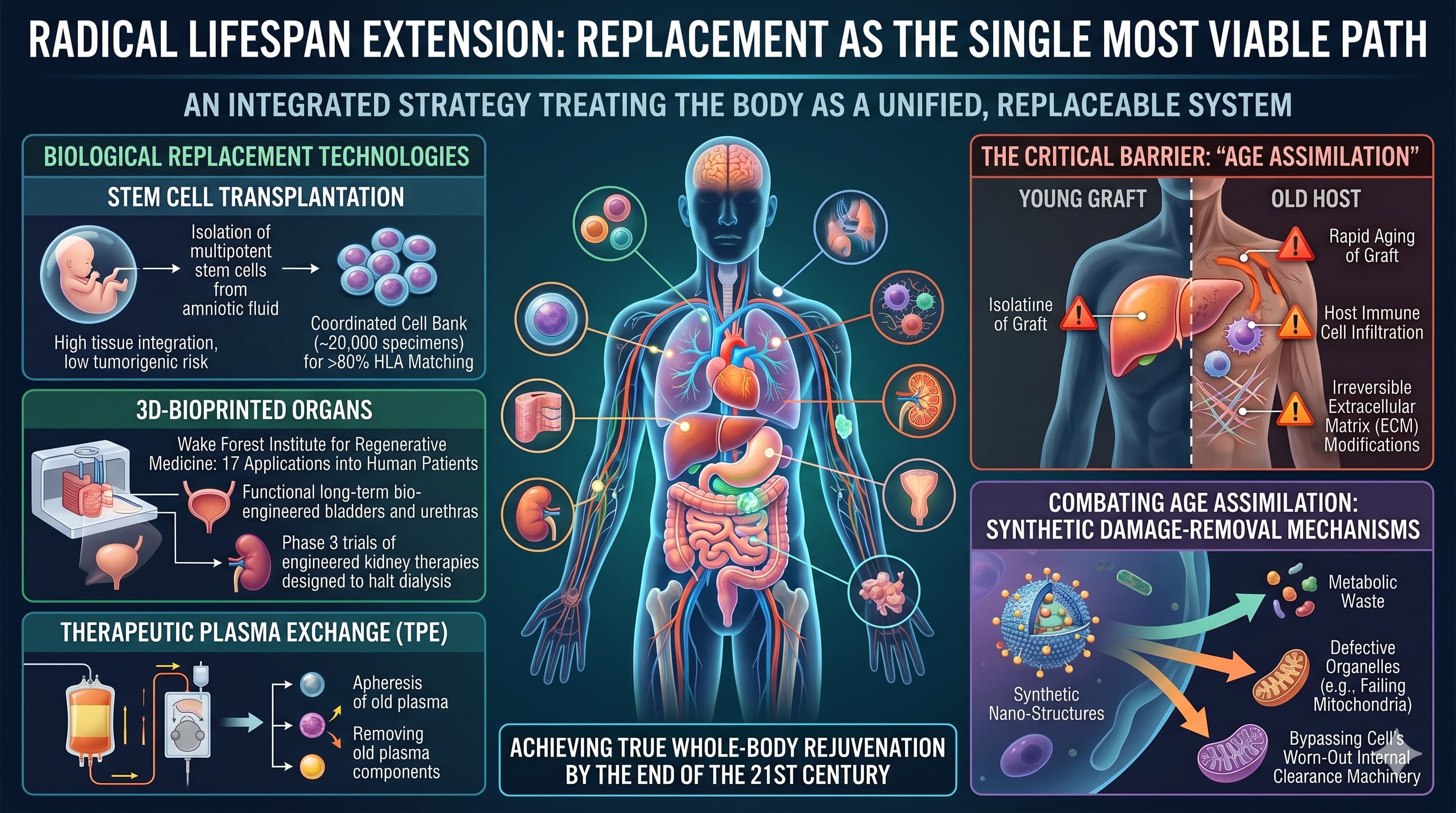
This Aging Cell perspective argues that “replacement-based” interventions may become a major route to systemic rejuvenation. The authors define these as interventions that replace cells, tissues, organs, physiological systems, or cellular components such as mitochondria or genes with biological or synthetic alternatives. Examples include stem-cell therapies, organ and tissue transplantation, bioprinted tissues, plasma exchange, synthetic cells, prostheses, dialysis-like devices, and brain–machine interfaces.
The paper is based around the first “Replacement in Aging” workshop at ARDD 2025. Its central claim is that ageing involves multi-level damage across molecules, organelles, cells, tissues, organs, and systemic regulatory networks, so durable rejuvenation will probably require more than conventional drug-like interventions targeting one or a few pathways. The authors propose combining replacement with regeneration and damage-removal technologies that can remove or export damaged molecules and organelles from cells and tissues.
A key theme is preventive replacement, meaning replacement before catastrophic organ failure rather than only after disease has become clinically advanced. The authors suggest that by 2100, technologies such as bioprinted organs, immune-system resets, synapse-level brain mapping and reconstruction, tissue-integrated devices, and hybrid biological–synthetic replacement could form part of longevity medicine.
The paper highlights several technical and biological barriers. These include rapid ageing of grafts after transplantation, “age assimilation” of young tissues in old hosts, immune infiltration, extracellular matrix remodelling, the number of organs that might need replacing for systemic rejuvenation, limited vascularisation of engineered tissues, and the difficulty of preserving identity in any form of progressive brain replacement.
The clinical examples are strongest in tissue engineering and regenerative medicine. Anthony Atala’s group is described as working on around 40 tissues and organs, with 17 applications already in patients. Examples include cell therapy for urinary incontinence, satellite-cell therapy for rotator cuff injury, chondrogenic priming of progenitor cells in severe knee osteoarthritis, engineered bladders, urethras, vaginal organs, vascular grafts, bioprinted skin, and engineered kidney therapies in a phase 3 trial.
The paper also discusses cell-lineage engineering, including efforts to differentiate human pluripotent stem cells into blood-vessel cells, haematopoietic progenitors, and brain-region-specific neurons. Comparative biology is presented as another route to replacement: for example, transferring naked mole-rat hyaluronan biology, bowhead whale CIRBP, or SIRT6 variants from long-lived species into shorter-lived organisms or human cells.
Plasma-based rejuvenation is discussed as a partial replacement or exchange strategy. The paper cites heterochronic parabiosis studies where exposure to young circulation extended mouse lifespan and reduced DNA methylation age in liver and blood, as well as therapeutic plasma exchange studies in humans that reportedly reduced biological age. However, the authors also note that effects may diminish over time and that optimal plasma components, exchange frequency, and clocks remain unresolved.
The final message is a roadmap: replacement interventions should be combined with damage removal, organ-specific biomarkers, functional readouts, ageing clocks, personalised prioritisation of which tissues to replace, immune-compatible cell or organ sources, and early diagnosis before organs reach severe dysfunction.
Novelty
The novelty is not primarily new experimental data. This is a perspective and workshop synthesis, not a primary research paper. Its contribution is conceptual and agenda-setting.
The most novel element is the attempt to define replacement as a distinct ageing-intervention category, separate from but complementary to geroprotective drugs, partial reprogramming, senolytics, regenerative medicine, and conventional transplantation. The authors frame replacement as a broad class ranging from gene replacement and mitochondrial replacement to plasma exchange, engineered organs, synthetic cells, and even progressive brain replacement.
A second novel aspect is the emphasis on systemic replacement rather than organ-by-organ repair. The authors argue that replacing a single failed organ is unlikely to produce durable rejuvenation if the old systemic environment rapidly ages the graft. This makes “age assimilation” a central problem for longevity science rather than merely a transplant-biology issue.
A third novel contribution is the idea of identifying the “minimum unit of replacement”: the smallest set of cells, tissues, organs, or systemic components whose replacement could produce broad rejuvenating effects. This is potentially important because whole-body replacement is not a near-term clinical strategy, whereas staged or prioritised replacement might be testable.
A fourth novel element is the proposed integration of replacement with synthetic damage-removal and export systems. The paper argues that replacement alone may not address damage such as extracellular matrix remodelling, persistent inflammatory niches, or systemic factors that corrupt new grafts. The figure on page 5 illustrates this combined model: export damaged mitochondria and molecules, bioprint or replace tissues, use tissue-integrated devices, and monitor effects with ageing biomarkers.
A fifth noteworthy aspect is that the authors explicitly include long-horizon technologies, including progressive brain replacement, synapse-level mapping, hybrid biological–synthetic organs, and tissue-integrated devices. These are speculative, but the paper places them within a structured research roadmap rather than treating them as science fiction.
Critique
The main weakness is that the paper is highly speculative relative to the current evidence base. It presents a broad vision of replacement-based rejuvenation, but most of the cited successes are either disease-specific regenerative therapies, preclinical animal studies, or early-stage biomarker studies. The leap from replacing damaged tissues in disease to preventive systemic rejuvenation in otherwise healthy older people remains large.
The concept of systemic rejuvenation is underdefined. The paper uses ageing clocks, omics, functional measures, tissue age assimilation, and organ function as endpoints, but it does not clearly specify what combination of changes would count as genuine rejuvenation rather than transient repair, improved function, or biomarker movement. This is especially important because some interventions, such as plasma exchange, may shift molecular signatures without proving durable healthspan extension.
The paper correctly identifies age assimilation as a major barrier, but it does not yet provide a mechanistic framework for solving it. If an old systemic environment rapidly ages a young graft, then replacement may require prior or simultaneous correction of inflammation, ECM stiffness, immune ageing, metabolic dysfunction, senescent-cell burden, and circulating factors. That makes replacement less a single intervention class and more a platform dependent on many other unresolved geroscience interventions.
There is also an important risk-benefit problem. Many replacement strategies are invasive, expensive, immunologically complex, and potentially dangerous. HSC transplantation is explicitly noted as having mortality risks too high for routine ageing intervention. Multi-organ transplantation, xenotransplantation, engineered organs, immune editing, and brain-cell replacement would need an extraordinarily high safety threshold before being justified in preventive longevity medicine.
The discussion of brain replacement and self-identity is philosophically and clinically underdeveloped. The paper acknowledges the issue, especially for progressive brain replacement, but gives little operational guidance on how identity, continuity of memory, personality, agency, or consent would be preserved or measured. This is one of the most difficult parts of the replacement agenda.
The paper could also do more to distinguish replacement of function from rejuvenation of biology. Dialysis, prostheses, and implants can replace function without making the organism biologically younger. Conversely, plasma exchange or gene therapy might modify ageing biology without replacing a structure. The category “replacement-based ageing intervention” is therefore broad and somewhat heterogeneous.
From your citrate/acetyl-CoA perspective, one gap is that the paper gives relatively little attention to the metabolic state of the host environment. If systemic ageing involves impaired mitochondrial function, altered citrate export, reduced nuclear acetyl-CoA, inflammatory suppression of anabolic transcription, or ECM remodelling, then replacement tissues may enter a hostile biochemical niche. The paper recognises damage removal and systemic context, but does not deeply address metabolic control of graft ageing, transcriptional maintenance, or epigenetic stability.
Overall, this is a useful agenda-setting paper. Its strength is that it broadens longevity thinking beyond small molecules and single pathways toward repair, replacement, engineering, and systems maintenance. Its weakness is that the roadmap is still more visionary than experimentally grounded. The most testable next steps would be: define biomarkers of durable tissue rejuvenation; quantify graft age assimilation; test combinations of replacement plus anti-inflammatory, ECM-remodelling, senolytic, metabolic, or mitophagy-enhancing interventions; and establish whether any replacement strategy improves hard functional outcomes rather than only clocks or local tissue repair.