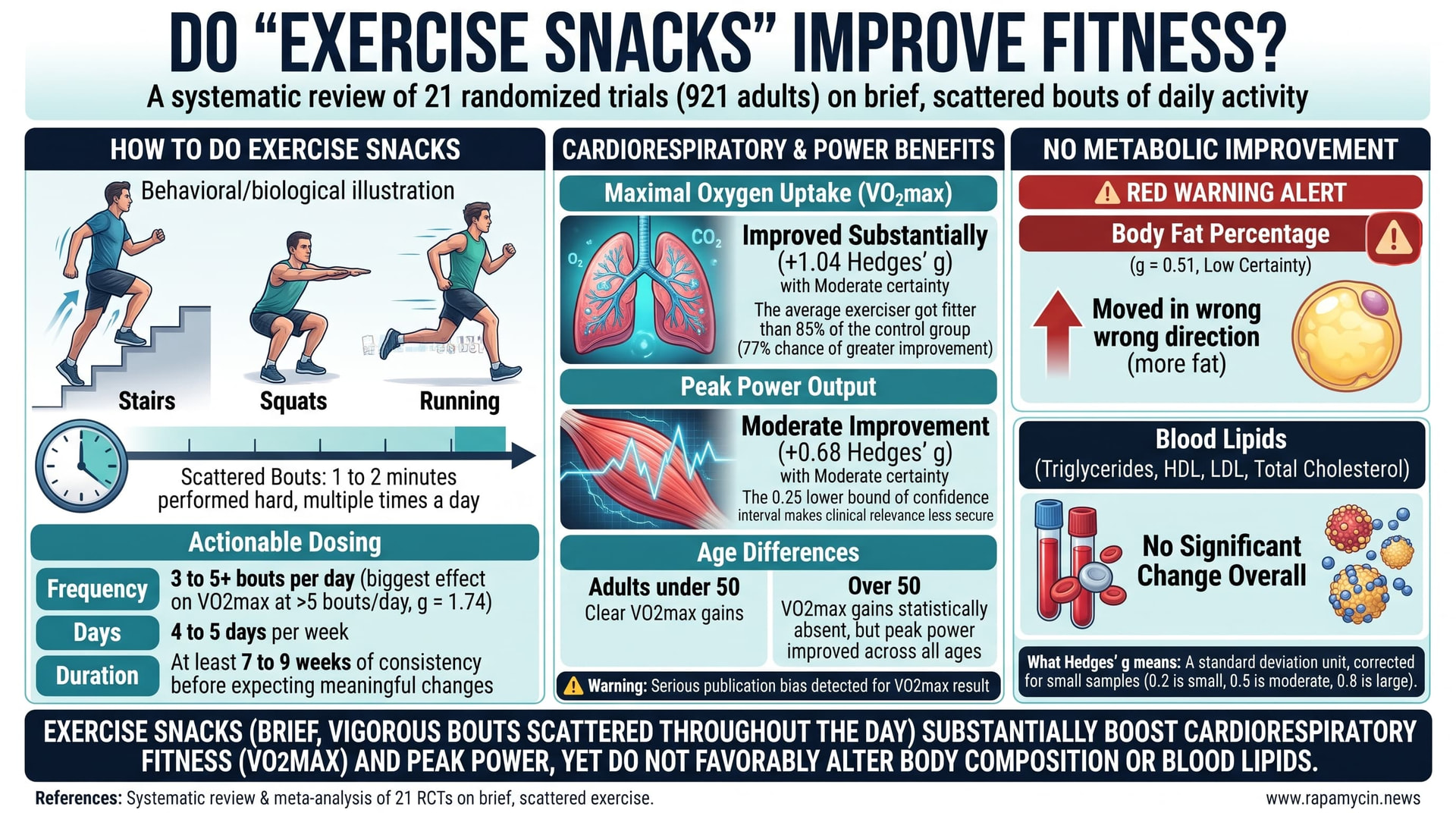
This systematic review and meta-analysis of 21 randomized controlled trials covering 921 adults asks whether exercise snacks, meaning multiple brief bouts of activity scattered through the day, deliver measurable physiological benefit. The answer splits cleanly. Cardiorespiratory fitness improved substantially, with maximal oxygen uptake showing a large pooled effect (Hedges’ g equals 1.04) and peak power output a moderate one (g equals 0.68), both rated moderate certainty. Body composition and blood lipids did not cooperate. Body fat percentage actually moved in the wrong direction (g equals 0.51 toward more fat, low certainty), and none of total cholesterol, HDL, LDL, or triglycerides shifted significantly overall. Age mattered: VO2max gains were clear in adults under 50 but statistically absent above 50, while peak power improved in every age band. Dose analyses pointed toward more bouts per day, four to five days per week, and seven to nine weeks of duration.
The World Health Organization counts roughly 1.8 billion adults who do not get enough physical activity, and the usual explanation is not ignorance but time. The exercise snack proposition is that the hour-long block was never the active ingredient. If you can accumulate the stimulus in one-minute and two-minute pieces, scattered across a workday, the physiology may not care how it arrived.
This review pulls together 21 randomized trials testing that idea, spanning 1994 to 2025 across ten countries, with 921 participants. The interventions are mostly unglamorous: climbing a public stairway at a brisk pace, thirty-second all-out cycle sprints, bodyweight resistance done at a desk.
The cardiorespiratory result is the strong one. Pooled across studies, maximal oxygen uptake improved with a Hedges’ g of 1.04, which sits firmly in large-effect territory and comfortably above the minimum important difference the authors set at 0.50. Peak power output improved with a g of 0.68. Both were graded moderate certainty. Given that VO2max is among the better single predictors of all-cause mortality, a real effect of this size from a few scattered minutes a day would be a meaningful finding.
Then the paper runs into its own data. Body fat percentage did not improve. It went the other way, with a pooled g of 0.51 toward higher body fat in the intervention arms, a result the authors report honestly and rate as low certainty. Heterogeneity for that outcome was 84 percent, meaning the included studies were measuring something that varied enormously between them. The entire signal came from the middle-aged stratum, where heterogeneity hit 92 percent and the confidence interval ran from 0.08 to 2.05. That is not a finding. That is noise with a p value attached, almost certainly driven by the mix of DXA, bioimpedance, and skinfold measurement across trials.
Blood lipids were flat. Total cholesterol, HDL, LDL, and triglycerides all produced confidence intervals straddling zero.
The age story is the most practically useful part. VO2max improved in adults under 25 and in the 25 to 50 band, but the over-50 estimate lost significance. Meta-regression confirmed the gradient, with study-level mean age explaining about half the variance in the VO2max effect. Peak power, by contrast, improved in all three age bands including the oldest. Older adults in this evidence base appear to gain muscular power from brief bouts even when aerobic capacity does not respond.
The caveat that governs everything above is publication bias. For VO2max, Egger’s test returned a p value below 0.001 and Begg’s test 0.006. That is an unambiguous funnel asymmetry on the paper’s flagship outcome, and it means the true pooled effect is probably meaningfully smaller than 1.04.
What survives scrutiny is modest and still useful: brief, repeated, vigorous bouts improve fitness in working-age adults, improve power at any age, and will not reshape your body composition or your lipid panel on their own.
Actionable Insights
Hedges’ g expresses a difference in standard deviation units, corrected for small samples. Roughly, 0.2 is small, 0.5 moderate, 0.8 large.
The VO2max result (g equals 1.04) means the average person doing exercise snacks ended up fitter than about 85 percent of the control group. Put differently, pick one exerciser and one control at random and the exerciser improved more about 77 percent of the time. The authors set a minimum important difference at 0.50, and both the point estimate and the entire confidence interval (0.68 to 1.39) clear it. Peak power (g equals 0.68) clears the threshold at the point estimate but its lower bound of 0.25 does not, so clinical relevance there is less secure.
The practical dosing signal: at least three bouts per day, with the largest VO2max effect in studies using more than five bouts daily (g equals 1.74, though with a very wide interval); four to five days per week; seven to nine weeks before expecting meaningful change. Sessions of one to two minutes performed hard are sufficient.
Set expectations honestly. Do not expect fat loss, and do not expect lipid improvement, from this alone. And discount the fitness numbers somewhat, because the publication bias on that outcome is real and significant.
Context and Source
- Open Access Paper: Effects of exercise snacks on cardiorespiratory fitness, body composition, and blood lipids in adults across different age groups: a systematic review and meta-analysis, Published October 2026.
- Institutions: School of Physical Education, Huaibei Normal University, Huaibei, China (Meng, Zheng). School of Sport, Exercise and Rehabilitation Sciences, University of Birmingham, United Kingdom (Li, Chen)
- Countries: China and United Kingdom
- Journal: The Journal of Nutrition, Health and Aging
- Impact evaluation:* The impact score of this journal is 5.0, evaluated against a typical high-end range of 0 to 60+ for top general science and medicine, therefore this is a Medium impact journal.