Dementia is rapidly emerging as one of the defining public health crises of our century, with global case numbers projected to nearly triple to 139 million by 2050. While the global North has historically dominated cognitive aging literature, a pioneering longitudinal study from Chile has turned the analytical lens toward the Global South, proving that where you live, how much formal learning you possess, and how often you move directly dictate the functional lifespan of the human brain. Crucially, this research demonstrates that cognitive decay is not an inevitable, uniform consequence of biological aging, but a highly unequal trajectory governed by modifiable life-course determinants.
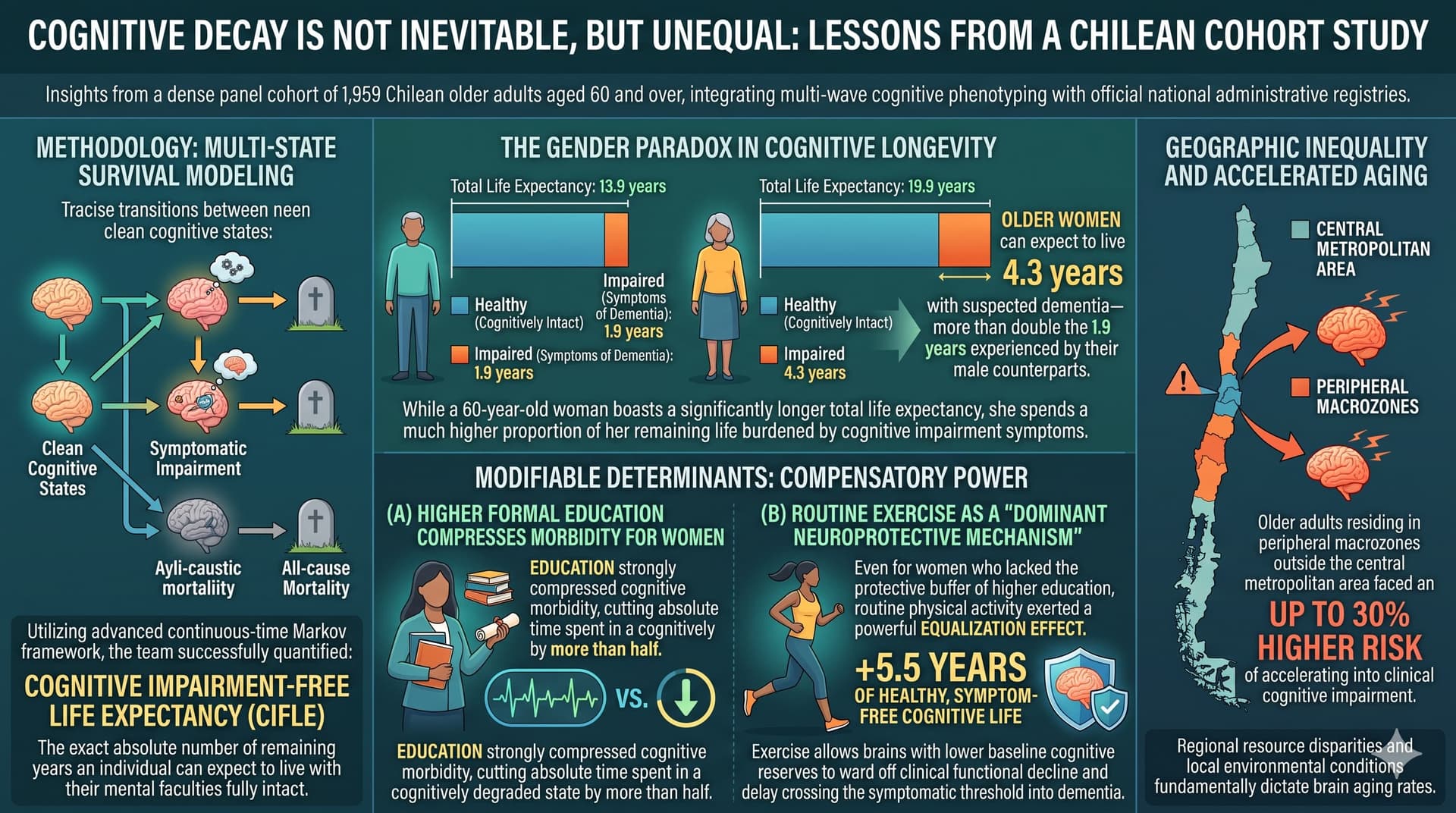
The investigators tracked a dense panel cohort of 1,959 Chilean older adults aged 60 and over, integrating multi-wave cognitive phenotyping with official national administrative registries to trace precise transitions between clean cognitive states, symptomatic impairment, and all-cause mortality. Utilizing advanced multi-state survival modeling under a continuous-time Markov framework, the team successfully quantified Cognitive Impairment-Free Life Expectancy (CIFLE)—the exact absolute number of remaining years an individual can expect to live with their mental faculties fully intact.
The longitudinal data exposed a stark “gender paradox” in cognitive longevity. While a 60-year-old woman boasts a significantly longer total life expectancy than a man (19.9 years versus 13.9 years), she will spend a much higher proportion of her remaining life burdened by cognitive impairment symptoms. At age 60, older women can expect to live 4.3 years with suspected dementia—more than double the 1.9 years experienced by their male counterparts.
However, the study’s most remarkable finding is the potent, asymmetrical compensatory power of lifestyle habits. Higher formal education strongly compressed cognitive morbidity for women, slashing their absolute time spent in a cognitively degraded state by more than half. Even more strikingly, for women who lacked the protective buffer of higher education, routine physical activity exerted a powerful equalization effect, adding 5.5 years of healthy, symptom-free cognitive life. This strongly indicates that routine exercise acts as a dominant neuroprotective mechanism, allowing brains with lower baseline cognitive reserves to ward off clinical functional decline and delay crossing the symptomatic threshold into dementia.
Finally, by mapping these metrics geographically, the study unveiled profound territorial inequalities. Older adults residing in peripheral macrozones outside the central metropolitan area faced an up to 30% higher risk of accelerating into clinical cognitive impairment, proving that regional resource disparities and local environmental conditions fundamentally dictate brain aging rates. National averages completely mask these divergent local crises, establishing an urgent mandate for geographically targeted public health buffering.
Actionable Insights
The discovery of these potent lifestyle and regional interactions delivers concrete, translatable principles for personal cognitive longevity and public health optimization:
- Deploy Physical Activity as a Structural Equalizer: Routine physical exercise behaves as a primary resilience factor that preserves brain health, adding up to 5.5 years of cognitive impairment-free life for individuals with lower formal educational backgrounds.
- Build Early-Life Cognitive Reserves: Achieving a secondary or higher formal education serves as a lifelong structural buffer, adding roughly 4.5 years of clear-headed life for women and delaying the clinical manifestation of underlying neuropathologies.
- Audit and Buffer Regional Environmental Risks: Brain aging is highly sensitive to geography; individuals living in remote or peripheral geographic macrozones face an independent, up to 30% higher risk of cognitive decline, making proactive personal lifestyle optimization mandatory for those outside major urban hubs.
- Target Sex-Specific Morbidity Windows: Because women experience a much wider absolute window of cognitive morbidity due to extended baseline survival under catabolic burdens, they must aggressively couple early cognitive task demands with progressive cardiorespiratory training to compress their late-life dependency phase.
Source:
- Paywalled Paper: Cognitive health and protective factors: from a life expectancy approach
- Institution: Society and Health Research Center and Escuela de Salud Pública, Universidad Mayor, Santiago, Chile; Millennium Institute for Care Research (MICARE); Faculty of Nursing, Universidad Andres Bello; Millennium Institute for Research in Depression and Personality (MIDAP), Santiago, Chile.
- Country: Chile.
- Journal Name: Social Science & Medicine, March 2026.
- Impact Evaluation: The impact score of this journal is 5.0, evaluated against a typical high-end range of 0–60+ for top general science, therefore this is a High impact journal.