Everything, Everywhere, All at Once: The Longevity Field Draws Its Map

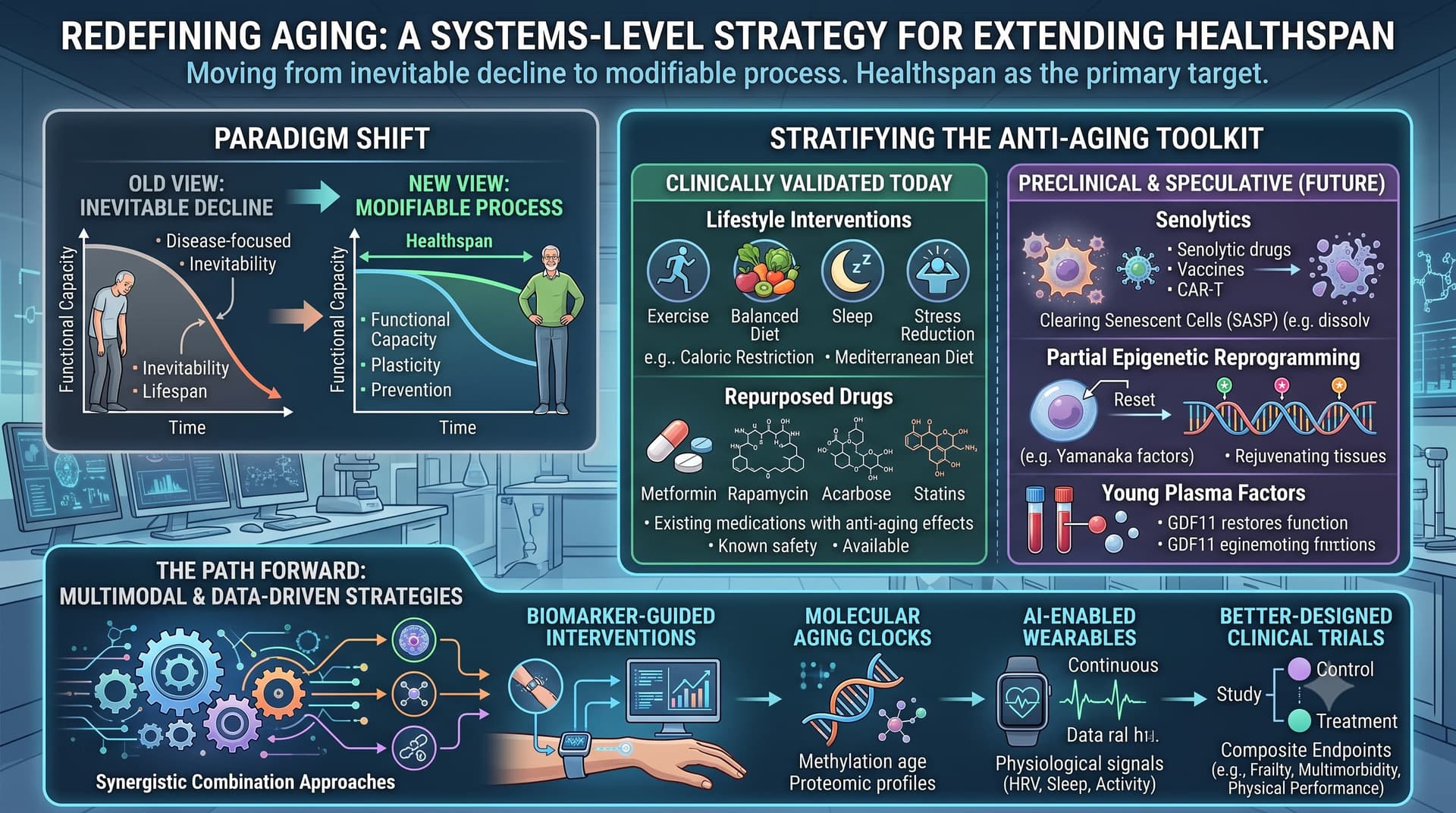
This review argues that aging has shifted from an inevitable decline to a modifiable, systems-level process, and that healthspan rather than raw lifespan is now the practical target. It stratifies the entire anti-aging toolkit into what is clinically validated today (lifestyle interventions and a handful of repurposed drugs) versus what remains preclinical and speculative (senolytic vaccines, CAR-T against senescent cells, partial epigenetic reprogramming, young plasma factors). The core message is that no single lever moves aging much on its own, so the credible path forward is multimodal, biomarker-guided, combination strategies, monitored with molecular aging clocks and AI-enabled wearables, and validated through better-designed trials with composite endpoints.

For most of medical history, aging was treated as the weather: something you endure, not something you change. This review documents how thoroughly that assumption has collapsed. Aging is now framed as a set of interacting biological programs, the “hallmarks,” and each hallmark is a potential drug target. The authors survey the whole battlefield and refuse to pretend the war is won.

The big idea is stratification by evidence. At the base sit lifestyle interventions, which the authors repeatedly call the most mature and cost-effective tools available. Caloric restriction, various fasting protocols, Mediterranean and DASH dietary patterns, structured exercise, protected sleep, and active social lives each nudge multiple aging pathways at once. Their advantage is not that any one of them is dramatic, but that they are safe, accessible, and additive. When combined, the review argues, they interact biologically and deliver larger system-wide gains than any isolated fix.

One tier up sit repurposed pharmaceuticals with human data: rapamycin for the mTOR pathway, metformin and the newer GLP-1 and SGLT2 drugs for metabolic aging, NAD precursors, spermidine and urolithin A for autophagy and mitochondrial cleanup, and low-dose colchicine for chronic inflammation. These show cross-tissue benefits in animals and encouraging but incomplete human signals.

Then the review climbs into more speculative territory: drugs and vaccines that selectively kill senescent “zombie” cells, engineered immune cells that hunt those cells down, transplanted microbiomes, and circulating “youth factors” from young blood. Highest and least proven of all is partial epigenetic reprogramming, the idea of resetting a cell’s age using a subset of the Yamanaka factors without erasing its identity. In mice this has restored vision and, in one striking result, more than doubled the remaining lifespan of very old animals. In humans it has never been tested.

Running through all of this is a monitoring layer: DNA methylation aging clocks, retinal and facial aging estimators, and wearables that passively track heart rate variability, sleep, and even speech. The authors are careful to note these clocks are not yet accepted by regulators as proof that a therapy works. The honest conclusion is that the field has a rich menu and a weak evidence base, and that the fix is better trials, not louder claims.

Actionable Insights

The genuinely take-home, do-it-today material lives almost entirely in the lifestyle and repurposed-drug tiers. Extracted effect sizes, so the magnitude is not hidden behind adjectives:

Caloric restriction (CALERIE trial, 218 adults, 25 percent restriction, 2 years): slowed the pace of biological aging on the DunedinPACE clock by 2 to 3 percent, which the authors translate to a 10 to 15 percent reduction in mortality risk. That is a real but modest signal, and it is a surrogate-clock estimate, not counted deaths.

Intermittent fasting (meta-analysis, over 1,200 participants): roughly 15 to 20 percent lower insulin resistance (HOMA-IR) and 3 to 5 mmHg lower systolic blood pressure, comparable to caloric restriction but with better adherence.

Mediterranean diet: associated with an 11 to 30 percent lower risk of age-related cognitive disorders and about 30 percent lower cardiovascular event incidence in high-risk people. These are observational associations, so residual confounding likely inflates them.

Exercise: resistance training raised maximal strength by about 30 percent over 12 weeks; aerobic training improved flow-mediated dilation by 3 to 5 percent. Progressive resistance work is the most reliable single intervention for preserving strength and bone.

Low-dose colchicine (0.5 mg/day): the review reports a 22 percent reduction in age-related cardiovascular comorbidities and an 18 percent reduction in all-cause mortality. Treat the mortality figure with caution (see limitations).

Social connection: social isolation carried a pooled hazard ratio of 1.32 for all-cause mortality (95 percent CI 1.26 to 1.39), meaning isolation raised death risk by about a third. Staying socially engaged is a free, high-leverage intervention.

Bottom line for a practitioner: the evidence-backed protocol is unglamorous. Move calories down modestly or compress the eating window, train for strength and aerobic capacity, protect 7 to 9 hours of sleep, eat a plant-forward Mediterranean-style diet, stay socially and cognitively active. Consider the repurposed drug tiers for further longevity and healthspan benefits.

Context / Source

  • Open access paper: Advances in anti-aging strategies
  • Type: Review article.
  • Institution: Xiangya Hospital, Central South University, Changsha, Hunan, China (with affiliated national geriatric and aging-medicine laboratories).
  • Country: China.
  • Journal: Cell Aging and Regeneration, published by AccScience Publishing (Singapore). DOI: 10.36922/CAR025440003. Published online July 20, 2026.
  • Impact evaluation: Cell Aging and Regeneration is a newly established journal. It has no Journal Impact Factor and no CiteScore, because both metrics require a multi-year citation history after indexing in Web of Science (for JIF) or Scopus (for CiteScore), and the journal has not existed long enough to accrue one.

Lifespan Analysis (against the short-lived controls reference)

The review presents no primary lifespan curves and reports no control-group median or maximum lifespans of its own, so a direct short-lived-controls audit of this paper is not possible. What can be done is to apply the framework from Pabis and colleagues (bioRxiv 2023.10.08.561459) to the specific lifespan claims the review repeats.

That reference paper’s central argument, the “900-day rule,” is that a mouse longevity result deserves high confidence only when control median lifespan approaches roughly 900 days, or when the treated group’s final lifespan sits well above 900 days. Short-lived, metabolically unhealthy control cohorts systematically exaggerate the apparent benefit of an intervention.

Applying that lens to this review:

The rapamycin figure of 10 to 25 percent lifespan extension in genetically diverse mice traces largely to the NIA Interventions Testing Program, which uses long-lived UM-HET3 controls that generally approach or reach the 900-day benchmark. Those particular numbers are therefore among the more credible in the paper. [Confidence: Medium-High]

The most eye-catching lifespan claim, that doxycycline-tunable OSK reprogramming “more than doubled remaining median lifespan” in 124-week-old mice, should be read with caution for a different but related reason. 124 weeks is roughly 868 days, so the animals were already near the end of a normal mouse lifespan when treatment began. Reporting “remaining” lifespan from an advanced starting age mechanically produces very large percentage figures from small absolute gains, and it sidesteps the question of what a healthy full-life control curve looked like. This is exactly the kind of framing the short-lived-controls literature warns can mislead. The review states the result without the control lifespan needed to evaluate it. [Confidence: Medium]

The chloroquine claim (extends median and maximum lifespan in “middle-aged” mice) is reported with no control lifespan and no numbers at all, so it cannot be assessed and should be treated as preliminary. [Confidence: Low]

Lifespan and Biomarker Data (How Big Are the Benefits, Really?)

A quick orientation before the numbers, because the way benefits get reported is where most people get misled.

There is a difference between how much a treatment moves the needle and how sure we are that it moved at all. A tiny p-value (the statistic researchers love) only tells you the effect is probably not pure luck. It says nothing about whether the effect is big enough to matter in your life. A drug can be statistically real and practically trivial at the same time. So the useful question is always “how large is the benefit,” not just “is it significant.”

Watch for three specific tricks in longevity reporting:

Relative versus absolute benefit. “Cuts your risk 30 percent” sounds huge, but 30 percent of a small risk is still a small risk. If your baseline chance of an event is 2 in 100, a 30 percent relative reduction takes you to about 1.4 in 100. Real, but not life-changing. Reviews almost always quote the bigger-sounding relative version, and this paper is no exception.

Surrogate markers versus actual outcomes. Some studies do not measure whether people lived longer or got sick less. They measure a stand-in, like a “biological aging clock” reading from a blood sample, and then estimate what that might mean for lifespan. That estimate is a model, not a body count. It can be right, but it is a prediction, not a result.

Subgroup and adherence effects. If a benefit only shows up in the people who took the pill most faithfully, or in one slice of the study population, be skeptical. The most motivated participants tend to be healthier in other ways too, so their better outcome may not be the drug’s doing.

With that lens, here are the strongest numbers the review repeats:

Loneliness and death risk: people who were socially isolated had roughly a one-third higher chance of dying during the study period, drawn from a very large pooled analysis (90 studies, 2.2 million people). The large size makes this one of the sturdier numbers in the paper. The catch is that it is observational, meaning nobody was assigned to be lonely. It is plausible that being sick makes people withdraw socially, rather than isolation causing the illness, so the true effect of loneliness itself is probably smaller. [Confidence: Medium-High]

Caloric restriction (CALERIE trial, 218 adults eating 25 percent less for 2 years): a “biological aging clock” slowed by 2 to 3 percent, which the authors translate into a 10 to 15 percent lower mortality risk. Read this carefully. The 2 to 3 percent is what was actually measured. The mortality figure is a projection off a surrogate marker, not a count of who lived or died, so treat it as an optimistic estimate rather than proof of longer life. [Confidence: Medium]

Low-dose colchicine: the review claims a 22 percent drop in age-related heart problems and an 18 percent drop in death from any cause. The heart-problem figure lines up with the broader evidence on this drug. The death figure does not. The actual trial being cited did not show a reliable reduction in overall deaths, so this number appears to be overstated or mixed up with a different result. It is a clean example of why you should not trust a review’s number without checking the original study. [Confidence: Low for the death-reduction figure specifically]

Nicotinamide riboside (a NAD booster) in people with poor leg circulation: walking distance in a standard 6-minute test improved by about 18 meters versus placebo, rising to about 31 meters in the people who took at least three-quarters of their doses. For perspective, patients usually need somewhere around 20 to 30 meters of improvement to actually notice a difference in daily life. So the benefit for the average participant sat just below the “you would feel it” threshold, and only the most diligent subgroup clearly crossed it. That kind of “it works if you really stick with it” result tends to look better than it is. [Confidence: Medium]

NMN (another NAD booster), safety study: 1,250 mg a day for up to 4 weeks caused no meaningful change in body composition or blood work. Note what this actually shows. It shows the supplement was safe and tolerated. It does not show it did anything beneficial. A “nothing bad happened” result is being cited, correctly, as a safety finding, but it is not evidence the pill helps. [Confidence: High that it shows safety, High that it showed no benefit signal]

SPRINTT (exercise plus nutrition counseling, 1,519 frail adults, average age 79): a 22 percent reduction in new cases of mobility disability over about 2 years. This one is more trustworthy than most, because the study was large and it measured a real-world outcome people care about (staying able to move around), not a lab surrogate. [Confidence: Medium-High]

The through-line: this review consistently reports benefits in the flattering relative-percentage form and leans on aging-clock surrogates. It rarely tells you the plain absolute numbers, and it never tells you how many people would need to take a treatment for one person to benefit. When a longevity claim is quoted to you as a big percentage, your default should be to ask what the underlying baseline risk was and whether anyone actually lived longer, or whether a clock just ticked slower. [Confidence: High]