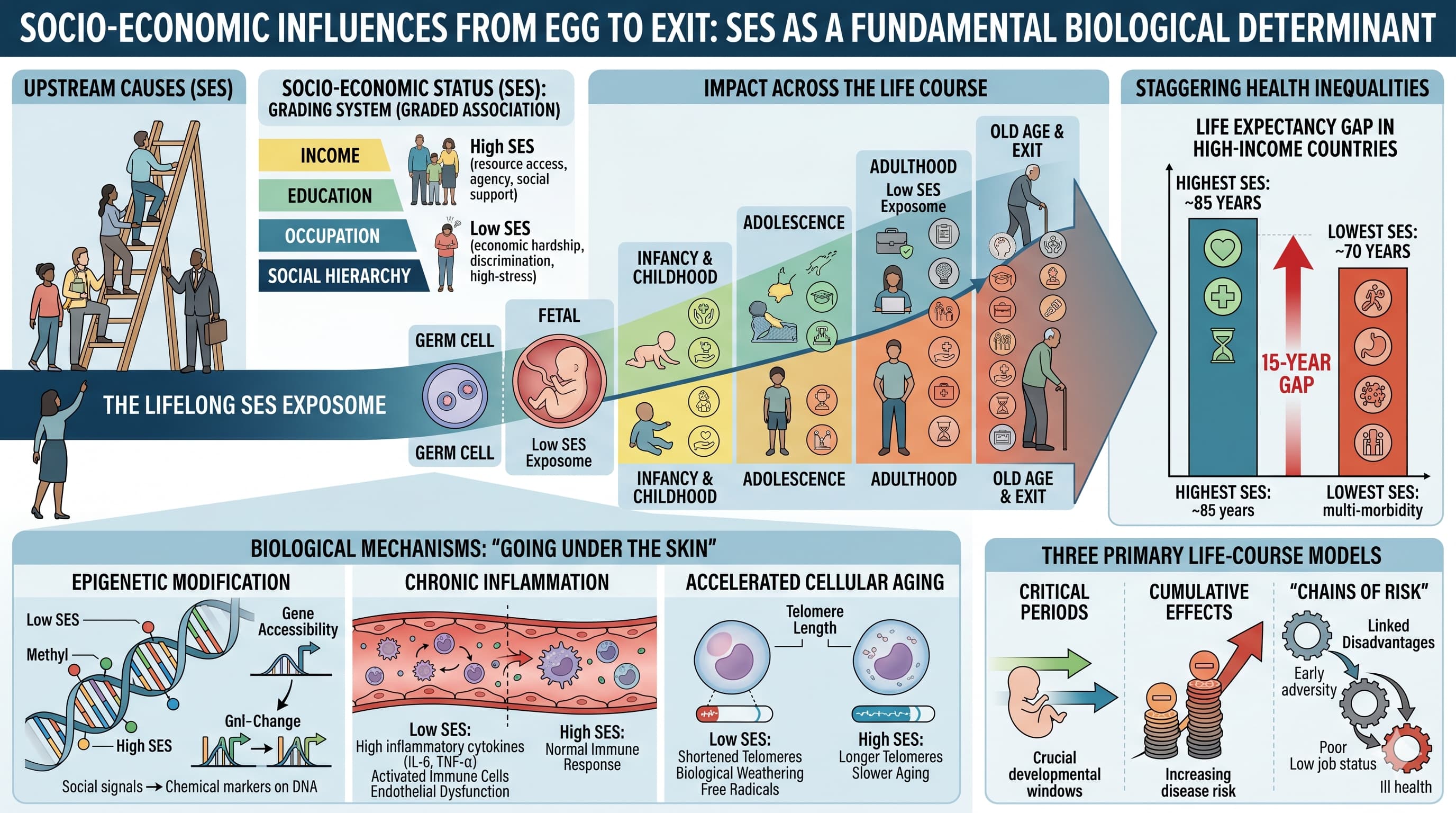
Socio-economic status (SES) is not merely a metric of bank balances or educational attainment; it is a fundamental biological determinant that impacts health outcomes from before fertilization until death. This review, “Socio-economic influences from egg to exit,” posits that SES functions as an “upstream” root cause, shaping what the authors call the SES exposome —a lifelong accumulation of physical, social, and cultural exposures. This exposome “goes under the skin,” translating social hierarchy into molecular reality through epigenetic modification, chronic inflammation, and accelerated cellular aging.
The biological impact is staggering: in some high-income countries, the gap in life expectancy between the highest and lowest SES groups reaches 15 years. This is not a simple binary of “poverty vs. wealth” but a graded association; every step down the social ladder correlates with increased mortality risk. The paper identifies three primary life-course models—critical periods, cumulative effects, and “chains of risk”—that interact to lock in these health trajectories.
The “egg” phase is particularly provocative: maternal SES influences oocyte quality and the risk of chromosomal aneuploidies like Down syndrome, which can double in lower SES environments regardless of maternal age. Post-birth, the SES exposome accelerates cardiovascular degeneration, showing fatty streaks in the arteries of even stillborn infants in high-risk environments. In the brain, lower SES is associated with smaller hippocampal volumes and a 22-year earlier modal onset of dementia compared to college graduates.
Critically, the authors introduce the concept of lifespan fluidity. While some biological changes like DNA mutations are irreversible, social mobility—particularly upward mobility via education—can shift an individual’s biological rate of aging. Upwardly mobile individuals often achieve health trajectories nearing those of “stable high” SES groups, suggesting that the “biological programming” of a disadvantaged childhood is not an absolute destiny, though it remains a heavy weight to carry.
Actionable Insights for Longevity
-
Prioritize Methyl Donor Availability: Maternal blood folate (Vitamin B9) levels are critical for the AHRR gene methylation, which facilitates the detoxification of cigarette smoke and environmental toxins. Supplementation or diet optimization in this pathway is a “high-leverage” intervention for prenatal and multigenerational health.
-
Mitigate Synergy in the Exposome: Air pollution (PM2.5) and cigarette smoke (including second-hand) act synergistically to accelerate atherosclerosis and increase BMI. Biohackers should treat air filtration as a non-negotiable longevity intervention, especially in lower-income urban areas.
-
Leverage Educational “Fluidity”: Each additional year of education is associated with a 3% decrease in mortality and a significant slowing of the “DunedinPACE” epigenetic clock. Continuous high-level cognitive engagement may serve as a compensatory mechanism for early-life adversity.
-
Monitor Systemic Inflammation: Lower SES is strongly linked to higher levels of C-reactive protein (CRP) and NFkB activation. For those from disadvantaged backgrounds, aggressive management of chronic inflammation is essential to offset “accelerated aging” phenotypes.
Source:
- Open Access Paper: Socio-economic influences from egg to exit: Emerging biology
- Institutions: Tampere University (Finland); University of Southern California (USA).
- Journal: Ageing Research Reviews, June 2026.
- Impact Evaluation: The impact score of this journal is 13.1 (JIF) or 21.4 (CiteScore), therefore this is a High impact journal.