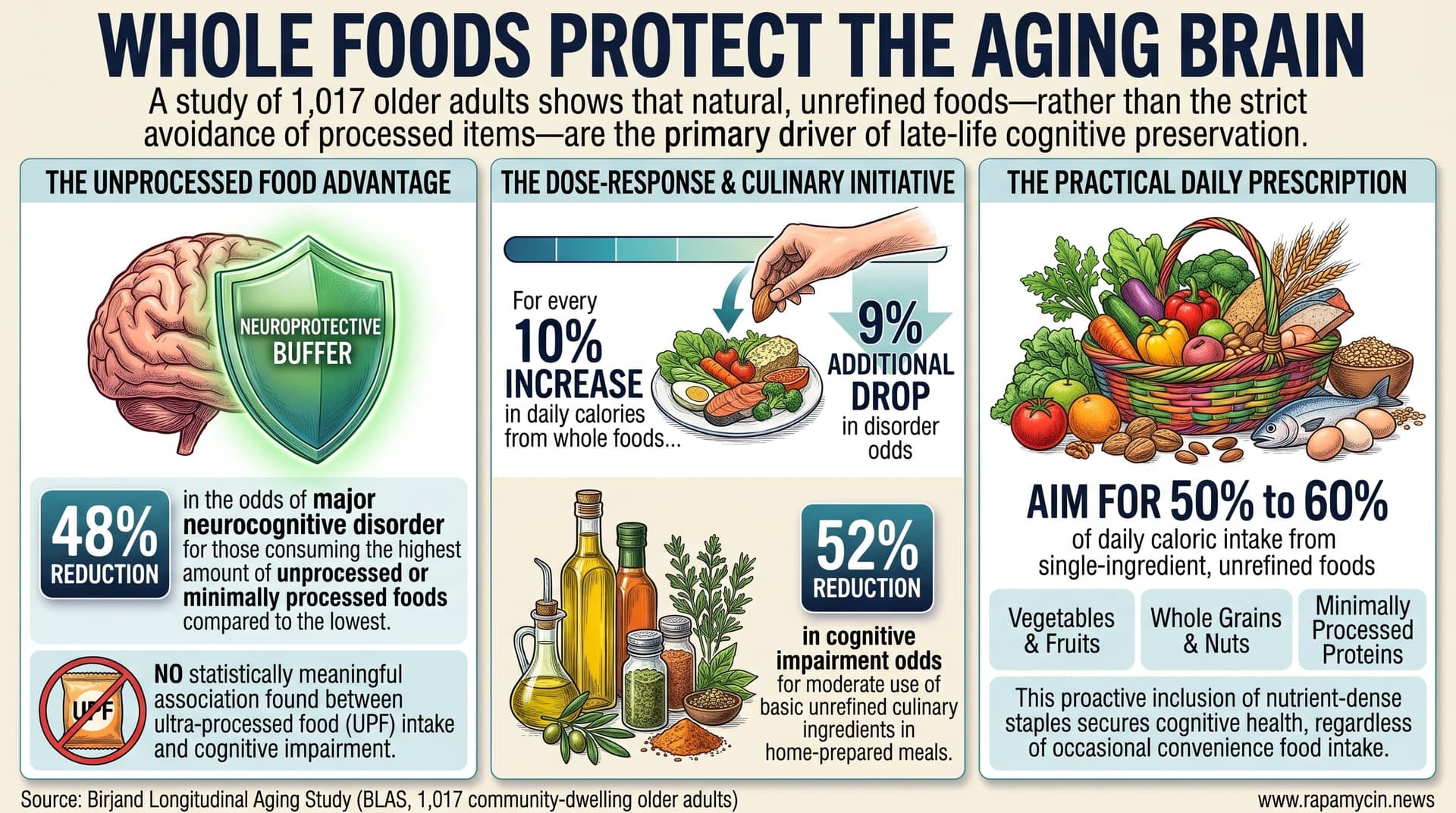
A cross-sectional investigation of 1,017 community-dwelling older adults from the Birjand Longitudinal Aging Study demonstrated that individuals consuming the highest amounts of unprocessed or minimally processed foods experienced a 48 percent reduction in the odds of major neurocognitive disorder compared to the lowest consumers. While contemporary public health messaging frequently identifies ultra-processed foods as major drivers of cognitive decay, this study observed no statistically meaningful association between ultra-processed intake and cognitive impairment. The primary dietary determinant of late-life cognitive preservation in this cohort was the proactive inclusion of nutrient-dense,intact food staples rather than the strict avoidance of industrially formulated items. These older Iranian adults ate relatively little ultra-processed food to begin with, so the study may simply have lacked the range to detect a harm.
The contemporary conversation surrounding human nutrition and brain longevity has focused heavily on the perils of ultra-processed food. From packaged snacks to industrial ready-meals, public health discourse suggests that manufactured foods actively degrade cognitive function. However, emerging observational evidence from populations outside Western nations suggests that what is omitted from the plate may matter substantially more than what is added. An investigation published in Aging Clinical and Experimental Research examining community-dwelling older adults indicates that high intake of unprocessed, intact foods exerts a substantial protective association against major neurocognitive disorders,while ultra-processed food intake shows no statistically meaningful link to cognitive deterioration.
Researchers evaluated 1,017 older adults participating in the second wave of the Birjand Longitudinal Aging Study in eastern Iran. Unlike Western demographic cohorts where ultra-processed products routinely supply over half of total daily calories, this cohort adheres to a more traditional culinary baseline. The investigators classified dietary intake using the NOVA classification system, which categorizes foods according to the extent and purpose of industrial processing.Cognitive status was determined through formal clinical neurological evaluations using Diagnostic and Statistical Manual of Mental Disorders (DSM-5) criteria, comprehensive neuropsychological test batteries, functional independence scoring,and structural brain magnetic resonance imaging when indicated. In total, 13.8 percent of the cohort met the clinical threshold for major neurocognitive disorder.
Analyzing dietary composition against neurological outcomes revealed a striking divergence. Participants consuming the highest tertile of unprocessed and minimally processed foods, such as fresh vegetables, fruits, whole grains, legumes, and intact meats, experienced a 48 percent reduction in the odds of major neurocognitive disorder compared to the lowest tertile, after rigorous adjustment for age, sex, education, physical activity, smoking, depressive symptoms, and total caloric intake. Every 10 percent increment in daily energy derived from unprocessed foods was associated with an additional 9 percent reduction in neurocognitive disorder odds. In addition, moderate consumption of traditional culinary ingredients, including basic vegetable oils, salt, and seasonings, reduced impairment odds by 52 percent, reflecting the neuroprotective benefit of home-prepared meals.
Conversely, ultra-processed food consumption exhibited no statistically significant relationship with neurocognitive impairment in any statistical model. Participants in the highest tertile of ultra-processed food intake demonstrated no verified elevation in disorder risk compared to those in the lowest tertile. Because the median ultra-processed food intake across the cohort was modest, representing approximately 130 kilocalories daily or roughly eight percent of total caloric intake, the findings demonstrate that low levels of industrial food consumption do not inherently undermine cognitive health.
These results challenge common dietary assumptions. Cognitive resilience in late life appears less reliant on obsessive avoidance of minor industrial ingredients and far more dependent on establishing a robust foundation of intact, nutrient-dense foods. Diets built around whole foods provide essential polyphenols, fermentable fibers, and micronutrients that suppress cerebral oxidative stress and sustain neuronal vitality. For clinicians and longevity professionals, the takeaway is clear: prioritizing the proactive addition of intact, whole-food calories offers measurable neuroprotection that far exceeds the passive elimination of processed convenience products.
Actionable Insights
To support long-term cognitive health, individuals should shift their focus from obsessively eliminating packaged foods to deliberately meeting a daily threshold of intact, unprocessed foods. In this older cohort, participants with normal cognitive function consumed an average of 760 daily kilocalories from unprocessed sources compared to 670 kilocalories among impaired peers. This absolute difference of roughly 90 kilocalories per day, equivalent to a single apple, one cup of cooked legumes, or a modest serving of chicken breast, correlated with a 48 percent relative reduction in the odds of developing a major neurocognitive disorder.
On a continuous scale, every 10 percent increase in the proportion of total daily calories derived from whole foods yielded an additional 9 percent drop in disorder odds. Furthermore, moderate use of basic culinary ingredients such as unrefined cooking oils and natural seasonings in home-prepared meals was associated with a 52 percent reduction in cognitive impairment odds. The practical prescription for longevity is straightforward: ensure that at least 50 to 60 percent of your daily caloric intake is composed of single-ingredient, unrefined foods including vegetables, fruits, whole grains, nuts, and minimally processed proteins, which provides an effective neuroprotective buffer regardless of occasional convenience food intake.
Context and Source
- Open Access Paper: Unprocessed vs. ultra-processed food intake and major neurocognitive disorder (MNCD) among older adults: insights from the second phase of the Birjand longitudinal aging study
- Institutions: Tehran University of Medical Sciences (Elderly Health Research Center, Obesity and Eating Habits Research Center, Department of Gerontology) and Birjand University of Medical Sciences (Geriatric Health Research Center, School of Health)
- Country: Iran
- Journal Name: Aging Clinical and Experimental Research
- Impact Evaluation: The impact score of this journal is 4.7, evaluated against a typical high-end range of 0 to 60+ for top general science, therefore this is a Medium impact journal.