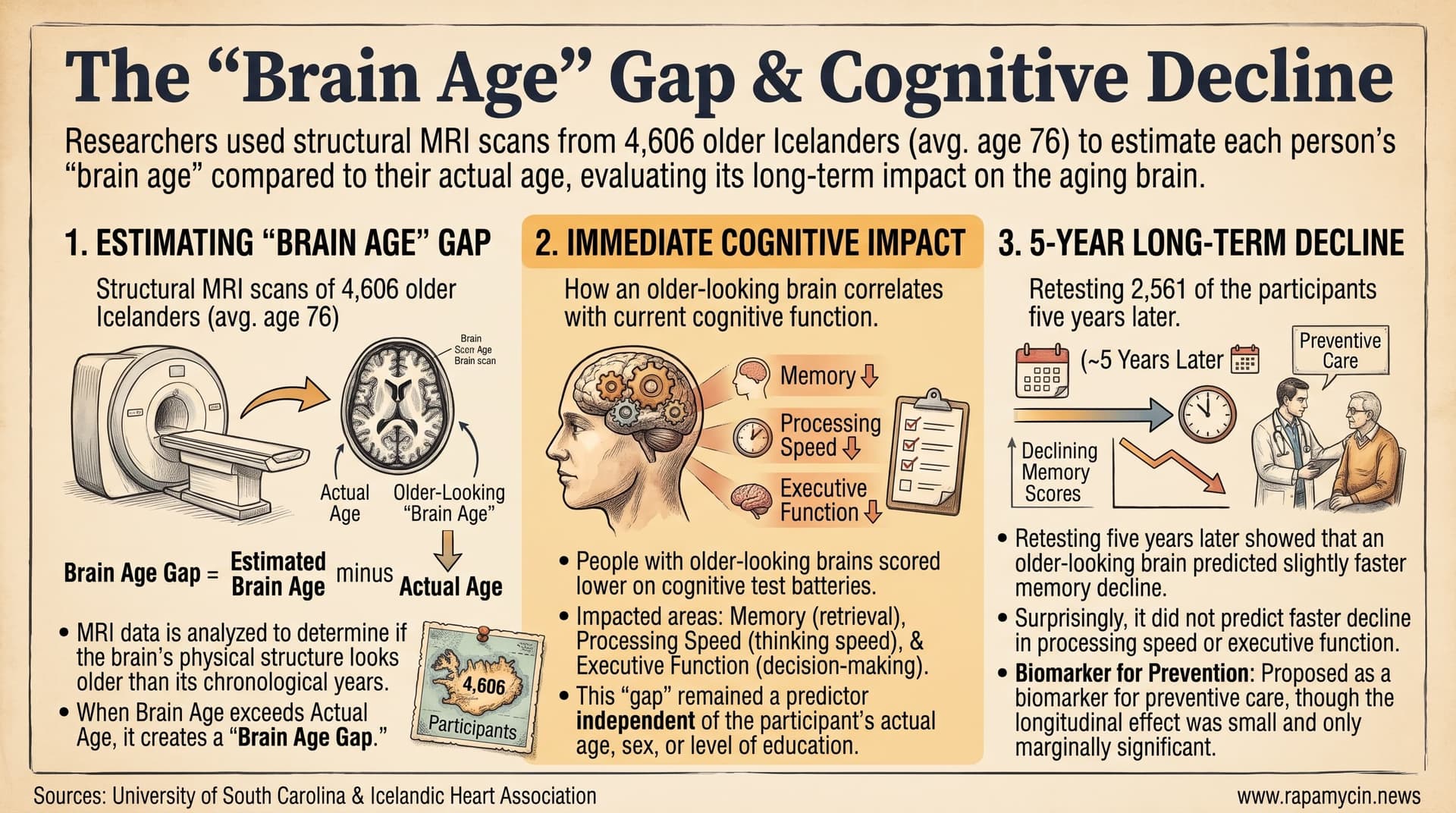
Researchers from the University of South Carolina and the Icelandic Heart Association used structural MRI scans from 4,606 older Icelanders (average age 76) to estimate each person’s “brain age,” then compared it with their actual age. People whose brains looked older than their years scored lower on memory, processing speed and executive function tests, independent of age, sex and education. In the 2,561 participants retested about five years later, an older-looking brain predicted slightly faster memory decline, but not faster decline in processing speed or (in the main model) executive function. The authors propose the brain age gap as a biomarker for preventive care, although the longitudinal effect was small and only marginally significant.
Two 75-year-olds can have very different brains. One may show the shrinkage typical of someone a decade older, while the other looks closer to 65. A new analysis of the long-running AGES-Reykjavik Study asks whether that difference, called the brain age gap, tells us anything about where a person’s thinking skills are headed.
The team took MRI scans collected between 2002 and 2006 from 4,606 Icelanders born between 1907 and 1935. An automated tool called volBrain estimated each person’s brain age from the structure of their brain. Subtracting real age from brain age gave the gap. A positive gap means the brain looks older than expected; a negative gap means it looks younger. In this group the average gap was about two years on the young side, with individuals ranging from roughly 19 years younger to 11 years older.
The first finding was clear and consistent. People with older-looking brains performed worse across all three areas of thinking tested: memory, processing speed and executive function, the set of skills used for planning, juggling information and switching tasks. Each additional year of brain age gap was linked to a cognitive deficit roughly equal to one year of ordinary aging for memory, and a bit less for processing speed.
The bigger question was whether brain age predicts the future. About five years later, 2,561 participants returned for testing. Everyone declined, as expected in this age group. People with older-looking brains lost memory slightly faster than others. A ten-year difference in brain age gap translated into about 30 percent more memory decline over five years. Grouping participants by their gap, the researchers also saw steeper drops in executive function among those whose brains looked older. Processing speed, by contrast, declined at much the same rate regardless of brain age.
The authors argue that this makes brain age useful as an early warning sign in people without obvious disease, and that it could help identify who might benefit most from attention to exercise, blood vessel health and cognitive training.
That conclusion deserves caution. The forward-looking memory effect only just crossed the conventional threshold for statistical significance, and the authors tested three areas of thinking without correcting for multiple comparisons. The study did not test any treatment, did not measure whether brain age itself changed, and did not account for blood pressure, diabetes, smoking or genetic risk. The participants were Icelandic, white, and assessed nearly two decades ago, and many dropped out before the second visit, often for reasons such as illness or death that are themselves tied to brain aging.
Still, the result adds a piece to a growing picture. A large body of earlier work shows that older-looking brains go with poorer thinking at a single point in time. Some researchers have argued that this mostly reflects differences fixed early in life rather than ongoing aging. A brain age gap that predicts future memory loss, even modestly, suggests the measure captures some of the active process too. Whether anyone can move that number, and whether moving it protects memory, remains the question that matters most.
Actionable Insights
This is an observational study. It tested no treatment, so its practical value is mainly in interpreting a brain age result.
- Reading a brain age report. In this cohort, each year your brain looks older than your birthday corresponded to roughly the memory deficit of one extra year of normal aging (0.047 standard deviations per brain-age year, versus 0.046 per calendar year of observed decline). A brain looking 5 years older equals about a quarter of a standard deviation lower memory score: real but modest, the gap between an average performer and someone around the 40th percentile.
- What to do about it. The authors point to physical activity, vascular health and cognitive training, none of which were tested here. The strongest outside evidence is for blood pressure control: in the SPRINT MIND trial, intensive control lowered mild cognitive impairment risk by about 19 percent.
- Treat an “old” brain age as a prompt to check blood pressure, glucose, sleep and activity, not as a diagnosis.
Context and Source
- Open Access Paper: Advanced brain age and longitudinal cognitive decline in healthy older adults
- Institutions: University of South Carolina (Departments of Communication Sciences and Disorders, Psychology, Neurology; Arnold School of Public Health); Icelandic Heart Association
- Countries: United States and Iceland
- Journal: GeroScience (Springer), official journal of the American Aging Association.
- Impact evaluation: The impact score of this journal is 4.9 (2024 Journal Impact Factor; CiteScore 8.3), evaluated against a typical high-end range of 0-60+ for top general science, therefore this is a Medium impact journal. Within aging-specific journals it sits in the top quartile.