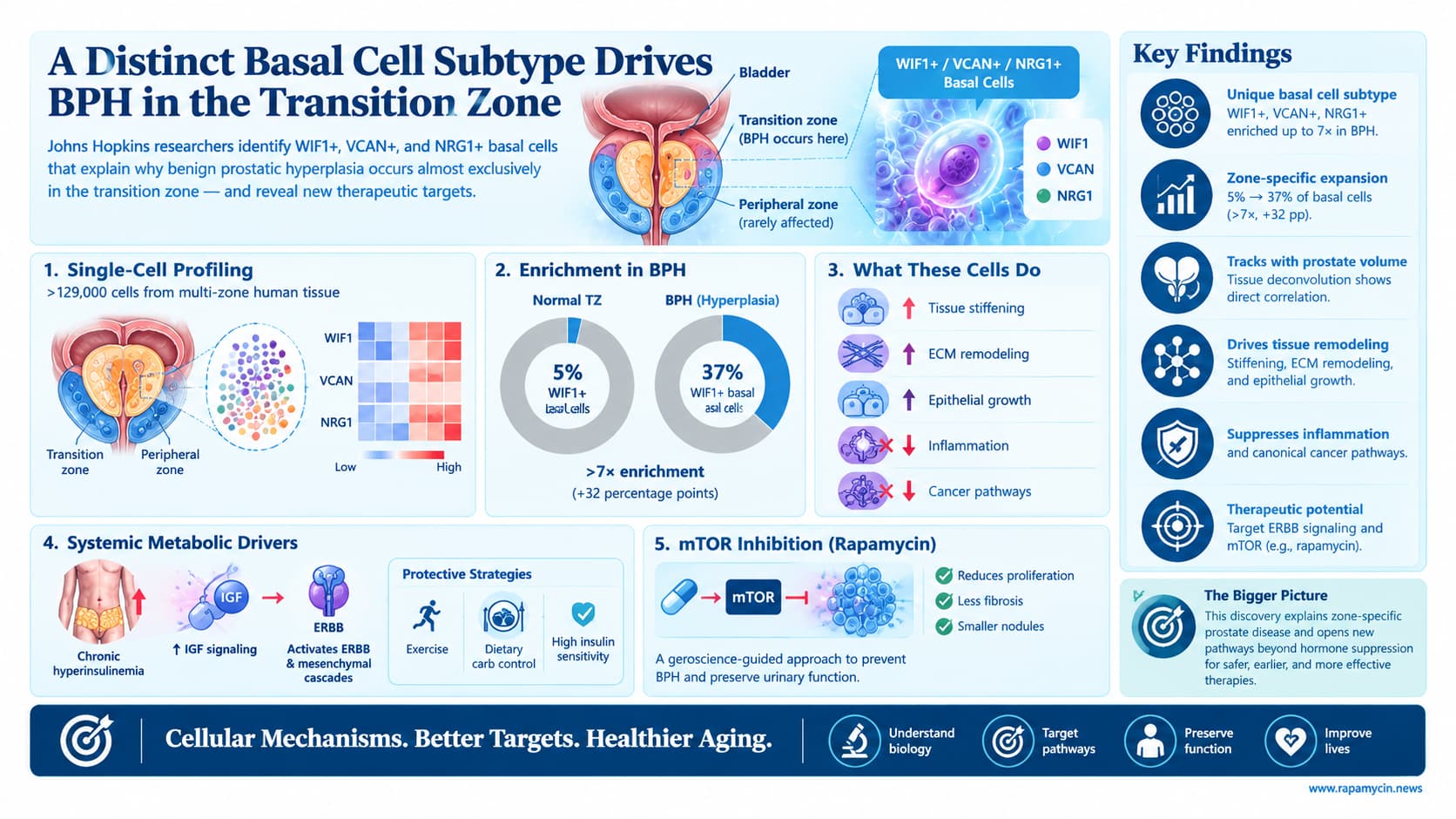
Researchers at Johns Hopkins University have identified a distinct basal cell subtype that explains why benign prostatic hyperplasia occurs almost exclusively within the transition zone of the human prostate. By profiling over 129,000 single cells from multi-zone human tissue specimens, the team discovered a population of basal epithelial cells marked by high expression of Wnt Inhibitory Factor 1 (WIF1), versican (VCAN), and neuregulin 1 (NRG1). These cells are enriched up to sevenfold in hyperplastic tissue compared to healthy glands. The population actively drives tissue stiffening,extracellular matrix remodeling, and epithelial growth while paradoxically suppressing local inflammation and canonical cancer pathways. This discovery provides a long-sought cellular mechanism for zone-specific prostate disease and highlights novel therapeutic targets beyond conventional hormone suppression.
For decades, urologists have wrestled with an anatomical enigma. The human prostate is divided into distinct zones, yet two of its most common pathologies strike with rigid spatial exclusivity. Prostate adenocarcinoma arises overwhelmingly in the outer peripheral zone, while benign prostatic hyperplasia develops almost entirely within the inner transition zone that wraps around the urethra. Despite the massive clinical burden of benign enlargement, which affects the majority of aging men and leads to progressive urinary obstruction, the cellular origin of this zonal bias has remained largely unexplained.
A research team led by scientists at the Johns Hopkins University School of Medicine has mapped the cellular landscape of the human prostate to resolve this paradox. Using single-cell RNA sequencing, the researchers isolated and profiled individual cells across all three anatomical compartments: the peripheral, central, and transition zones. While luminal cells displayed relatively uniform characteristics across the gland, the basal cell layer, which sits beneath the secretory luminal cells and contains stem and progenitor activity, harbored previously unrecognized diversity.
Among four distinct basal cell subpopulations identified in the analysis, one cluster stood out for its strict geographic distribution. Marked by the expression of the secreted Wnt antagonist WIF1 alongside structural genes such as VCAN,this basal subtype was abundantly concentrated in the transition zone while remaining virtually undetectable in the peripheral and central zones. Tissue staining on intact human prostatectomy specimens confirmed that these cells form a specialized niche anchored inside transition zone glands.
The biological profile of these WIF1-positive basal cells clarifies how they orchestrate tissue overgrowth. Rather than simply multiplying in isolation, these cells behave like active tissue architects. Computational pathway modeling and cell-cell communication networks revealed that they secrete neuregulin 1, a signaling molecule that binds directly to ERBB2 and ERBB3 receptors on neighboring luminal cells to stimulate their expansion. Simultaneously, they churn out heavy structural proteoglycans, particularly versican, and activate programs associated with epithelial-mesenchymal transition and angiogenesis. Through these signals, the cells drive both the muscular expansion and the fibrous matrix stiffening that characterize hyperplastic nodules.
Intriguingly, the data also shed light on why the transition zone remains relatively protected from aggressive malignant transformation. Alongside WIF1, these basal cells produce other soluble pathway inhibitors, including SFRP1 and DKK3,while suppressing inflammatory signaling cascades driven by tumor necrosis factor and interferon. By maintaining a microenvironment of suppressed Wnt activity and reduced inflammatory turnover, these cells preserve glandular architecture against malignant dedifferentiation, even as they fuel the steady, non-malignant expansion of benign hyperplasia.
Actionable Insights
Benign prostatic hyperplasia is frequently treated as an unavoidable consequence of male endocrine aging, managed primarily by suppressing dihydrotestosterone with 5-alpha reductase inhibitors like finasteride or dutasteride. The discovery of WIF1-positive basal cells reveals why these hormonal therapies often fail to halt long-term disease progression. The primary driver of transition zone enlargement is not merely androgen-driven luminal hypertrophy, but an aggressive, basal-mediated remodeling of the extracellular matrix and surrounding stroma.
In quantitative terms, WIF1-positive basal cells expand from roughly 5 percent of the total basal population in normal transition zone tissue to approximately 37 percent in clinical hyperplasia specimens. This represents a greater than sevenfold enrichment (an absolute increase of 32 percentage points, with high statistical significance). Furthermore, tissue deconvolution reveals that these cells track directly with overall prostate volume.
Because these cells stimulate neighboring tissue through ERBB family receptors and deposit heavy matrix proteins like versican, individuals seeking to protect urinary function must address the systemic metabolic factors that stimulate these growth programs. Chronic hyperinsulinemia and elevated insulin-like growth factor signaling strongly amplify ERBB and mesenchymal remodeling cascades. Maintaining high insulin sensitivity through regular exercise and dietary carbohydrate control remains essential. Furthermore, emerging evidence demonstrates that mTOR pathway inhibitors, such as rapamycin, directly suppress the proliferative and fibrotic microenvironment of hyperplastic nodules, suggesting that geroscience-guided therapies targeting cellular remodeling and senescence may offer preventative alternatives to surgical resection.
Context and Source
- Open Access Paper: A transition zone enriched WIF1+ basal cell subtype is associated with benign prostatic hyperplasia
- Primary Institutions: Sidney Kimmel Comprehensive Cancer Center, Department of Pathology, and The Brady Urological Institute, Johns Hopkins University School of Medicine, Baltimore, Maryland, USA; Department of Urology, Northwestern University Feinberg School of Medicine, Chicago, Illinois, USA
- Country: United States
- Journal Name: The Journal of Pathology
- Impact Evaluation: The impact score of this journal is 5.4, evaluated against a typical high-end range of 0 to 60+ for top general science, therefore this is a High impact journal.