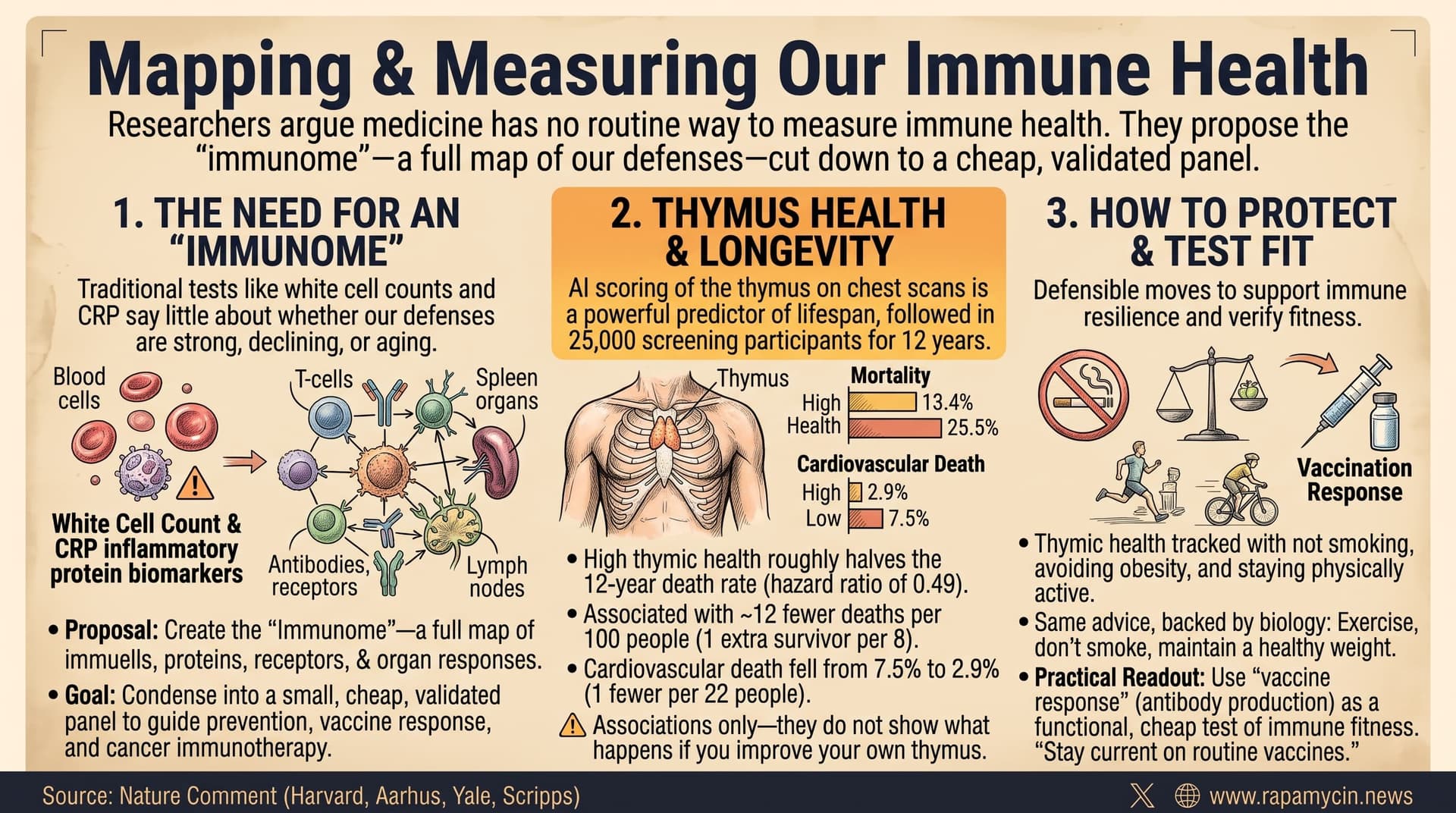
In a Nature Comment, four researchers from Harvard/Mass General Brigham, Aarhus, Yale and Scripps argue that medicine has no routine way to measure immune health. A white cell count and C-reactive protein say little about whether a person’s defenses are strong, declining, or aging faster than they are. They propose building the “immunome,” a full map of immune cells, proteins, receptors, organs and responses to challenges like vaccination. That data would then be cut down to a small, cheap, validated panel that could guide prevention, vaccination and cancer immunotherapy. The piece presents no new data. It rests on recent work, much of it from the authors’ own groups, including AI scoring of the thymus on CT scans and a machine-learning “immune health metric.”
Ask a doctor how healthy your heart is and you get numbers: blood pressure, cholesterol, maybe a stress test. Ask how healthy your immune system is and you mostly get a shrug. A white blood cell count and a C-reactive protein reading are about the extent of it. Neither tells you whether your defenses are robust, failing quietly, or aging faster than the rest of you.
In a Comment piece in Nature, Hugo Aerts, Nicolai Birkbak, John Tsang and Eric Topol argue that this gap can now be closed. They propose building the “immunome,” a full description of immune health spanning cells, proteins, organs and their interactions. That description would then be distilled into a few inexpensive tests a clinic could actually run.
The premise rests on growing evidence that people of the same age carry very different immune systems. Genes, smoking, air pollution, diet and past infections all shape them. The biological age of the immune system also tracks with risk of cancer, neurodegeneration and death.
Several recent tools hint at what a clinical readout might look like. An AI system that grades the thymus on routine chest CT scans found that adults with a healthier-looking thymus had roughly half the death rate over 12 years. A machine-learning score built from people with rare inherited immune disorders also picked up immune dysfunction in common autoimmune disease. The same score predicted how well older adults respond to vaccines. Separately, proteomic clocks can estimate immune age from blood proteins.
The road map has three stages. First, collect deep, repeated measurements in large and genetically diverse populations, including before and after vaccination, which works as a standardized stress test of immune competence. Second, simplify: find the smallest set of measurements that still captures meaningful differences, and prove across many hospitals that acting on them improves decisions. Third, set rules on consent, privacy and discrimination before anything goes mainstream. An immune profile, like a genome, could reveal future disease risk. Unlike a genome, it changes over time.
The authors offer an analogy. Blood pressure does not describe the whole cardiovascular system, and glucose does not capture all of metabolism, yet both are indispensable. An immune equivalent may need several numbers rather than one.
The weak points are real, and the authors acknowledge some of them. AI models trained on thousands of immune variables can learn differences between labs, scanners and populations as easily as differences in biology. Most immune-profiling data come from wealthy countries.
The bigger problem is that none of the cited work shows that measuring immune health, then acting on it, improves outcomes. Blood pressure earned its place because lowering it was proven to prevent strokes. For immune health there is not yet a validated lever to pull.
Much of the highlighted evidence also comes from the authors’ own labs, including the thymus CT studies and the immune health metric. That is normal for an agenda-setting essay, but readers are hearing the case from its advocates.
Still, the direction is sound. The thymus data suggest immune aging can already be measured from scans millions of people have had. The open question is whether that number will ever change a treatment decision.
Actionable Insights
This is an opinion piece, so it tests no intervention. The useful numbers come from the studies it cites, especially the thymus CT work.
- In about 25,000 lung-screening participants followed for 12 years, 13.4% of people with high thymic health died, compared with 25.5% with low thymic health.
- That is a hazard ratio of 0.49, or roughly half the death rate.
- In plain terms, there were about 12 fewer deaths per 100 people, or one extra survivor for every 8 people in the high group versus the low group.
- Cardiovascular death was 2.9% versus 7.5% in the same comparison. That is an absolute gap of 4.6 points, about one fewer death per 22 people.
- These figures compare the best and worst groups and are associations. They do not show what happens if you improve your own thymus.
- Thymic health tracked with smoking, obesity and physical activity. Not smoking, avoiding excess body fat and staying active are the defensible moves, and they are the same advice you have already heard.
- The authors propose vaccine response as a practical readout of immune fitness. Staying current on routine vaccines costs little.
Context and Source
- Open Access Article: Could measuring immune health reshape medical care?
- Article type: Comment (opinion and agenda-setting piece, not primary research)
-
Authors and institutions:
- Hugo J. W. L. Aerts: Mass General Brigham and Harvard Medical School (USA), and Maastricht University (Netherlands)
- Nicolai J. Birkbak: Aarhus University and Aarhus University Hospital (Denmark)
- John S. Tsang: Yale University (USA)
- Eric J. Topol: Scripps Research (USA), corresponding author
- Countries: USA, Netherlands, Denmark
- Journal: Nature, Vol 658, pp. 1128 to 1130, 29 October 2026
- Impact evaluation: The impact score of this journal is 56.1 (2025 Journal Impact Factor, released June 2026), evaluated against a typical high-end range of 0-60+ for top general science, therefore this is an Elite impact journal.