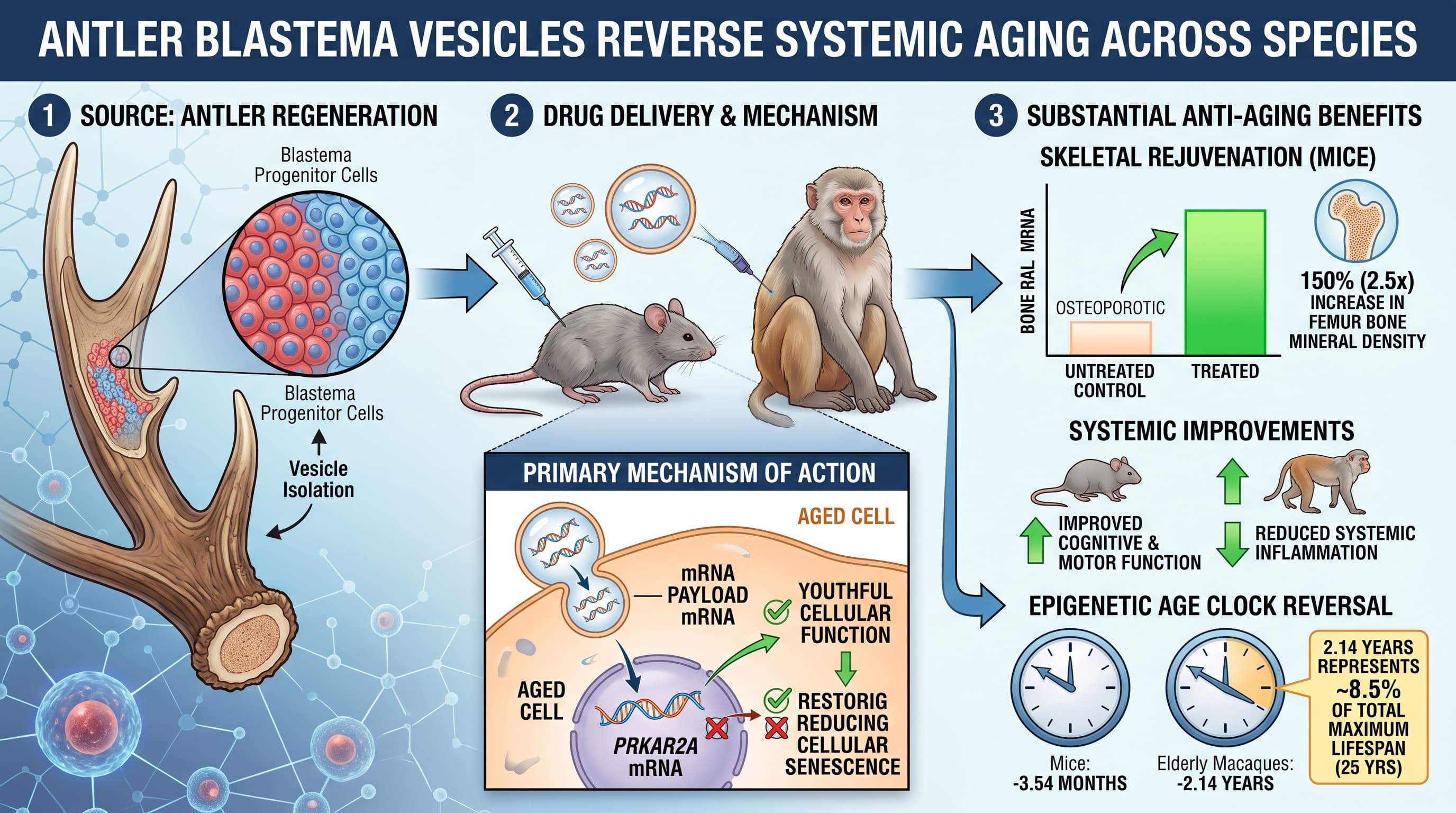
The research paper demonstrates that extracellular vesicles derived from antler blastema progenitor cells can reverse multiple signs of systemic aging in both rodents and nonhuman primates. Researchers isolated these vesicles from regenerating deer antlers and injected them intravenously into aged mice and elderly rhesus macaques. The treatment significantly increased bone mineral density, improved cognitive and motor function, reduced systemic inflammation, and reversed blood-based epigenetic age clocks. The primary mechanism of action relies on the transfer of specific messenger RNA payloads, notably Prkar2a, which restores youthful cellular function and reduces cellular senescence.
Nature has engineered a highly efficient regeneration machine in the form of deer antlers. Mammalian organs typically lose their regenerative capacity shortly after birth, but deer antlers are the exception. These bony structures can regenerate completely every single year, growing at a remarkable rate of up to 2.75 centimeters per day. The biological drivers behind this extreme growth are antler blastema progenitor cells. A consortium of researchers in China successfully cultured these cells and extracted their extracellular vesicles, testing whether the regenerative signals contained within could be transferred to entirely different species.
The resulting study represents a major shift in systemic rejuvenation research. Most current longevity interventions focus on metabolic restriction or the selective destruction of senescent cells. This intervention uses cross-species cellular communication to force old cells to adopt youthful expression profiles. The researchers injected the antler-derived vesicles into 18-month-old mice and 16 to 18-year-old rhesus macaques. The physiological changes were profound and systemic. In mice, the vesicles reversed bone loss, increased fatigue resistance on treadmills, and improved spatial memory. In the macaque cohort, the treatment resulted in increased spontaneous physical activity, improved manual dexterity, and a measurable increase in total intracranial brain volume.
The active ingredients driving these biological changes are the messenger RNA payloads encapsulated within the vesicles. The researchers identified Prkar2a as a primary geroprotective factor. When the vesicles fuse with aged host cells, this RNA is translated into a regulatory subunit of the PKA holoenzyme, which subsequently triggers downstream longevity pathways, reduces oxidative stress, and halts the senescence-associated secretory phenotype.
While cross-species vesicle transfer sounds inherently risky regarding immune rejection, the study reported no adverse immunological reactions in the treated animals. This suggests that stem cell-derived extracellular vesicles might bypass the histocompatibility barriers that normally plague cell therapies. The ability to freeze, store, and inject these vesicles without triggering severe immune responses positions them as a highly scalable alternative to traditional stem cell transplantation.
Actionable Insights
For individuals focused on human longevity, the immediate translation of this research requires careful interpretation. The study proves that systemic rejuvenation via extracellular vesicles is biologically possible in primates, but commercial antler products like oral deer velvet supplements will not replicate these results. Extracellular vesicles and their fragile RNA payloads are destroyed in the human digestive tract.
The most practical insight is the identification of Prkar2a and the PKA pathway as primary targets for reducing cellular senescence. The magnitude of the observed benefits is substantial. In mice, bone mineral density in the femur increased by 150 percent (a 2.5-fold increase) compared to untreated controls, shifting skeletal profiles from osteoporotic to youthful. Epigenetic aging clocks derived from blood methylation showed a reversal of 3.54 months in mice and 2.14 years in elderly macaques. For a macaque, 2.14 years represents roughly 8.5 percent of its total maximum lifespan of 25 years. Until intravenous delivery of standardized, purified stem cell vesicles becomes clinically available, biohackers should focus on existing interventions known to modulate PKA signaling and macroautophagy to achieve similar downstream reductions in systemic inflammation.
Context and Source
-
Open Access Paper: Extracellular vesicles from antler blastema progenitor cells reverse bone loss and mitigate aging-related phenotypes in mice and macaques., Published: 14 July 2025
Institution: Fourth Military Medical University, Kunming Institute of Zoology, Northwestern Polytechnical University, among others. - Country: China.
- Journal: Nature Aging.
- Impact: The impact score of this journal is 17.0, evaluated against a typical high-end range of 0-60+ for top general science, therefore this is an Elite impact journal.