Cultivating Purpose Increases Odds of Reaching Age 100 by 27 Percent

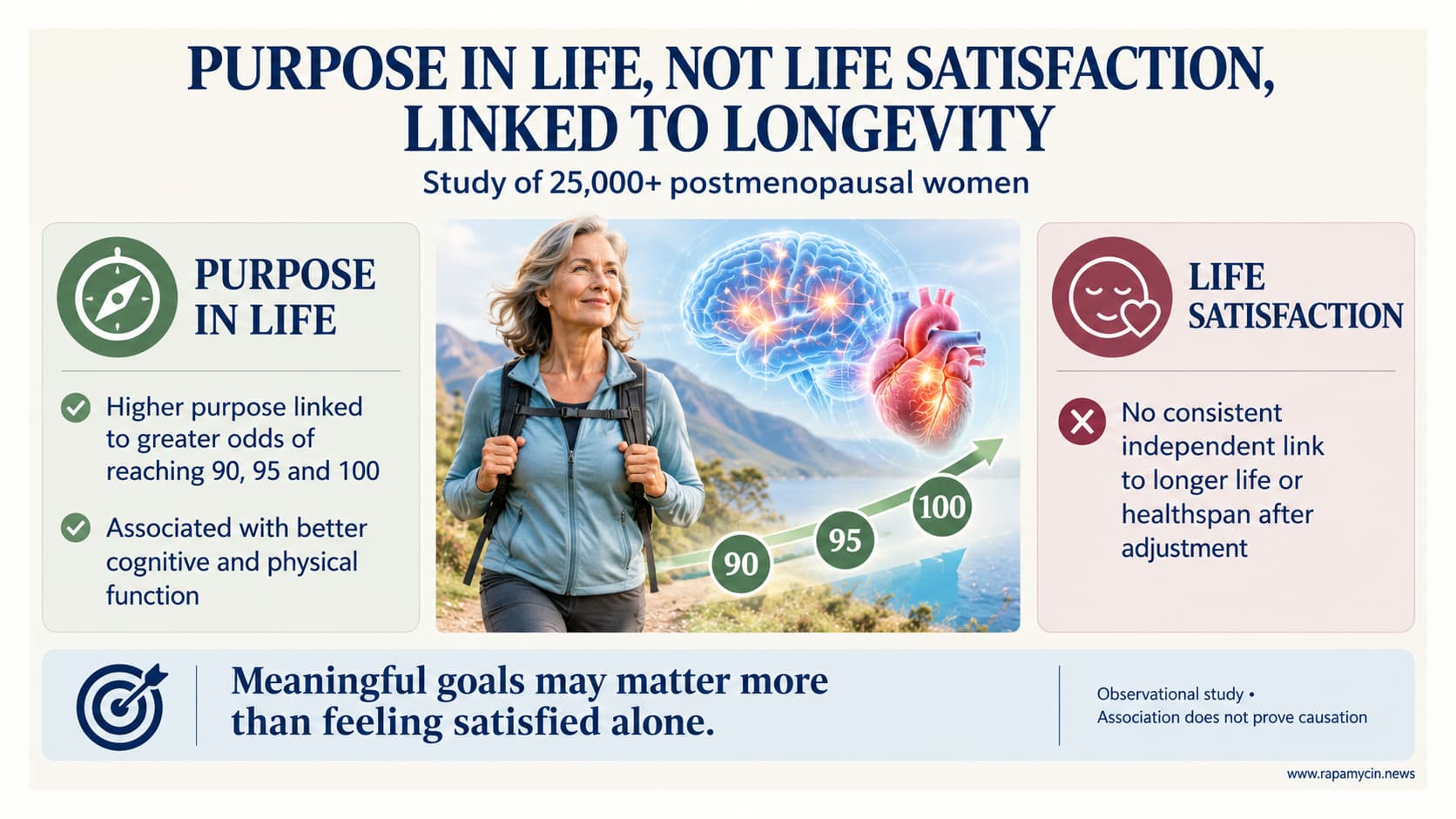
This epidemiological study of over 25,000 postmenopausal women investigates the independent associations of two distinct psychological constructs, purpose in life and satisfaction with life, with exceptional and healthy longevity. Researchers found that a standard deviation increase in purpose in life significantly elevated the odds of surviving to ages 90, 95, and 100, while also preserving cognitive and physical function. Conversely, satisfaction with life did not consistently associate with extended lifespan or healthspan after adjusting for health and psychosocial factors.

The pursuit of happiness is widely considered a fundamental human goal, but when optimizing for extreme longevity, aiming for a defined purpose yields vastly superior biological returns. Epidemiological research historically focuses on mitigating risk factors like smoking or metabolic dysfunction, leaving the physiological impact of psychosocial assets underexplored. This dataset tracks 25,050 postmenopausal women to distinguish the biological value of two distinct psychological states. The first state is purpose in life, characterized by goal-directed behavior and a sense of meaning. The second state is satisfaction with life, which reflects a general contentment with current conditions.

The data strongly suggests that contentment is insufficient for extending lifespan. While satisfaction with life showed no consistent association with survival after adjusting for health and psychosocial factors, having a defined purpose acted as a powerful independent variable for both exceptional and healthy longevity. Out of the initial cohort, 18,406 women survived to age 90 or older. Participants demonstrating higher purpose in life achieved a significantly greater probability of reaching ages 90, 95, and 100. Furthermore, these individuals retained intact mobility and cognitive function at age 90, highlighting an extension of healthspan rather than just lifespan.

Mediation analysis indicates that resilience and physical activity partially explain this phenomenon. This indicates that purposeful individuals are more likely to engage in protective health behaviors and recover rapidly from physiological stressors. For individuals seeking to maximize their biological potential, building a structured, goal-oriented life architecture appears to be a measurable and effective longevity intervention.

Actionable Insights The practical takeaway for maximizing healthspan is that cultivating a specific mission provides stronger biological returns than pursuing general happiness. To leverage this finding, individuals should clearly define personal objectives that drive daily engagement and forward momentum. The effect size of this intervention is substantial. A one standard deviation increase in purpose in life correlates with a 17 percent increased odds of surviving to age 90, a 17 percent increased odds of reaching age 95, and a 27 percent increased odds of surviving to age 100. Furthermore, a one standard deviation increase in purpose is associated with an 18 percent increased odds of maintaining intact cognitive and physical function past age 90.

The data indicates that satisfaction with life yields an odds ratio below 1.0 for these same outcomes, meaning contentment alone provides no statistical longevity benefit. Structuring your daily routine around a defined purpose, engaging in rigorous physical activity, and building psychological resilience are the practical steps required to replicate these observed survival advantages.

Context/Source

Related Reading:

Biomarker Data (Effect Size Calculation) The study quantifies the treatment effect of psychosocial assets using covariate-adjusted logistic regression models. For purpose in life, the standardized effect sizes are reported as odds ratios per one standard deviation increase in the continuous variable:

  • Survival to age 90: Odds Ratio 1.17 (95% CI 1.13 to 1.21), representing a 17 percent increased probability of survival.

  • Survival to age 95: Odds Ratio 1.17 (95% CI 1.12 to 1.22), representing a 17 percent increased probability of survival.

  • Survival to age 100: Odds Ratio 1.27 (95% CI 1.15 to 1.41), representing a 27 percent increased probability of survival.

  • Healthy Longevity at 90+: Odds Ratio 1.18 (95% CI 1.14 to 1.23), indicating an 18 percent increased probability of surviving with intact mobility and cognitive function.

Conversely, satisfaction with life yielded odds ratios of 0.95 for age 90, 0.93 for age 95, 0.94 for age 100, and 0.99 for healthy longevity, demonstrating no positive effect on survival after adjustment for health and psychosocial factors.

10 Great Books on Developing Your Sense of Purpose in Life

  1. Life on Purpose: How Living for What Matters Most Changes Everything by Victor J. Strecher (Public Health, University of Michigan) This text analyzes the intersection of behavioral science, epidemiology,and philosophy to demonstrate how a defined life purpose correlates with increased longevity and preserved cognitive function. Strecher synthesizes empirical data linking a strong sense of purpose to measurable biological outcomes, such as reduced telomere degradation and lower risk of cardiovascular disease. The work distinguishes between verified epidemiological correlations and informed speculation regarding precise causal mechanisms, noting that purpose likely acts as a biological buffer against allostatic load and chronic stress.

  2. Man’s Search for Meaning by Viktor E. Frankl (Clinical Psychiatry, University of Vienna) Frankl outlines logotherapy, proposing that the primary human drive is the pursuit of meaning rather than the pursuit of pleasure or power. The text relies on clinical observation and historical accounts from concentration camps to argue that existential purpose is a necessary component of psychological survival under extreme physiological stress. While foundational to existential psychology, the clinical data remains qualitative, requiring modern neurobiological validation to fully map the mechanistic pathways Frankl originally hypothesized.

  3. Meanings of Life by Roy F. Baumeister (Social Psychology, Florida State University) This work differentiates between meaning and happiness by arguing that meaning requires four distinct components:purpose, values, efficacy, and self-worth. Baumeister evaluates historical and sociological data to demonstrate that pursuing transient happiness often conflicts with building a meaningful life, which requires sacrifice and long term temporal integration. The text identifies a knowledge gap regarding how different cultures prioritize these four components, acknowledging that much of the foundational psychological literature relies heavily on Western cohorts.

  4. Flow: The Psychology of Optimal Experience by Mihaly Csikszentmihalyi (Positive Psychology,Claremont Graduate University) Csikszentmihalyi details the phenomenological state of flow, where focused engagement in challenging tasks generates intrinsic purpose and psychological order. The research is grounded in the Experience Sampling Method to track daily cognitive states, demonstrating that purpose is cultivated through active, skill-demanding behaviors rather than passive consumption. The precise neurochemical markers defining the flow state remain a subject of active scholarly debate, with additional functional magnetic resonance imaging data needed to isolate its exact neural correlates.

  5. Flourish: A Visionary New Understanding of Happiness and Well-being by Martin E. P. Seligman (Positive Psychology, University of Pennsylvania) Seligman introduces the PERMA model, positioning meaning and purpose as distinct, measurable components of human flourishing that operate independently of positive emotion. The book argues that cultivating purpose requires serving something larger than the self, shifting the focus of clinical psychology from disease models to optimizing psychological assets. The field continues to debate whether the five elements of PERMA are truly independent constructs or overlapping facets of a single general well-being factor.

  6. The Sweet Spot: The Pleasures of Suffering and the Search for Meaning by Paul Bloom (Cognitive Psychology, University of Toronto) Bloom argues that voluntary suffering and effort are necessary components for establishing a meaningful life, directly challenging purely hedonic models of human motivation. The text synthesizes cognitive science and evolutionary psychology to explain why humans actively seek out difficult, stressful, or painful experiences to build a sense of purpose. Acknowledging scholarly debates around masochism versus meaningful struggle, the book notes that additional data is required to determine the exact physiological threshold where voluntary suffering ceases to build purpose and begins causing psychological damage.

  7. The Path to Purpose: How Young People Find Their Calling in Life by William Damon (Developmental Psychology, Stanford University) Damon examines the developmental psychology of purpose, defining it as a stable and generalized intention to accomplish something that is both meaningful to the self and consequential for the world. The text utilizes longitudinal interviews to identify how purpose develops during adolescence and early adulthood, concluding that environmental scaffolding and adult mentorship are critical variables. The book identifies a significant knowledge gap in how isolated digital environments and continuous social media usage influence the development of long term purpose in contemporary cohorts.

  8. The Happiness Hypothesis: Finding Modern Truth in Ancient Wisdom by Jonathan Haidt (Moral Psychology, New York University) Haidt analyzes historical philosophical concepts of purpose through the lens of modern neuroscience and cognitive psychology, arguing that meaning emerges from the coherence between the individual and their social environment. The book posits that purpose is not purely internally generated but requires external structural support from culture, work, and relationships. The text separates verified psychological phenomena, such as the adaptation principle, from speculative sociological interpretations, emphasizing the need for cross-cultural data to validate universal claims about human meaning.

  9. Languishing: How to Feel Alive Again in a World That Wears Us Down by Corey Keyes (Sociology,Emory University) Keyes examines the sociological and psychological absence of mental health, arguing that restoring a functional sense of purpose is the primary intervention for languishing, a state entirely distinct from clinical depression. The research relies on epidemiological data to show that the absence of meaning is a stronger predictor of future morbidity than the presence of negative affect. The text highlights a debate within clinical psychiatry regarding whether languishing should be classified as a distinct pathology or viewed on a continuum of general well-being.

  10. How Will You Measure Your Life? by Clayton M. Christensen (Business Administration, Harvard Business School) This text applies organizational behavior theories and resource allocation models to personal life strategy, demonstrating how individuals fail to allocate time and energy toward their stated long term purposes. Christensen argues that marginal cost thinking leads to short term decisions that consistently undermine long term meaning in relationships and careers. While highly practical, the book relies heavily on translating corporate strategy to personal psychology, leaving a knowledge gap regarding how these specific resource allocation models hold up under rigorous psychological clinical trials.

Scholarly Debates and Knowledge Gaps

The academic study of purpose remains characterized by significant methodological and definitional debates. A primary dispute involves whether purpose is entirely subjective, determined solely by individual perception, or if it requires an objective, prosocial component that benefits the broader community. Furthermore, the field struggles with a heavy reliance on self-reported psychometric questionnaires, which are vulnerable to transient mood fluctuations and cognitive biases.

To achieve complete scientific rigor, the discipline requires additional longitudinal studies utilizing objective physiological biomarkers. Isolating the precise neurological pathways and epigenetic mechanisms that translate abstract psychological purpose into measurable longevity and healthspan outcomes remains the most critical knowledge gap requiring future biological data.