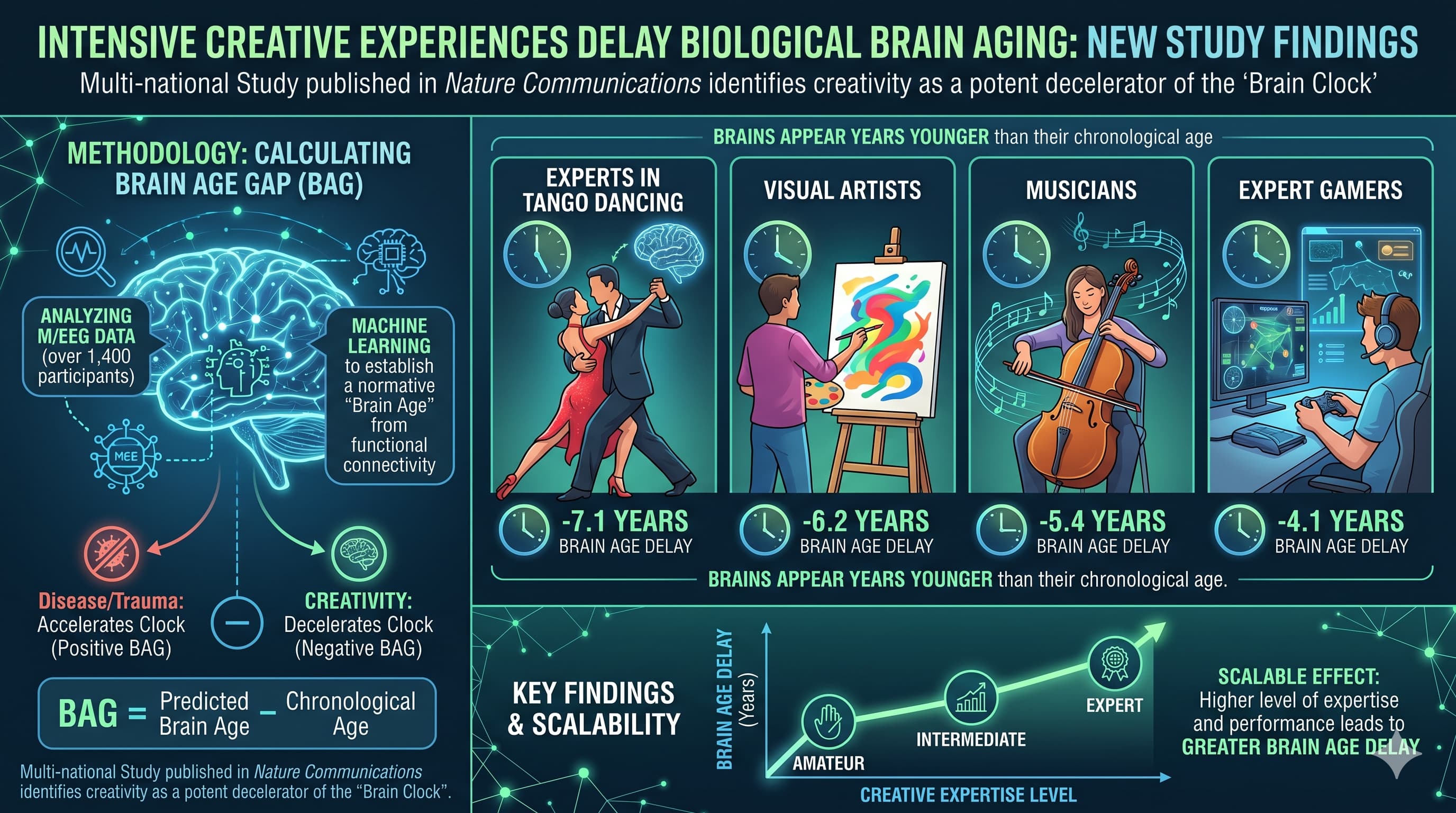
Recent research suggests that the “starving artist” might at least have a younger brain. A multi-national study published in Nature Communications has demonstrated that intensive creative experiences—ranging from professional tango dancing and music to visual arts and even strategy video games—are associated with significant delays in biological brain aging. By utilizing “brain clocks” derived from functional connectivity data, researchers found that individuals with high levels of creative expertise possess brains that appear years younger than their chronological age.
The study employed machine learning to analyze M/EEG (magneto/electroencephalography) data from over 1,400 participants to establish a normative “brain age”. This allowed researchers to calculate the Brain Age Gap (BAG)—the difference between how old a brain “looks” functionally versus the person’s actual age. While previous research has focused on how disease and trauma accelerate this clock, this paper identifies creativity as a potent “decelerator”.
The findings were consistent across diverse domains. Experts in tango dancing showed a brain age delay of approximately 7.1 years, while musicians, visual artists, and expert gamers showed delays of 5.4, 6.2, and 4.1 years, respectively. Crucially, the effect was scalable: the higher the level of expertise and performance, the greater the delay in brain aging.
The researchers also investigated whether these effects could be induced in the short term. A group of non-experts underwent 30 hours of training in the strategy game StarCraft II. Even this relatively brief intervention resulted in a 3.1-year reduction in brain age, suggesting that the brain’s “clock” is plastic and responsive to new, complex cognitive demands. The study concludes that creative pursuits enhance “brain efficiency” and biophysical coupling, particularly in frontoparietal hubs that are otherwise highly vulnerable to the ravages of time.
Actionable Insights
-
Prioritize Mastery Over Novelty: While learning new skills is beneficial, the data shows a “tiered effect”. Long-term expertise provides a significantly more robust protective effect against brain aging than short-term learning (expertise > learning). Aim for professional-level proficiency or deep, multi-year commitment to a creative craft to maximize neural preservation.
-
Engagement Specificity: The protective effects are linked to high-performance metrics. In the gaming study, improvements in “actions per minute” (APM) directly correlated with reduced brain age. This suggests that passive engagement is insufficient; the activity must be demanding and require adaptive problem-solving.
-
Targeted Short-Term Interventions: If long-term mastery is not feasible, even 30 hours of intensive training in a complex, strategy-based activity can yield measurable improvements in brain health.
-
Cross-Domain Benefits: The study indicates that the specific medium (music vs. dance vs. gaming) matters less than the “creative” nature of the task, which involves novel and effective idea production. Choose a domain that facilitates personalized playstyles and adaptive tactics.
Context
- Open Access Paper: Creative experiences and brain clocks
- Lead Institutions: Latin American Brain Health Institute (BrainLat), Universidad Adolfo Ibáñez (Chile); Trinity College Dublin (Ireland); and Global Brain Health Institute (GBHI) at UCSF (USA).
- Journal: Nature Communications.
- Impact Evaluation: The impact score (JIF) of this journal is approximately 14.7, evaluated against a typical high-end range of 0–60+ for top general science; therefore, this is an Elite impact journal.