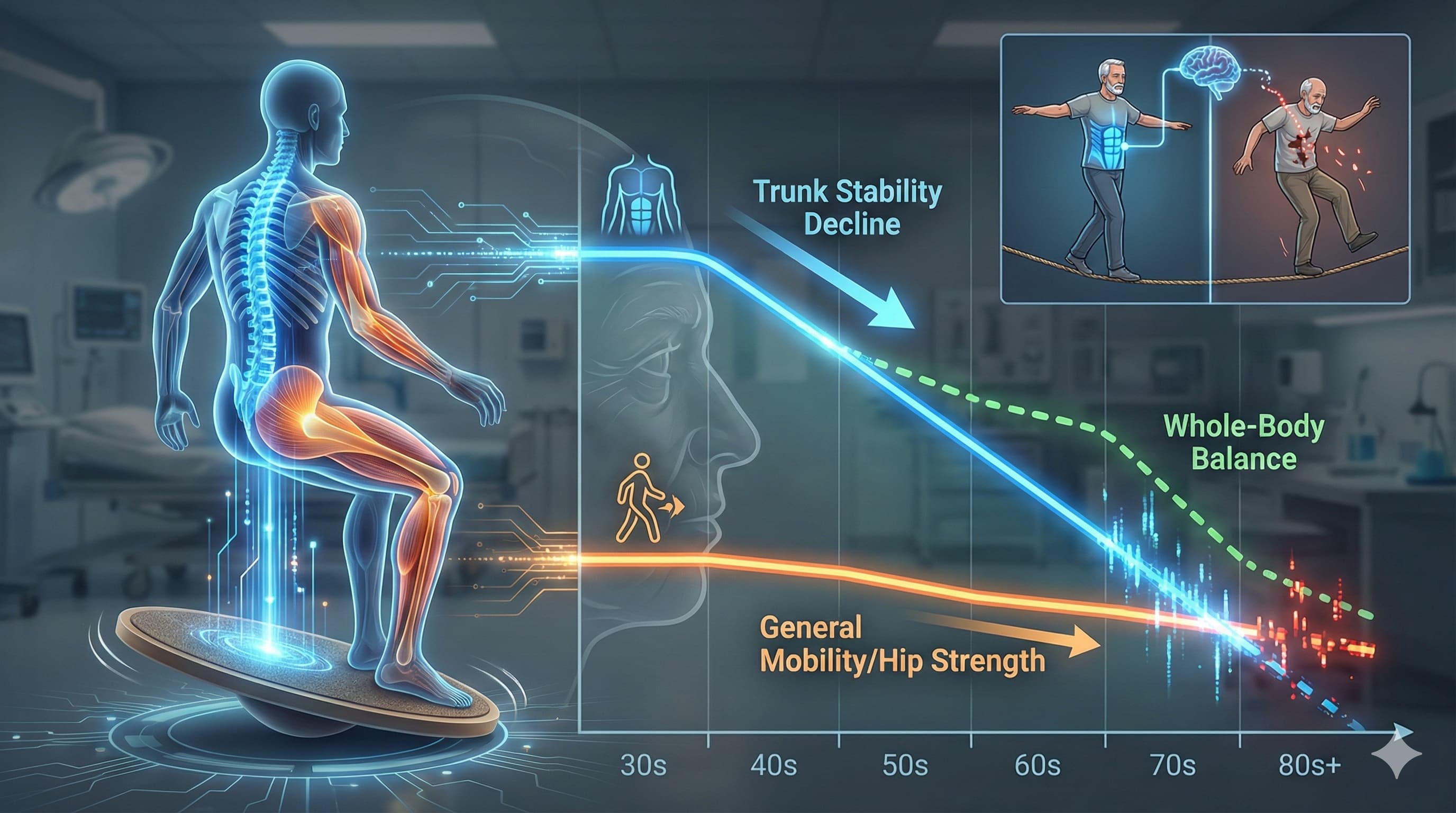
Core Stability: The Silent Biomarker of Aging That Outpaces Mobility and Strength

A new study has identified trunk stability (core control) as a rapidly deteriorating physical capability that outpaces declines in general mobility and hip strength during aging, particularly in males. While traditional metrics like the “Timed Up & Go” (TUG) test remained relatively stable in physically active older adults, trunk stability—measured by the ability to control the upper body on an unstable seat—showed a steep, linear decline starting as early as age 30. Crucially, this study reveals that trunk stability is the primary predictor of whole-body dynamic balance, suggesting that “core control” is not just about strength, but is a critical neuro-mechanical prerequisite for preventing falls. This implies that standard gym routines focusing on gross strength may fail to address the specific proprioceptive and fine-motor degradation of the trunk that compromises longevity.

Source:


Part 2: The Biohacker Analysis

Study Design Specifications

  • Type: Cross-Sectional Observational Study
  • Subjects: Human (N=127).
    • Demographics: Healthy, physically active adults aged 30–80 years.
    • Sex Distribution: 42 Males, 85 Females.
    • Activity Level: 120–300 minutes of physical activity per week.

Mechanistic Deep Dive

This research dissects the biomechanical “inverted pendulum” model of human aging, identifying Trunk Stability as the weak link in the kinetic chain.

  • Neuromuscular Decay: The study differentiates between “Global” functional mobility (TUG test) and “Local” fine motor control (Unstable Sitting). The rapid decline in trunk stability (R^2=71% variance in males) suggests that general physical activity preserves gross motor function (legs/hips) but fails to arrest the decay of fine neuromuscular control in the core.
  • Proprioceptive Failure: The authors posit that the degradation is driven by age-related reductions in proprioception and reaction time, which are critical for the micro-adjustments required to stabilize the torso.
  • The “Core” Driver: Correlation analysis revealed that trunk stability is the strongest predictor of tandem stance balance (r=0.629, p<0.013). This suggests that “balance” exercises are downstream of “core stability.” If the trunk cannot be stabilized, the vestibular and visual systems cannot effectively orient the body.

Novelty

  • Differential Decay Rates: This paper provides quantitative evidence that physical systems age at vastly different rates. In males, trunk stability deteriorated ~4.48% per year, whereas functional mobility (TUG) only declined by ~0.55% per year.
  • The Male “Stiffness” Trap: The data identified a sex-specific vulnerability. Males showed a much sharper decline in trunk stability than females (R^2=71% vs R^2=46%). This supports the hypothesis that aging males rely on “rigidity” strategies rather than the dynamic control strategies seen in females, leading to a catastrophic loss of function when that rigidity fails.
  • Unstable Sitting Protocol: The use of a specialized unstable seat isolates the trunk from lower-limb compensation, offering a purer metric of core neuro-control than traditional planking or standing tests.

Critical Limitations

  • Cross-Sectional Confounding: As a cross-sectional study, it cannot distinguish between true aging effects and cohort differences (e.g., 80-year-olds today may have different lifelong activity patterns than 30-year-olds).
  • “Healthy Survivor” Bias: The cohort was highly active (up to 300 min/week). The results likely underestimate the decline in the general, sedentary population.
  • Sample Imbalance: The study suffered from significant imbalance in sex and age distribution, specifically a lack of males in their 50s and a 2:1 female-to-male ratio, limiting the statistical power of subgroup analyses.
  • No Causality: The study identifies correlations (core stability to balance) but cannot prove that training core stability causes improved balance without a longitudinal intervention.

[Confidence: High]


Part 3: Claims & Verification

  • Claim 1: Core (trunk) stability is a critical predictor of balance and fall risk in older adults.
  • Claim 2: Trunk stability deteriorates with age, independent of general mobility.
  • Claim 3: Males experience a steeper decline in trunk stability/muscle density than females.
    • Evidence Level: C (Conflicting/Nuanced Observational Data).
    • Verification: While the specific paper claims a steeper stability decline in males, broader literature paints a complex picture. Some studies show males have larger muscles but females experience greater age-related decreases in muscle density (fat infiltration). Other studies suggest older males have significantly reduced trunk range of motion compared to females. The “steeper stability decline” is a specific finding of this paper that adds nuance to the known physiological changes.
    • Citation: Age and gender related neuromuscular changes in trunk flexion-extension (2015).
  • Claim 4: “Timed Up & Go” (TUG) scores remain relatively stable in active older adults despite core decay.
  • Claim 5: Unstable sitting is a valid measure of trunk control separate from lower limb strength.
    • Evidence Level: C (Validation Studies).
    • Verification: The “Function in Sitting Test” (FIST) and similar protocols have established validity and reliability for assessing sitting balance, specifically in populations where standing balance is compromised. Using it to isolate trunk control from leg strength in healthy adults is a valid methodological extension.
    • Citation: Function in Sitting Test (FIST) Psychometrics.
  • Claim 6: Hip strength correlates with functional mobility.

Part 4: Actionable Intelligence (Deep Retrieval & Validation Mode)

The Translational Protocol: “Neuromuscular Core Calibration”

Since the primary intervention is mechanical (proprioceptive training) rather than pharmacological, the “Human Equivalent Dose” framework is adapted to “Minimum Effective Volume” based on the validated meta-analysis data.

  • Protocol Mechanism: Unstable Surface Training (UST) to force high-frequency proprioceptive micro-adjustments, arresting the decay of the “inverted pendulum” control loop.
  • Human Equivalent Dose (Exercise Volume Calculation):
    • Formula: Frequency × Duration × Intensity (Time Under Tension)
    • Minimum Effective Dose (MED): Based on meta-analyses (Level A evidence), significant balance remodeling requires 2–3 sessions/week for a minimum of 6 weeks.
    • Session Volume: 20–30 minutes of total “instability time.”
    • Math: 3 sessions/week $\times$ 20 mins $\times$ 6 weeks = 360 minutes of cumulative neuro-adaptation time to see initial ROI.
  • Adaptation Kinetics (PK/PD):
    • Onset of Action: Neuromuscular adaptations (firing rate/synchronization) occur within 2–4 weeks.
    • Structural Hypertrophy: Measurable increases in trunk muscle density (countering the “fatty infiltration” noted in the study) require 8–12 weeks.
    • Half-Life: Detraining effects (loss of balance gains) are rapid; cessation of training results in a return to baseline within 4–8 weeks.
  • Safety & Contraindications:
    • Spinal Pathology: High-frequency micro-oscillations can exacerbate existing herniated discs or spondylolisthesis.
    • Fall Risk: Paradoxically, the training increases acute fall risk. Safety requirement: Must be performed in a “constrained environment” (e.g., seated within a rack or with handrails) for the first 4 weeks.
    • Vascular: Avoid Valsalva maneuver during stabilization to prevent blood pressure spikes (critical for older adults with hypertension).

Biomarker Verification

How do you know it’s working without an unstable seat device?

  1. Primary Target: Single-Leg Stance Test (Eyes Closed). A generic proxy for proprioceptive acuity. Improvement >10 seconds indicates central integration success.
  2. Secondary Target: Sitting Functional Reach Test. Distance reached without losing balance.
  3. Molecular Proxy (Speculative): Reduced serum Myostatin and increased IGF-1 (local), though systemic detection is noisy.

Feasibility & ROI

  • Sourcing:
    • Low Cost: 65cm Swiss Ball (ensure hard inflation).
    • High Tech: “Swopper” chair or Bosu ball on a standard chair (use caution).
    • Research Standard: Custom unstable seat with force plate (Laboratory only).
  • Cost vs. Effect:
    • Cost: <$50 one-time equipment cost.
    • ROI: High. Fall prevention is the single highest ROI intervention for longevity (avoiding the “hip fracture death spiral”).

Part 5: The Strategic FAQ

1. “I can squat 1.5x bodyweight. Doesn’t that prove my core is stable?”

Answer: No. Squatting demonstrates bracing capacity (high-threshold motor unit recruitment/rigidity). This study identifies the decay in fine-motor control (low-threshold, proprioceptive micro-adjustments). You can be “stiff” and strong but lack the dynamic reaction time to catch a fall. This protocol targets the software (neural control), not just the hardware (muscle size).

2. “Why sit? Isn’t standing more functional?”

Answer: Standing allows your ankles and knees to compensate for a weak core. Sitting isolates the “lumbopelvic cylinder,” forcing the trunk muscles to do 100% of the stabilization work. It unmasks the deficit that your legs are hiding.

3. “Does this correlate with grip strength or VO2 max?”

Answer: No. The data shows trunk stability is an independent variable. You can have high VO2 max (aerobic fitness) and high grip strength, yet still have a degrading core control system (as seen in the “Active” cohort of the study).

4. “Is this sex-specific? Do men need this more?”

Answer: Yes. The study found men degrade faster ($R^2=71%$ variance) than women. Men tend to rely on “stiffness” strategies which fail catastrophically with age. Men need this high-frequency instability training to preserve fluidity.

5. “Can I just use a standing desk?”

Answer: Unlikely to be sufficient. Standing implies a static posture. The benefit comes from perturbation—fighting gravity in an unstable environment. You need to be “actively unstable,” not just standing still.

6. “Will this fix my lower back pain?”

Answer: Likely, but proceed with caution. Deep multifidus atrophy is a leading cause of LBP. Reactivating these deep stabilizers often resolves pain, but acute overloading can trigger spasms. Start with low amplitude.

7. “How do I measure progress without a force plate?”

Answer: Time to Failure. Sit on a Swiss ball with one foot lifted. Measure how long you can hold before touching down. Repeat with eyes closed.

8. “What is the ‘Minimum Effective Dose’ for maintenance?”

Answer: Once baseline stability is restored (after ~12 weeks), 1 session/week of high-intensity instability training is likely sufficient to maintain neuromuscular pathways.

9. “Is there a pharmaceutical mimetic for this?”

Answer: No. No drug can train proprioception. This is purely a neural-circuitry adaptation.

10. “If I have to choose between this and Zone 2 cardio, what wins?”

Answer: Zone 2 wins for metabolic mortality. But this protocol takes 10 minutes and can be done whileworking. It is not an “either/or”—it is a “must-add” for mechanical longevity.