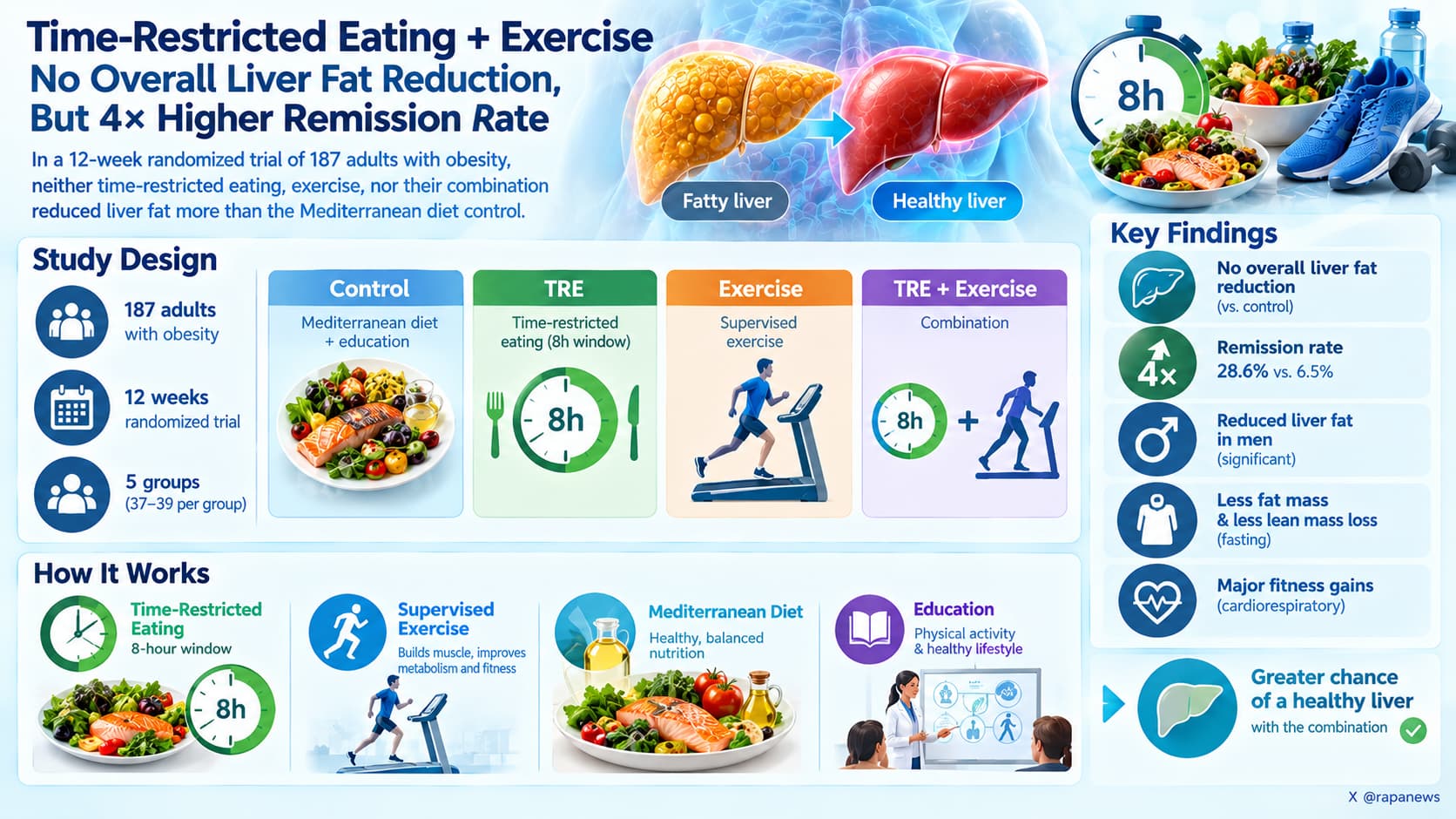
In a 12-week randomized controlled trial involving 187 adults with obesity, researchers evaluated whether an 8-hour time-restricted eating window, supervised exercise, or their combination could reduce intrahepatic fat fraction more effectively than usual care consisting of Mediterranean diet and physical activity education. Across the full cohort, neither intervention alone nor their combination produced a statistically significant reduction in liver fat compared to the educational control group. However, the combination of time-restricted eating and exercise quadrupled the rate of steatotic liver disease remission to 28.6% compared to 6.5% in controls, triggered a significant reduction in liver fat among male participants, reduced fat mass, blunted fasting-induced lean mass loss, and drove large improvements in cardiorespiratory fitness.
Intermittent fasting has become one of the most widely adopted lifestyle strategies for metabolic health, often promoted as an accessible tool to clear ectopic fat from vital organs. However, high-quality clinical trials testing whether compressing daily meals into an eight-hour window can outmatch standard medical advice for clearing liver fat remain scarce. The TEMPUS randomized controlled trial sought to answer this question by evaluating 187 adults with obesity over twelve weeks. Participants were assigned to usual care consisting of monthly Mediterranean diet and exercise education, an eight-hour time-restricted eating protocol, a twice-weekly supervised exercise regimen combining high-intensity intervals with resistance circuits, or both interventions combined.
The primary metric of success was intrahepatic fat fraction measured by high-resolution magnetic resonance imaging. When evaluating the entire study population, the headline outcome was neutral. Compared to standard care, the reduction in liver fat was 0.4% in the fasting group, 0.8% in the exercise group, and 1.1% in the combined group, none of which reached statistical significance. Furthermore, comparing the active groups against one another revealed no significant differences in liver fat reduction.
A closer look at the data reveals important secondary benefits. When analyzing participants who entered the trial with confirmed metabolic dysfunction-associated steatotic liver disease, the combined intervention quadrupled the remission rate. Remission occurred in 28.6% of participants in the combined group compared to only 6.5% in the control group. Sex-stratified analyses revealed a clear biological divergence: men in the combined group experienced a significant 2.2% reduction in liver fat relative to control, whereas women showed no measurable difference.
Beyond liver fat, the interventions produced contrasting effects on overall body composition. Time-restricted eating alone caused an average loss of 2.2 kilograms of total weight, but nearly one kilogram of that loss came from lean muscle tissue. When supervised resistance training and aerobic intervals were combined with the fasting window, participants lost 1.8 kilograms of fat mass while substantially protecting their fat-free mass. Participants in the exercise cohorts also achieved substantial gains in cardiorespiratory fitness, increasing their maximal aerobic capacity by over 15%.
These findings illustrate that while an eight-hour fasting window does not serve as a standalone cure for fatty liver, pairing fasting with structured resistance and aerobic exercise creates meaningful improvements in systemic body composition and physical fitness. Nevertheless, follow-up testing at twelve months showed that liver fat reductions dissipated once supervision ended, demonstrating that sustainable lifestyle maintenance is essential to preserve organ-level metabolic improvements.
Actionable Insights
Adopting an 8-hour time-restricted eating window without structured physical activity poses a distinct risk to lean body mass. In this study, individuals practicing time-restricted eating alone lost 0.9 kilograms of lean tissue, representing an unintended loss of muscle mass. To prevent this, anyone using fasting schedules should pair their protocol with concurrent resistance exercise, which preserved fat-free mass while accelerating fat loss by 1.8 kilograms compared to standard care.
For reversing steatotic liver disease, combining an 8-hour eating window with twice-weekly interval and resistance workouts produces substantial benefits. The absolute remission rate rose from 6.5% to 28.6%, reflecting an absolute risk reduction of 22.1 percentage points and a relative risk of 4.40. This corresponds to a number needed to treat of approximately 4.5, meaning fewer than five patients need to complete this dual protocol for one person to fully reverse clinical fatty liver disease within twelve weeks.
Additionally, the exercise protocol generated a 5.7 mL/kg/min improvement in estimated maximal oxygen consumption (VO2max) over control, representing a moderate-to-large functional effect (Cohen’s d of 0.53). Because every 1-MET (3.5 mL/kg/min) increase in aerobic capacity reduces all-cause mortality risk by roughly 7% to 51%, adding structured intervals to dietary restrictions provides vital longevity insurance.
Context and Source
- Open Access Paper: Effects of time-restricted eating and supervised exercise on intrahepatic fat and cardiometabolic health in adults with obesity: the TEMPUS randomized controlled trial, Published: 14 October 2026.
- Institution: Department of Physical Education and Sports, Faculty of Sport Sciences, Sport and Health University Research Institute (iMUDS), University of Granada
- Country: Spain
- Journal Name: Nature Communications
- Impact Evaluation: The impact score of this journal is 14.7, evaluated against a typical high-end range of 0–60+ for top general science, therefore this is a High impact journal.