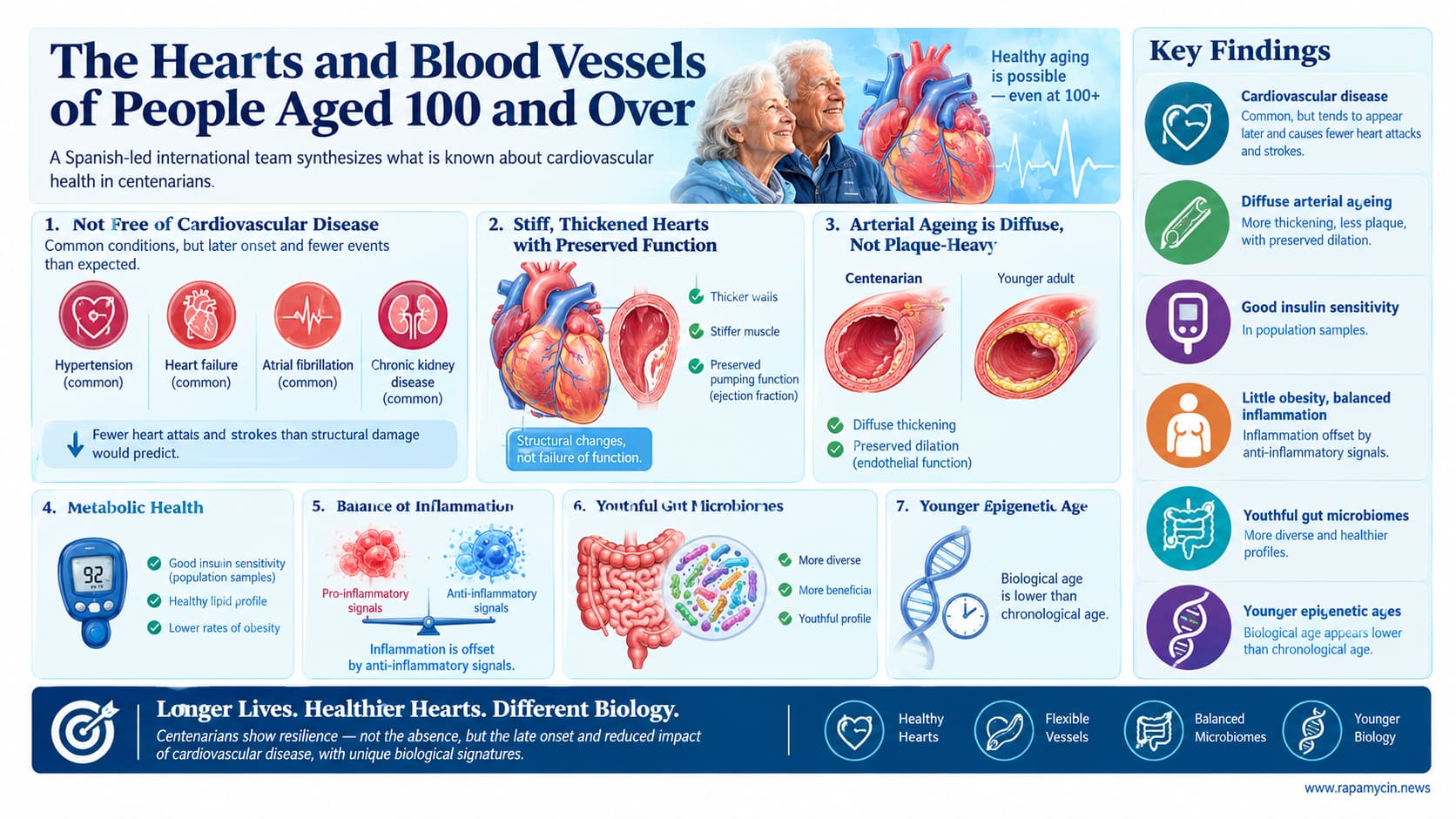
This Nature Reviews Cardiology article from a Spanish-led international team synthesizes what is known about the hearts and blood vessels of people aged 100 and over. Centenarians are not free of cardiovascular disease. Hypertension, heart failure, atrial fibrillation and chronic kidney disease are common, but these conditions tend to appear later in life and cause fewer heart attacks and strokes than their structural damage would predict. Centenarians typically show stiff, thickened hearts with preserved pumping function, diffuse rather than plaque-heavy arterial ageing, preserved blood vessel dilation, good insulin sensitivity in population samples, little obesity, inflammation offset by anti-inflammatory signals, youthful-looking gut microbiomes, and younger epigenetic ages. The authors frame this resilience as a mix of three processes: delayed pathology, adaptive compensation and survivorship selection.
People who live to 100 are often imagined as genetic lottery winners whose hearts simply never wore out. A new review in Nature Reviews Cardiology paints a more interesting picture: their hearts do age, sometimes heavily, but the damage rarely tips into catastrophe.
The authors, led from the Universidad Europea de Madrid, combed through cohort studies, autopsy series and molecular profiling of centenarians across Europe, Asia and the Americas. The first surprise is how common heart disease is at the extreme of life. Depending on the population, between roughly 40 and 74 percent of centenarians have high blood pressure, and up to half show signs of heart failure or ischaemic heart disease. What distinguishes them is timing. Swedish, Spanish, British and American data repeatedly show that centenarians develop strokes, heart attacks, atrial fibrillation and heart failure years later than people who die in their seventies or eighties.
When centenarians’ hearts are examined directly, the pattern resembles what cardiologists call heart failure with preserved ejection fraction. The heart muscle thickens and stiffens, and filling pressures rise, but the pump keeps working. Many people with these findings have no symptoms. Their arteries tend to thicken evenly rather than developing the focal plaques that rupture and cause heart attacks. Strikingly, plaque prevalence in one Japanese series peaked at 83 percent in people in their nineties, then fell to 60 percent in centenarians. Whether this reflects plaques shrinking or plaque-prone people dying earlier is unknown.
Several biological themes recur. Blood vessel linings in healthy Italian centenarians dilated as well as, or better than, those of younger adults. Insulin sensitivity in carefully selected centenarians matched that of people under 50. Inflammation is not absent; markers such as IL-6 remain elevated. But it is counterbalanced by higher anti-inflammatory signals, and a single bout of exercise lowered dozens of inflammatory proteins in people over 100. Their gut bacteria look more like those of young adults than those of 70-year-olds. Genetically, centenarians carry fewer damaging gene variants, and blood-forming stem cells in some semi-supercentenarians appear resistant to the age-related mutations that drive heart disease.
Lifestyle matters even late. In a large Chinese cohort, the healthiest habit profile was linked to 61 percent higher odds of reaching 100. Among people over 90, not smoking was associated with 17 percent lower mortality.
The review’s honesty is its strength. The authors stress that most evidence compares centenarians with younger people at a single point in time. That makes it impossible to tell whether centenarians age differently or whether people with unfavorable profiles simply died before reaching 100. Only one randomized trial has ever been run in centenarians, and it tested exercise, not drugs.
The clinical message is that standard cut-offs for blood pressure, kidney function and heart failure markers, built on younger patients, may mislead in the very old. The broader message for everyone else is that the goal may not be to prevent cardiovascular ageing entirely, but to delay it and build enough reserve to tolerate it.
Actionable Insights
This review describes people who already reached 100, so lessons for younger readers are indirect. Several still stand out.
Do not smoke. Even after age 90, abstinence was linked to 17 percent lower mortality. Yearly death risk at that age is high (roughly 15 to 35 percent), so this could mean about 3 to 6 fewer deaths per 100 people per year. [Confidence: Low-Medium]
Combine healthy habits. Regular exercise, a varied diet and no smoking together were associated with 61 percent higher odds of reaching 100, an odds ratio of 1.61, versus the least healthy profile. Each 1-point gain in a lifestyle score added about 7 percent to survival time even in centenarians.
Prioritize muscle over scale weight. Low lean mass is common in centenarians and strongly predicts death. Strength training improved function in a centenarian trial.
Favor variety in your diet. Diverse, plant-forward diets were associated with survival, but strict vegetarians were less likely to reach 100, a finding likely confounded and weak in its own right.
Do not over-apply centenarian rules. The relaxed blood pressure targets (130 to 150 mm Hg systolic) and hesitancy about statins discussed here apply to frail people over 85. They do not apply to a healthy 55-year-old, whose risk-factor control decades earlier is likely part of why centenarians get there.
Context and Source
- Paywalled Paper: Cardiovascular resilience in centenarians
- Lead institution: Universidad Europea de Madrid, with Hospital General Universitario Gregorio Marañón, CIBERFES, IIS La Fe, Lund University, University of Lisbon, UC Irvine, Lobachevsky State University and 2E Science
- Country: Spain (lead), with Portugal, Sweden, the USA, Russia and Italy
- Journal: Nature Reviews Cardiology, published online 26 October 2026
- Impact evaluation: The impact score of this journal is 50.2 (2025 Journal Impact Factor, Clarivate JCR 2026; five-year JIF 60.3), evaluated against a typical high-end range of 0-60+ for top general science, therefore this is an Elite impact journal.