Cellular Reset Without Cancer Risk: SRSF1 Splicing Factor Rewinds the Biological Clock

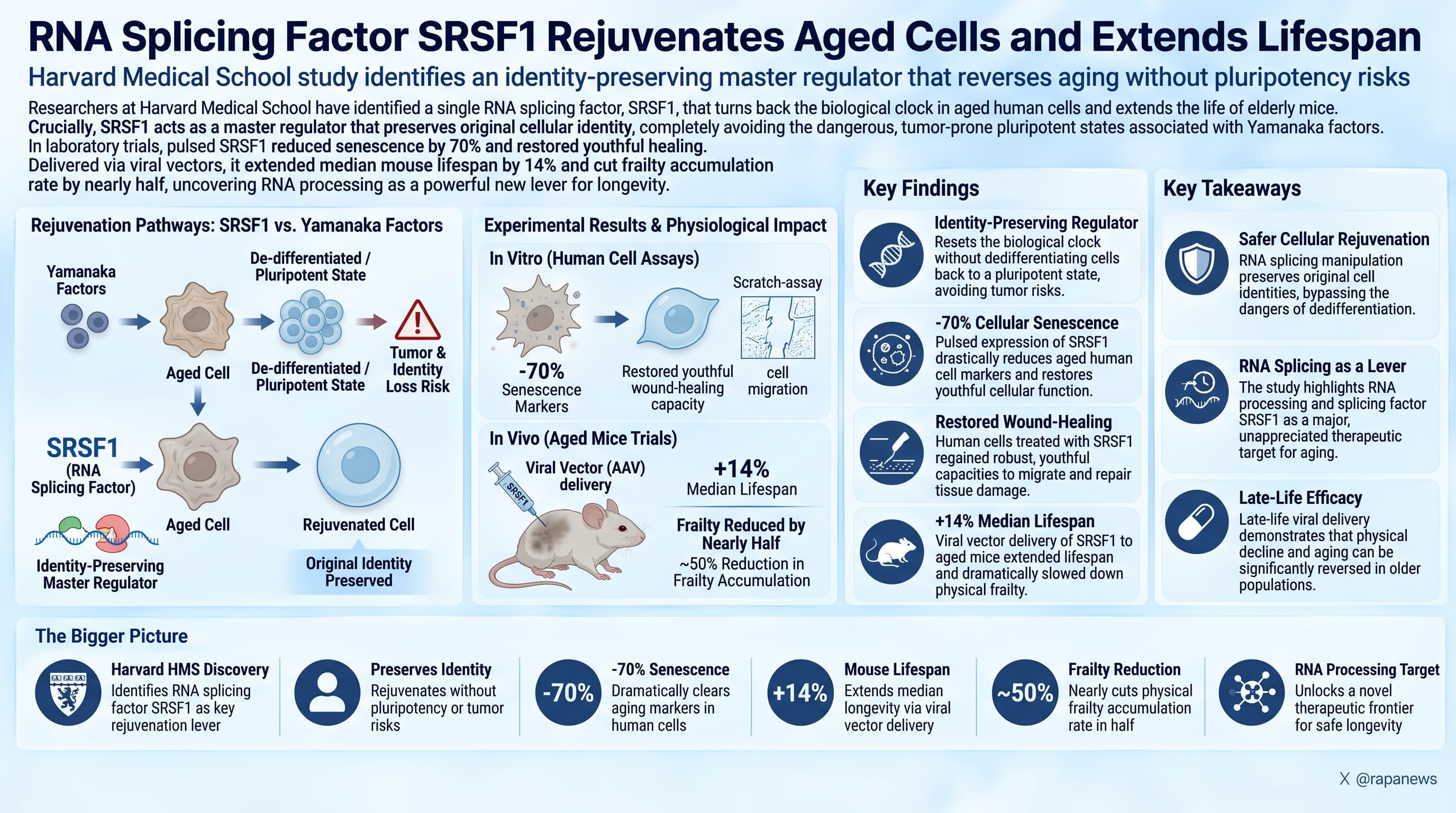
A team led by researchers at Harvard Medical School has identified a single RNA splicing factor, SRSF1, that can turn back the biological clock in aged human cells and extend the life of elderly mice without erasing cellular identity. Unlike canonical Yamanaka factors, which rejuvenate cells by stripping them down toward a dangerous pluripotent state capable of forming tumors, SRSF1 acts as an identity-preserving master regulator. In laboratory assays, pulsed expression of SRSF1 reduced cellular senescence markers by 70 percent and restored youthful wound-healing capacity. Delivered via viral vectors to aged mice, the treatment extended median lifespan by 14 percent and cut the rate of physical frailty accumulation by nearly half, revealing RNA processing as an unappreciated therapeutic lever for longevity.

For nearly two decades, the holy grail of cellular rejuvenation has been overshadowed by an intractable biological trade-off. When scientists use the Nobel-winning Yamanaka factors to roll back the cellular clock, they walk a razor edge between youthful vigor and uncontrolled growth. Push the cells slightly too far, and they forget what they are, shedding their specialized functions and seeding teratomas. Researchers have long suspected that rejuvenation and dedifferentiation are governed by distinct molecular machinery, but separating the two in living organisms has proved exceedingly difficult.

A multidisciplinary team at Harvard University and international collaborator centers tackled this impasse from the ground up by building an interpretable transcriptomic clock. By mapping gene expression patterns across primary human dermal fibroblasts aged 1 to 96 years, they isolated seven core cellular processes that dictate biological aging, including histone methylation, endoplasmic reticulum quality control, and cell junction organization. They subsequently built a targeted cDNA overexpression library of 89 candidate genes, prioritizing regulatory factors positioned at high-connectivity hubs within the human aging network.

Their screen uncovered SRSF1, a conserved serine and arginine-rich splicing factor whose endogenous levels drop steadily across adult human life. When introduced into fibroblasts collected from donors up to 79 years old, SRSF1 turned back the transcriptomic clock by an average of 18 years under continuous short-term induction, matching the rejuvenating power of Yamanaka factors. Crucially, single-cell analysis and surface marker profiling demonstrated that SRSF1-treated cells retained their structural morphology and specialized fibroblast identities. Pluripotency markers like OCT4, SOX2, and NANOG remained completely silent, confirming that somatic cell memory stayed intact.

The rejuvenation observed in the computer models translated directly into living biology. At the cellular level, SRSF1 expression suppressed inflammatory nuclear factor-kappa B signaling, lightened proteostatic stress burdens, and restored synthetic collagen output. In scratch-wound models, aged human skin cells treated with SRSF1 migrated to close open wounds 50 percent faster than control cells, whereas Yamanaka factor induction actually slowed healing due to loss of cell differentiation.

To test organismal benefits, the team administered inducible adeno-associated virus vectors delivering SRSF1 into 80-week-old female mice, an age roughly equivalent to a 60-year-old human. When pulsed periodically, SRSF1 extended median lifespan by 14 percent, adding over 100 days of life, and lengthened maximal lifespan by 11 percent. A Bayesian longitudinal analysis of physical frailty revealed that treated animals accumulated physiological deficits 44 percent slower than untreated controls, delaying the onset of significant frailty by four months. Further experiments in roundworms proved that this splicing factor is an essential downstream player in the longevity effects seen with mTOR inhibition, establishing RNA splicing as a fundamental driver of healthy aging across species.

Actionable Insights

For those looking to apply these findings immediately, there is an important caveat: SRSF1 is a regulatory gene product, not an over-the-counter dietary supplement. Nevertheless, this research provides vital practical lessons for evaluating longevity strategies today.

First, the real-world magnitude of the observed benefits is substantial. In elderly mice, pulsed SRSF1 expression produced a 14 percent extension in median lifespan (886 days versus 778 days) and an 11 percent increase in maximum lifespan. More importantly for healthspan, it generated a 44 percent reduction in the weekly rate of frailty accumulation, delaying clinical frailty onset by 123 days, roughly 10 to 12 years in human terms. In human cells, it eliminated 70 percent of senescence-associated beta-galactosidase activity, lowered inflammatory NF-kB activation by 33 percent, and cut wound-closure times in half.

Second, the study demonstrates that more is not better. When the authors delivered continuous, high-dose SRSF1 using a strong constitutive promoter, the therapeutic benefit vanished completely, failing to improve muscle regeneration or skin repair. In roundworms, uncontrolled expression halted embryonic development. This demonstrates that biohackers must abandon the concept that pushing a longevity pathway to its ceiling is beneficial. Dynamic, cyclical, or pulsed interventions, rather than continuous high-dose protocols, are essential when manipulating epigenetic and RNA-processing pathways.

Finally, the study confirms that SRSF1 acts downstream of mTOR inhibition. Genetic knockdown of the SRSF1 homolog in worms completely abolished the 30 percent lifespan extension conferred by mTOR disruption. This means existing lifestyle practices that downregulate mTORC1, including intermittent fasting, dietary protein restriction, and physician-supervised rapamycin regimens, likely depend in part on sustaining baseline RNA splicing fidelity. Supporting cellular proteostasis and metabolic flexibility remains the most immediate, accessible way to capture the biological benefits described in this paper.

Context and Source

  • Paywalled Paper: Transcriptomic reprogramming screen identifies SRSF1 as a regulator of aging
  • Institutions: Wyss Institute for Biologically Inspired Engineering at Harvard University; Department of Genetics, Harvard Medical School; Paul F. Glenn Center for Biology of Aging Research; Harvard T.H. Chan School of Public Health; Department of Biological Engineering, MIT; Computational Biology Group, CIC bioGUNE-BRTA; Luxembourg Centre for Systems Biomedicine, University of Luxembourg; Ikerbasque, Basque Foundation for Science.
  • Countries: United States, Spain, Luxembourg.
  • Journal Name: Nature Aging
  • Impact Evaluation: The impact score of this journal is 17.0, evaluated against a typical high-end range of 0–60+ for top general science, therefore this is a High impact journal.
2 Likes

This raises the question as to what is upstream (if anything) of SRSF1 or splicing in general. One answer is acetylation.

1 Like

https://www.nature.com/articles/s43587-026-01234-8

The author has tweeted here with a sharing link
https://x.com/amplesa/status/2111117746713014413

I can access the original via Oxford University and have used that for the analysis.

I think splicing is part of the issue of the changed phenotype of ageing, but also part of development. On the other hand I am not persuaded that intervening directly on splicing is a good way of mitigating ageing.

chatGPT(6max);

This paper provides persuasive evidence that SRSF1 can alter several age-associated cellular states, together with a promising but preliminary mouse lifespan result. It does not yet establish that SRSF1 restores splicing fidelity, broadly reverses ageing, or offers a safe therapeutic strategy.

Plesa, Jung and colleagues, Transcriptomic reprogramming screen identifies SRSF1 as a regulator of aging, Nature Aging, published 14 October 2026. Source: s43587-026-01234-8.pdfs43587-026-01234-8.pdf.

The researchers searched for genes that could shift aged cells towards younger gene-expression patterns.

They first developed a transcriptomic ageing clock using 292 genes covering seven biological processes, including histone methylation, protein translation and endoplasmic reticulum quality control. In 105 held-out samples, predicted age correlated with chronological age at 0.85, with a mean absolute error of approximately 9.6 years.

They then screened 89 candidate genes, plus controls, by increasing their expression in human skin fibroblasts from three older donors. SRSF1 emerged as the most consistent candidate, with further validation across six donor lines.

SRSF1 is an RNA-processing protein that helps determine how RNA is spliced into different transcript variants. Altering its abundance can therefore affect many downstream proteins and cellular processes.

Experiment or measurement Main finding Interpretation
Transcriptomic clock in aged fibroblasts Approximately 18 years lower predicted age after three days of induction A substantial shift in the clock score; these are model-derived years
Persistence after treatment withdrawal Approximately 11 years lower predicted age two days after a five-day induction Some short-term persistence, but durable rejuvenation was not established
Senescence-associated beta-galactosidase Approximately 70% lower activity across five donor lines Reduced senescence-associated marker activity
Inflammatory signalling Approximately 33% lower nuclear NF-kB signal across three donor lines Supports an anti-inflammatory effect
Proteasome activity Approximately 46% lower activity Authors interpret this as reduced proteostatic stress, but the interpretation is uncertain
Mouse lifespan Median increased from 778 to 886 days: 108 days, or 14% Significant survival improvement in one small experiment
Mouse frailty Estimated rate of frailty accumulation reduced by approximately 44% Encouraging functional evidence, based on longitudinal modelling
Worm longevity Reducing the SRSF1 counterpart partly suppressed longevity from reduced mTORC1 signalling Supports involvement in that longevity pathway

In the mouse survival experiment, nine control and ten treated female mice received viral vectors. Induction began at 606 days of age. The survival difference was statistically significant, with a log-rank P value of 0.0002.

SRSF1-treated fibroblasts largely retained their usual identity markers and morphology, without activating the pluripotency programme seen with Yamanaka factors. This is an attractive feature of the intervention.

Several secondary results were less convincing. Reductions in DNA-damage signalling and reactive oxygen species, and increased collagen production, did not reach statistical significance. DNA methylation clock responses were also mixed: two of three human donor lines showed reductions, while only one of three mouse liver clocks detected a significant benefit.

The principal novelty is the combination of a targeted screening method, a specific RNA-processing regulator and a mammalian survival experiment.

Three contributions stand out:

  • A biologically interpretable screening system. The clock separates age-associated expression changes into cellular processes, making the screen more informative than a single unexplained age score.
  • SRSF1 as a candidate for changing aged cellular states while preserving identity. The authors link its induction to coordinated changes in gene expression, RNA processing, inflammatory signalling and selected functional measurements.
  • Late-life mouse survival and frailty benefits. This is the most consequential extension beyond a cell-culture screening result.

However, the broader proposition that splicing regulation influences ageing is established. Earlier work showed that increasing the distinct splicing factor SFA-1 extended worm lifespan and that SFA-1 was required for dietary restriction and TORC1-related longevity. SFA-1 should not be confused with SRSF1. PMC

Likewise, a 2017 study associated small-molecule changes in splicing-factor expression with reversal of several senescence features in human fibroblasts. The present paper advances that research through its specific genetic intervention and mouse results. PubMed

The study has useful strengths, but several claims require narrower interpretation.

Its strengths include replication across independent human donors, testing both stable gene expression and transient mRNA delivery, and examining outcomes beyond an ageing clock. Mouse allocation was randomised, treatment groups were housed together, and animal assessments were blinded. These features make the results more credible.

The main limitations are:

  1. A younger transcriptomic score does not establish comprehensive rejuvenation.

    A protein that controls RNA processing can directly change the expression measurements used by the clock. A clock that predicts chronological age accurately is not automatically validated for measuring rejuvenation after such a perturbation.

    The paper itself illustrates this problem: some interventions improved functional measurements while producing apparently older transcriptomic scores. It also acknowledges that KAT7 partly distorted its own score because it was included in the predictor.

    The functional and survival experiments therefore carry more weight than the reported number of transcriptomic years reversed. Similarly, the histone-methylation module measures expression of relevant genes; it does not directly measure restored histone methylation.

  2. The evidence for reversing established cellular senescence is limited.

    The authors report that both control and treated fibroblasts remained capable of proliferation, and p16 did not change significantly. These cultures were therefore not a clear model of stable senescence with persistent cell-cycle arrest.

    Lower beta-galactosidase activity and reduced senescence-associated gene expression support a change in cellular state. They do not establish that genuinely arrested senescent cells were restored to normal function.

    The SASP evidence also comes principally from gene-expression signatures, rather than comprehensive measurements of secreted inflammatory proteins.

  3. Altered splicing is demonstrated; correction of defective splicing is not.

    SRSF1 changed transcript variants, including those affecting chromatin regulators and endoplasmic reticulum quality-control genes. These findings provide plausible mechanistic leads.

    However, the study does not establish which changes restore youthful isoforms, which merely create a different expression programme, or which are necessary for the functional benefits.

    A stronger causal test would identify specific beneficial isoforms and show that preventing their production abolishes the effect. Comparisons with SRSF1 variants lacking particular RNA-processing functions would also help separate splicing-dependent effects from its other activities.

  4. The mouse survival result needs independent replication.

    The survival curves separate substantially, so the finding should not be dismissed simply because the cohort is small. Nevertheless, there were only 19 animals, all female, from one strain, in one experiment. Effect sizes from such studies can be unstable and may depend on the particular causes of death in that cohort.

    The claim of increased maximum lifespan is especially provisional. It was based on post hoc analysis of the 90th percentile, with P = 0.030. Another recognised test of survival at that percentile, the Wang-Allison test, was not significant, with P = 0.47.

    The 44% frailty figure is a model-derived reduction in accumulation rate. It should not be interpreted as a demonstrated 44% reduction in every aspect of biological ageing.

  5. Exposure, durability and physiological mechanism remain uncertain.

    The viral vector predominantly targeted the liver, but additional Srsf1 transcripts were not robustly detected at the terminal sampling point. Without longitudinal expression measurements, the effective dose and duration are uncertain.

    Tissue analyses were also performed at different ages because treated mice generally survived longer. Although informative, these endpoint comparisons cannot cleanly distinguish primary treatment mechanisms from consequences of different survival trajectories and terminal conditions.

    Strong constitutive expression failed to improve wound repair or muscle regeneration. This supports caution about dosing, but the different expression systems do not isolate timing as the sole explanation.

  6. Reduced proteasome activity is an ambiguous result.

    The authors suggest that lower activity reflects less damaged protein requiring disposal. That is plausible, but reduced activity could also indicate reduced clearance capacity.

    Direct measurements of damaged-protein burden, aggregates and protein turnover would be needed to distinguish these possibilities. The finding should therefore be described as reduced proteasome activity, with improved proteostasis remaining an interpretation.

  7. Preserving cell identity does not establish cancer safety.

    This is a particularly relevant concern for SRSF1. Earlier experiments showed that modest overexpression could transform immortalised rodent fibroblasts and promote tumour formation. Other work found that increased SRSF1 promoted pancreatitis and accelerated pancreatic cancer driven by mutant KRAS. These are specific experimental contexts, but they make tissue and dose control central questions. PubMed

    The present study does not provide the tumour surveillance and pathology evidence needed to establish long-term safety. Retention of fibroblast identity addresses one concern associated with reprogramming; it does not resolve oncogenic risk.

  8. The direction of benefit is not consistent across species.

    An independent study published in January 2026 found that reducing Rbp1, the fly counterpart of SRSF1, extended lifespan, including when reduction began later in adult life. Springer Nature Link

    This does not invalidate the mouse findings. It does weaken a general claim that increasing SRSF1 is beneficial across organisms. My interpretation is that the relevant variable may be an appropriate balance of RNA-processing activities, dependent on tissue, age and physiological context.

    The worm experiment in the present paper is also a loss-of-function test: it shows that the counterpart contributes to a particular longevity pathway. It does not demonstrate that increasing it extends normal worm lifespan.

The disclosed patent applications and company interests make independent replication particularly valuable, although they do not themselves undermine the results.

For the mitochondrial citrate, acetyl-CoA, chromatin and splicing hypothesis, this paper is relevant chiefly at the RNA-processing end of the proposed pathway.

It strengthens the case that manipulating an RNA-processing regulator can influence age-associated phenotypes and potentially organismal survival. It does not test whether mitochondrial dysfunction or insufficient nuclear acetyl-CoA caused the original changes. Nor does it directly measure histone acetylation, transcriptional elongation or restoration of long-gene transcription.

The most informative follow-up would combine SRSF1 manipulation with measurements of nuclear acetyl-CoA, histone acetylation, transcription and specific age-disrupted isoforms. That could distinguish compensation for an upstream defect from correction of the defect itself.

1 Like

Thanks for posting this, John. I agree with some of your skepticism about directly manipulating splicing to mitigate aging. What I find really interesting is that SRSF1 may be a pretty significant regulatory nexus for proper protein expression and cellular maintenance. The connections to mTOR, autophagy, and proteostasis are especially intriguing. I also wonder whether better viral vectors and tissue-specific targeting might eventually yield more impressive longevity numbers in these animals, particularly if more tissues could benefit from carefully controlled SRSF1 overexpression.