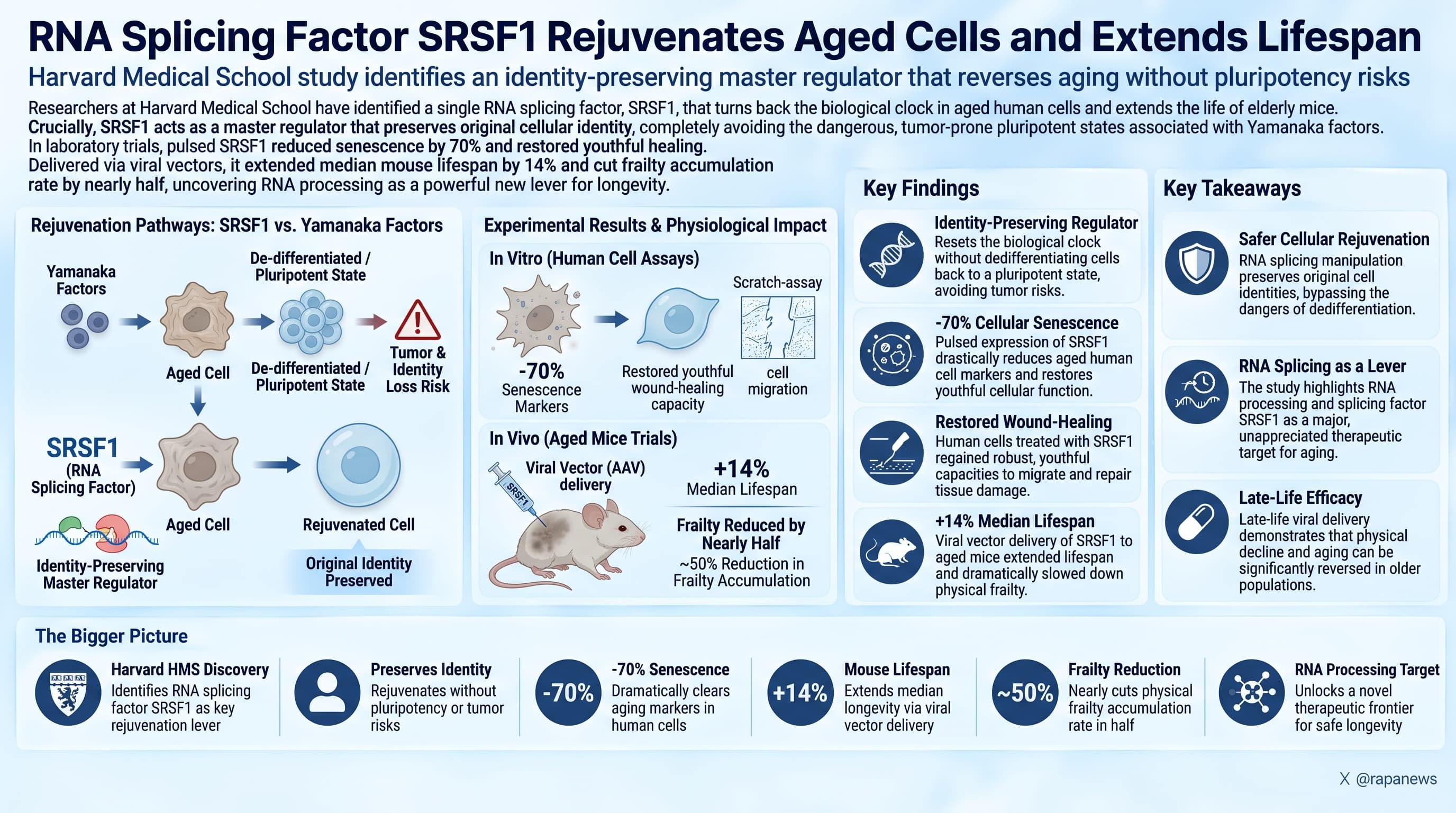
A team led by researchers at Harvard Medical School has identified a single RNA splicing factor, SRSF1, that can turn back the biological clock in aged human cells and extend the life of elderly mice without erasing cellular identity. Unlike canonical Yamanaka factors, which rejuvenate cells by stripping them down toward a dangerous pluripotent state capable of forming tumors, SRSF1 acts as an identity-preserving master regulator. In laboratory assays, pulsed expression of SRSF1 reduced cellular senescence markers by 70 percent and restored youthful wound-healing capacity. Delivered via viral vectors to aged mice, the treatment extended median lifespan by 14 percent and cut the rate of physical frailty accumulation by nearly half, revealing RNA processing as an unappreciated therapeutic lever for longevity.
For nearly two decades, the holy grail of cellular rejuvenation has been overshadowed by an intractable biological trade-off. When scientists use the Nobel-winning Yamanaka factors to roll back the cellular clock, they walk a razor edge between youthful vigor and uncontrolled growth. Push the cells slightly too far, and they forget what they are, shedding their specialized functions and seeding teratomas. Researchers have long suspected that rejuvenation and dedifferentiation are governed by distinct molecular machinery, but separating the two in living organisms has proved exceedingly difficult.
A multidisciplinary team at Harvard University and international collaborator centers tackled this impasse from the ground up by building an interpretable transcriptomic clock. By mapping gene expression patterns across primary human dermal fibroblasts aged 1 to 96 years, they isolated seven core cellular processes that dictate biological aging, including histone methylation, endoplasmic reticulum quality control, and cell junction organization. They subsequently built a targeted cDNA overexpression library of 89 candidate genes, prioritizing regulatory factors positioned at high-connectivity hubs within the human aging network.
Their screen uncovered SRSF1, a conserved serine and arginine-rich splicing factor whose endogenous levels drop steadily across adult human life. When introduced into fibroblasts collected from donors up to 79 years old, SRSF1 turned back the transcriptomic clock by an average of 18 years under continuous short-term induction, matching the rejuvenating power of Yamanaka factors. Crucially, single-cell analysis and surface marker profiling demonstrated that SRSF1-treated cells retained their structural morphology and specialized fibroblast identities. Pluripotency markers like OCT4, SOX2, and NANOG remained completely silent, confirming that somatic cell memory stayed intact.
The rejuvenation observed in the computer models translated directly into living biology. At the cellular level, SRSF1 expression suppressed inflammatory nuclear factor-kappa B signaling, lightened proteostatic stress burdens, and restored synthetic collagen output. In scratch-wound models, aged human skin cells treated with SRSF1 migrated to close open wounds 50 percent faster than control cells, whereas Yamanaka factor induction actually slowed healing due to loss of cell differentiation.
To test organismal benefits, the team administered inducible adeno-associated virus vectors delivering SRSF1 into 80-week-old female mice, an age roughly equivalent to a 60-year-old human. When pulsed periodically, SRSF1 extended median lifespan by 14 percent, adding over 100 days of life, and lengthened maximal lifespan by 11 percent. A Bayesian longitudinal analysis of physical frailty revealed that treated animals accumulated physiological deficits 44 percent slower than untreated controls, delaying the onset of significant frailty by four months. Further experiments in roundworms proved that this splicing factor is an essential downstream player in the longevity effects seen with mTOR inhibition, establishing RNA splicing as a fundamental driver of healthy aging across species.
Actionable Insights
For those looking to apply these findings immediately, there is an important caveat: SRSF1 is a regulatory gene product, not an over-the-counter dietary supplement. Nevertheless, this research provides vital practical lessons for evaluating longevity strategies today.
First, the real-world magnitude of the observed benefits is substantial. In elderly mice, pulsed SRSF1 expression produced a 14 percent extension in median lifespan (886 days versus 778 days) and an 11 percent increase in maximum lifespan. More importantly for healthspan, it generated a 44 percent reduction in the weekly rate of frailty accumulation, delaying clinical frailty onset by 123 days, roughly 10 to 12 years in human terms. In human cells, it eliminated 70 percent of senescence-associated beta-galactosidase activity, lowered inflammatory NF-kB activation by 33 percent, and cut wound-closure times in half.
Second, the study demonstrates that more is not better. When the authors delivered continuous, high-dose SRSF1 using a strong constitutive promoter, the therapeutic benefit vanished completely, failing to improve muscle regeneration or skin repair. In roundworms, uncontrolled expression halted embryonic development. This demonstrates that biohackers must abandon the concept that pushing a longevity pathway to its ceiling is beneficial. Dynamic, cyclical, or pulsed interventions, rather than continuous high-dose protocols, are essential when manipulating epigenetic and RNA-processing pathways.
Finally, the study confirms that SRSF1 acts downstream of mTOR inhibition. Genetic knockdown of the SRSF1 homolog in worms completely abolished the 30 percent lifespan extension conferred by mTOR disruption. This means existing lifestyle practices that downregulate mTORC1, including intermittent fasting, dietary protein restriction, and physician-supervised rapamycin regimens, likely depend in part on sustaining baseline RNA splicing fidelity. Supporting cellular proteostasis and metabolic flexibility remains the most immediate, accessible way to capture the biological benefits described in this paper.
Context and Source
- Paywalled Paper: Transcriptomic reprogramming screen identifies SRSF1 as a regulator of aging
- Institutions: Wyss Institute for Biologically Inspired Engineering at Harvard University; Department of Genetics, Harvard Medical School; Paul F. Glenn Center for Biology of Aging Research; Harvard T.H. Chan School of Public Health; Department of Biological Engineering, MIT; Computational Biology Group, CIC bioGUNE-BRTA; Luxembourg Centre for Systems Biomedicine, University of Luxembourg; Ikerbasque, Basque Foundation for Science.
- Countries: United States, Spain, Luxembourg.
- Journal Name: Nature Aging
- Impact Evaluation: The impact score of this journal is 17.0, evaluated against a typical high-end range of 0–60+ for top general science, therefore this is a High impact journal.