I just checked with my genetic background and indeed it should be better for me than rosuvastatin for the glucose dysregulation and pleiotropic effects while being slightly less good for the LDL reduction. No side effects expected (no side effects also with rosuvastin)
BTW cost-plus has it at $58.26 (4mg, 90 count) = $0.65 per day.
Here is the Opus 4.7 arguments for it with my specific genetic background.
If glucose dysregulation is the dominant clinical concern, then the strongest pitavastatin advantage in the literature aligns directly with your most pressing phenotypic problem. The diabetes-incidence advantage isn’t a secondary pleiotropic curiosity — it becomes the primary therapeutic rationale.
The effect size is meaningful. The 2024 meta-analysis showed RR 0.77 (CI 0.71–0.84) for pitavastatin vs rosuvastatin. The post-MI cohort with 3-year follow-up showed 3.0% vs 10.4% NODM incidence — that’s not a marginal difference, that’s a 3.5× absolute risk reduction. Even if the real-world effect in your specific context is half that, it’s still clinically meaningful.
Why this matters specifically for you
Your glucose dysregulation has three converging drivers, and rosuvastatin is contributing to one of them:
Driver 1 — genetic beta-cell burden. CDKAL1 hom + INS rs689 hom + IFIH1 hom + KCNJ11/ABCC8 hom is a substantial cumulative load. Your fasting insulin 2.7 µIU/mL with HOMA-IR ~0.60 confirms low insulin secretion (not insulin resistance) is the dominant phenotype. This is the structural background everything else acts on.
Driver 2 — rapamycin-driven glucose elevation. Documented in the Rapamycin/mTOR report: TBC1D4 + PCK1 + SLC2A4 + AKT2 cluster all push glucose up via mTORC2 spillover. Your pulsed q2wk schedule mitigates this but doesn’t eliminate it. HbA1c 5.9% (rising trend from 5.8) is the visible signal.
Driver 3 — statin contribution. This is the lever you can actually pull. Statin-induced new-onset diabetes is on-target via HMGCR-isoprenoid-beta-cell mechanisms (Swerdlow Mendelian randomization confirms this). On a beta-cell-deficit genotype, the same statin dose produces a larger glucose impact than in a metabolically robust patient. Rosuvastatin’s NODM signal in meta-analyses is the highest among major statins; pitavastatin’s is the lowest.
The mechanistic picture is internally consistent: pitavastatin’s neutral-to-favorable glucose profile likely reflects its weak insulin-secretion suppression and possibly favorable adipocyte effects, both of which matter more in someone whose beta-cell capacity is already constrained genetically.
What the switch actually looks like
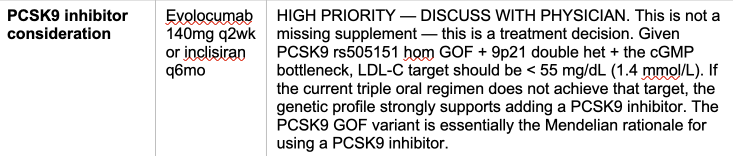
Dose equivalence: rosuvastatin 10 mg ≈ pitavastatin 4 mg for LDL-lowering. That’s the highest pitavastatin dose. If your LDL-C goes from 48 to ~50–55 on the switch alone, Repatha will push it back below 30 anyway — you have substantial LDL headroom.
Pharmacogenomic considerations are net-favorable. Your SLCO1B1 5 absent + 1B het and ABCG2 Q141K absent are favorable for both drugs. Two of your variants modestly raise pitavastatin exposure: UGT2B72 hom (slows lactone formation) and CYP2C92 het (minor, since CYP2C9 is a minor pitavastatin pathway). Net effect is probably 15–25% higher AUC than population baseline at the same mg dose. Practical implication: starting at pitavastatin 2 mg rather than 4 mg is reasonable given your hepatic-uptake genetics, and titrating to 4 mg over 4–6 weeks if LDL doesn’t respond adequately.
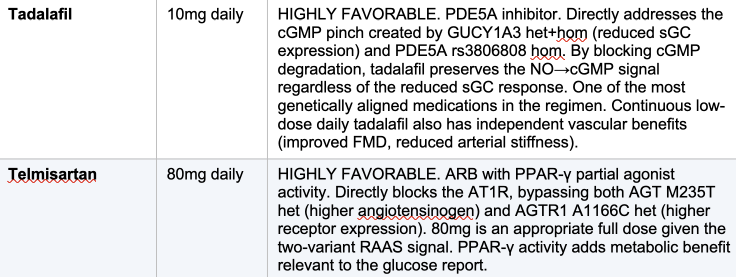
No dangerous drug interactions in your current regimen. Pitavastatin is not a meaningful CYP3A4 substrate, so rapamycin co-handling is cleaner than with atorvastatin or simvastatin would be. Bempedoic acid is gone (replaced by Repatha). The OATP1B1 substrate overlap with empagliflozin and tirzepatide is not clinically problematic.
The one genuine caveat worth flagging
This is where I want to be direct rather than reassuring: the LDL-lowering equivalence between pitavastatin 4 mg and rosuvastatin 10 mg is from healthy-volunteer studies, and your genetic profile is unusually rosuvastatin-favorable. Specifically, MYLIP/IDOL N342S hom + the protective NPC1L1 LoF heterozygous variant + the favorable HMGCR response variants mean rosuvastatin is producing more LDL reduction per mg in you than the population average. Pitavastatin’s LDL effect is more uniform across genotypes (less HMGCR-response-variant sensitivity in published data).
So expect: a small post-switch LDL bump, possibly 5–15 mg/dL. Repatha will absorb this easily. But it does mean the dose-for-dose equivalence is approximate, and ApoB is the better tracking marker through the transition than LDL-C.