Following @CronosTempi suggestion, here is a deep dive into the BBB genetic pathways.
As a lot of those pathways have already been studied in previous deep dive, this is framed as an addendum to the Alzheimer/Dementia report. The diagram below gives cross-references to the pathway reference suite preserved (Glycation §2.1, Dementia §4.3 / §2.4 / §2.8 / §4.8, Endothelial, Homocysteine, BBB Addendum).
I’m continuing my deep dives into the genetic pathways to get actionable insights as the previous ones have been incredible precise and useful. This time I’m looking at blood brain barrier genetic pathways.
Here is the general description of the pathways and their variants. I will put the finding about my own genome below it as an example of what useful and actionable insights you can get.
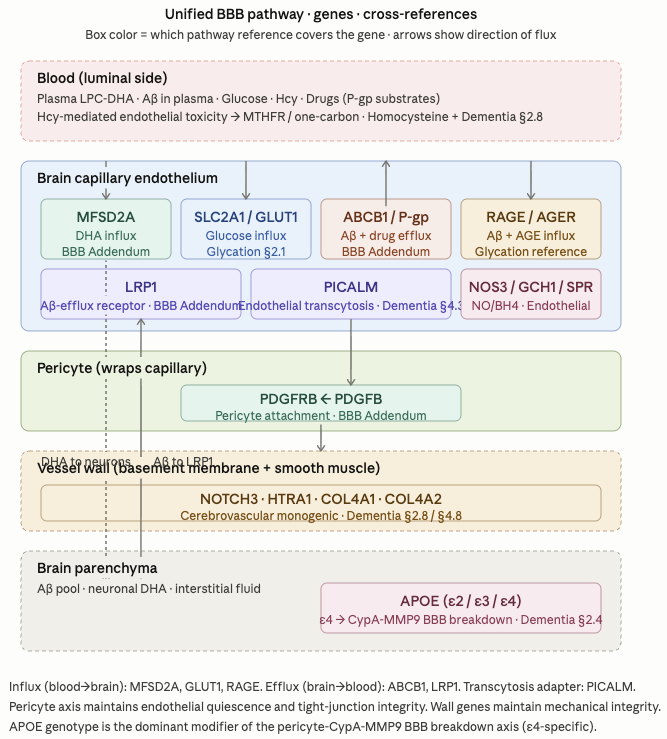
BBB_Addendum_Pathway_Reference.pdf (211.9 KB)
The pdf report above is valid for everybody but here is the summary of the findings I get when I apply it to my own genome.
For once there is nothing detrimental here which is good.
The addendum does not change any of the existing recommendations for you from the Dementia, Endothelial, or Homocysteine reports.
Net BBB picture: Mostly clean. Favorable APOE ε3/ε3 backdrop, favorable ABCB1 GCC/GCC haplotype, neutral LRP1 and MFSD2A, mild uncertain-weight pericyte-axis findings. Combined with clean cerebrovascular monogenic genes (NOTCH3, HTRA1, COL4A1/2 from the Dementia report), the integrated BBB-genetic risk is approximately population-baseline, and the dominant practical levers remain modifiable risk factors (BP, glucose, lipids, DHA intake, sleep, exercise) already addressed by the current regimen.