Sorry Beth, just to clarify, lowering lipids will not directly help lower CRP.
The overall purpose is to reduce cardiovascular risk. That risk is made up from a bunch of factors, including lipids and inflammation. So the paper is saying that if you can’t control the inflammation (i.e. CRP won’t go down), you can be more aggressive with the lipids to reduce the overall risk.
These numbers are made up, but for example; maybe CRP of 3.5 and LDL-C of 30mg/dl is equal to CRP of 0.5 and LDL-C of 80mg/dl in terms of overall cardiac risk.
I cannot tolerate statins repatha inclisiran bempedoic. severe glute pain. Cannot walk or sleep. CAC 166 and LDL 5.5 / Anyone have this problem and have had relief with a medication/supplement? Someone suggested to try tadalafil, then try rapa, then try ss31. Any strategies?
Thank you for this!!! Good ol’ SS-31 strikes again!!
Btw… you asked if it was giving me extra energy and I was non committal.
After skipping a couple doses, today I gave myself a double dose (aprox 9mg) …coincidence or not, I had more energy and motivation today than I’ve had in forever. My husband even said what has gotten into you. Too soon to be sure it’s related, but days like today pretty much don’t happen.
@Satchel so sorry to hear this and hope someone has some good ideas for you!
EDIT: I skipped a dose and then tried a double dose again of SS-31. Lighting did not strike twice, so unfortunately it seems SS-31 was not the cause of my jackrabbit energy that day.
Just to be clear - you’ve tried all those medications and they all have the same side effect on you - severe glute pain?
You may want to look at Ezetimibe (Zetia) - another cholesterol-lowering medication.
You mentioned your LDL is 5.5. , Is that a typo, or your actual LDL-C measure in mmol/L? If its real - you must be outside the USA, which is fine, I just wanted to make sure.
I have read that: According to the 2019 European Society of Cardiology (ESC) guidelines, optimal, lower-risk ranges are <3.0 mmol/L, while for very-high-risk patients, the target is reduced to <1.4 mmol/L ( <55 mg/dL)
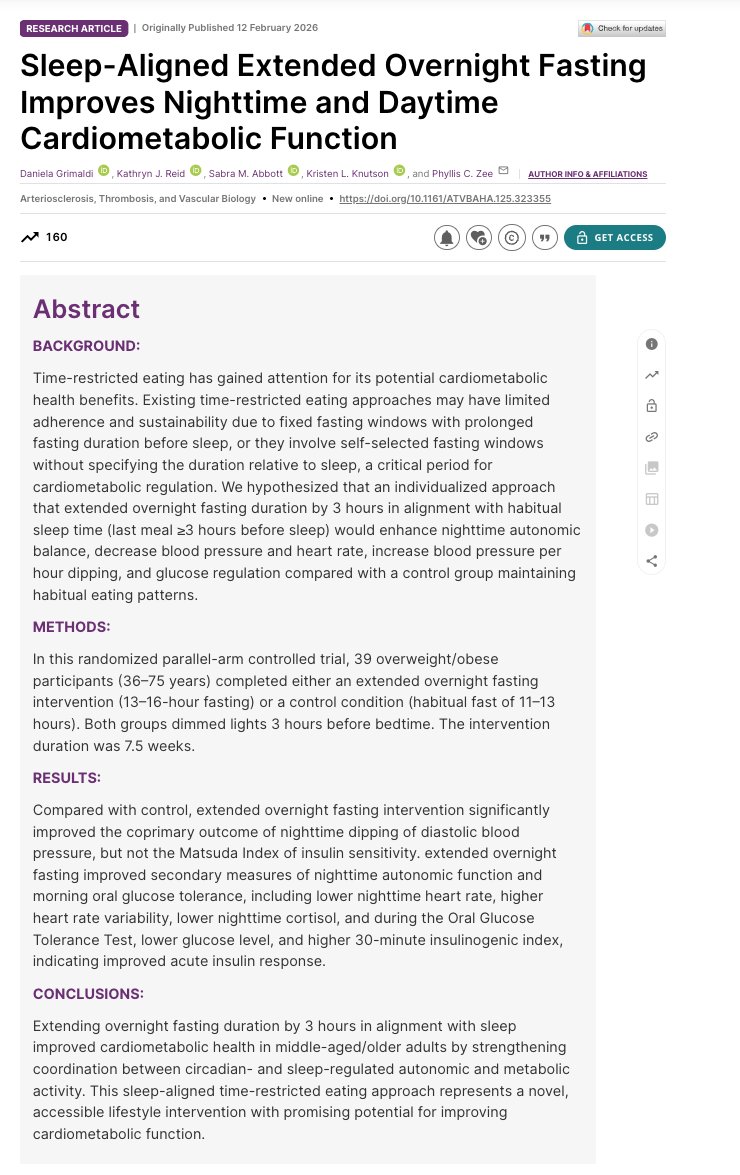
Having your last meal at least 3 hours before bed improves blood pressure, heart health, and even blood glucose regulation. Participants who stopped eating 3+ hours before sleep (extending their overnight fast to 13-16 hours) improved overnight diastolic blood pressure dipping by 3.5% and overnight heart rate by 5%. They also had a higher (better) HRV, lower cortisol, and improved insulin sensitivity. That was without changing what or how much they ate! This is one strategy I’ve advocated for years, so it’s promising to see further support from a controlled study on “sleep-aligned” eating patterns. What you eat matters. But so does when.
Title: Sleep-Aligned Extended Overnight Fasting Improves Nighttime and Daytime Cardiometabolic Function
Authors: Daniela Grimaldi, Kathryn J. Reid, Sabra M. Abbott, Kristen L. Knutson, and Phyllis C. Zee Journal:Arteriosclerosis, Thrombosis, and Vascular Biology (ATVB) Publication Date: February 12, 2026 DOI:10.1161/ATVBAHA.125.323355
Only maybe 20% to 30% – not enough to significantly lower risk in those of us with high Lp(a) and therefore not approved or even being investigated as a treatment. The upcoming drugs lower it approx 90% or more.
Clinically low levels of Lipoprotein(a) [Lp(a)]—typically defined as <10 mg/dL or <25 nmol/L—are overwhelmingly established as cardioprotective and beneficial for human longevity due to a drastically reduced risk of atherosclerotic cardiovascular disease (ASCVD) and aortic stenosis,
That statement from Gemini Pro is kind of confusing – makes it sound like having some (very low level) is cardioprotective when I think it means to say that the absence of Lp(a) is what is beneficial.
Actually I think there is some small protective benefit of Lp(a) as a protection against infection but over around 30mg/dl it is bad --causes inflammation in the blood vessels.
My Lp (a) is 9. Will Repatha make it even lower? And if it’s that low why it didn’t protect me from having a high calcium score? I suspect that either my Lp (a) or CAS were calculated incorrectly.
Having a low Lp(a) doesn’t guarantee a low calcium score if your LDL particles have been elevated much or most of your life and/or if you’ve had some chronic low grade inflammation. Things would likely be considerably worse if you also had high Lp(a).
You have side effects from those 3 different classes of medication? I don’t know how to explain that. Are you being prescribed these by a doctor?
LDL 5.5 = ~200mg/dl, which is very high. And you have a positive calcium score. That means you already have established cardiovascular disease. You’ve built plaque, and it’s been going for long enough to go through cycles of repair and calcification. And with LDL of 5.5 mmol/L, you will be building more plaque as time goes on.
How old are you?
Tadalafil may be cardioprotective by lowering cardiac stress, but it doesn’t affect lipids. Rapamycin may be protective by lowering inflammation, but it generally makes lipids worse.
Mine wasn’t affected at all by Repatha. I think it’s quite unreliable as an Lp(a)-lowering agent.
The CAC might have been worse if your Lp(a) was higher. And of course there are contributions from ApoB (LDL-C etc), and others. Atherosclerosis is generally “area under the curve” thing, where the longer you went with higher lipids and other risk factors, the higher the CAC will go, with some lag time. You can roughly imagine that 10 years at 200mg/dl is equivalent to 20 years at 100mg/dl in terms of total accumulation.
I’m currently experimenting with oral enobosarm (ostarine) 6mg daily, which has completely normalized my Lp(a). LDL and ApoB are extremely low thanks to modern pharma and liver enzymes are normal, courtesy of TUDCA. I’m going with the theory that any risk from low HDL is more than offset by the 75% drop in Lp(a) and my very low LDL/ApoB. Next I’ll lower the enobosarm dose to 3mg and retest Lp(a) to see what the lowest effective dose is.
To be clear, enobosarm is still experimental (in stage 3 clinical trials) and is not approved for any use at this point and comes with risks of serious side effects such as (but not limited to) suppression of endogenous testosterone/estrogen synthesis. Its effect on Lp(a) has never been tested in clinical trials.
Note: I posted a few months back that it was IGF1-LR3 that was responsible for my decreased Lp(a), but I had no idea at the time that the enobosarm I was also taking off/on could have such a dramatic effect on Lp(a). Stopping enobosarm while continuing LR3 caused my Lp(a) to climb back to 175. Stopping LR3 and restarting enobosarm quickly dropped Lp(a) back to 50.