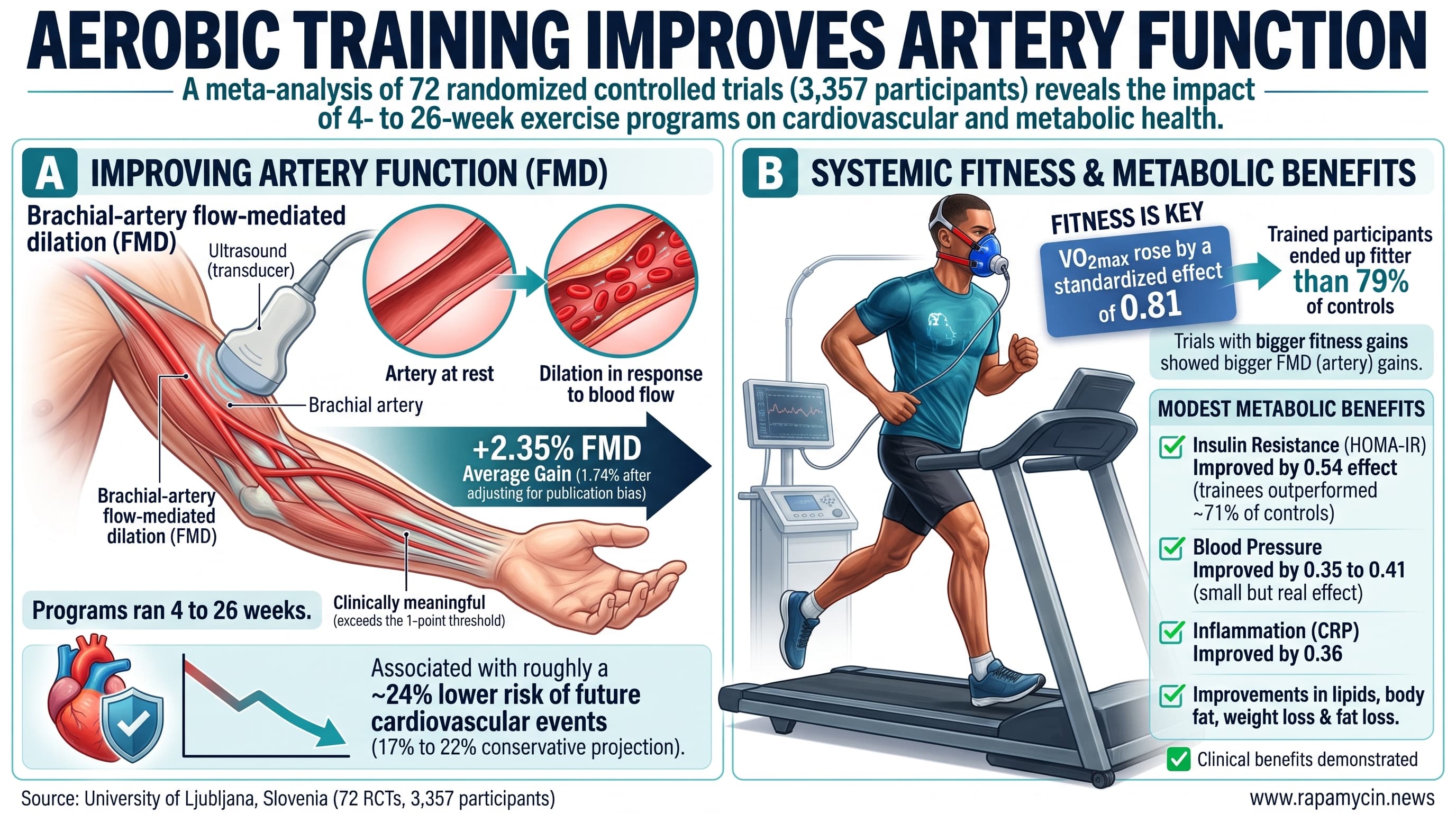
Researchers from the University of Ljubljana in Slovenia pooled 72 randomized controlled trials, with 3,357 participants, that compared aerobic training against no exercise. They focused on brachial-artery flow-mediated dilation (FMD), an ultrasound test of how well an artery widens in response to increased blood flow. Programs lasting 4 to 26 weeks raised FMD by 2.35 percentage points on average. After adjusting for likely missing small negative studies, the gain was 1.74 points. The authors translate this, using observational data, into a roughly 24 percent lower risk of future cardiovascular events. Exercise also improved fitness, blood pressure, insulin resistance, lipids, CRP and body fat. Trials that produced more weight loss, fat loss, blood pressure reduction or VO2max gain tended to show larger FMD gains.
The lining of your blood vessels, the endothelium, is easy to overlook. It is a single layer of cells, yet it decides how readily arteries relax, how sticky their walls become and how they respond to blood pressure. When it falters, heart attacks and strokes tend to follow years later. A new meta-analysis asks how much aerobic exercise can do for this lining, and which other changes travel with the improvement.
The team, from the University of Ljubljana, gathered 72 randomized trials in which adults did aerobic training such as walking, cycling, running or interval sessions, while a comparison group did not. Every trial measured flow-mediated dilation. In this test, a blood pressure cuff briefly cuts off blood flow to the forearm, and ultrasound then records how much the brachial artery widens once the cuff is released. A bigger widening means a healthier endothelium.
Across the trials, exercise raised FMD by about 2.4 percentage points relative to no exercise. That may sound small, but typical values in middle-aged adults sit only in the mid-single digits, so it is a meaningful shift. Earlier observational studies link each one-point rise in FMD to roughly 8 to 13 percent fewer cardiovascular events. On that basis, the authors estimate a risk reduction of about 24%
Exercise did more than that. Fitness, measured as VO2max, rose substantially. Blood pressure, insulin resistance, blood sugar, triglycerides, LDL cholesterol and CRP all fell modestly. Body fat dropped even though none of these trials involved dieting, although body weight barely moved. Blood markers of nitric oxide, the main molecule behind artery relaxation, rose sharply.
The novel part is the meta-regression, which tests whether trials with bigger changes in one measure also showed bigger changes in FMD. The answer was yes for weight loss, fat loss, blood pressure reduction and fitness gains. The authors read this as evidence that these adaptations work together, with body composition leading the way.
That interpretation needs care. The comparison is between trials, not within individuals. Trials where people trained harder or more consistently would be expected to improve on everything at once, so the links may reflect training dose more than any specific pathway.
The pooled numbers carry other caveats. Results differed enormously between trials, with about 90 percent of the variation reflecting real differences rather than chance. Small positive trials appear overrepresented. The largest trials tended to show the smallest effects. Several studies contributed multiple exercise groups compared against the same control group, which can make the evidence look more precise than it is. Most participants already had cardiovascular or metabolic disease, and only 17 trials studied healthy people.
Still, the core message is solid and familiar. Aerobic training reliably improves the function of your arteries, and the people who gain the most fitness and lose the most fat are likely to see the largest benefit.
Actionable Insights
- Aerobic training improves artery function. The average gain in FMD was 2.35 percentage points, or about 1.7 after correcting for publication bias. Both figures exceed the 1-point threshold usually considered clinically meaningful. Programs ran 4 to 26 weeks.
- Fitness is the most useful thing to track. VO2max rose by a standardized effect of 0.81, meaning the average trained participant ended up fitter than about 79 percent of controls. Trials with bigger fitness gains also showed bigger FMD gains.
- Expect modest metabolic benefits. Insulin resistance (HOMA-IR) improved by an effect of 0.54, so the typical trainee did better than about 71 percent of controls. Blood pressure improved by about 0.35 to 0.41, a small but real effect, and CRP by 0.36.
- Exercise alone barely changes body weight, with an effect of minus 0.13, which is trivial. Body fat percentage fell more, by 0.36. Trials with more fat loss saw larger FMD gains, so pairing training with fat loss is sensible.
- The roughly 24 percent risk reduction is a projection from observational data. A more conservative estimate is around 17 to 22 percent, and it has not been confirmed with actual event outcomes.
Bottom line for biohackers
Aerobic training improving endothelial function is one of the most robust findings in exercise physiology, and this review confirms it with a realistic gain of about 1.7 to 2.4 FMD points. Practically, measure what you can track reliably at home or in a clinic: VO2max or a validated estimate, blood pressure, waist circumference or body fat, and fasting insulin or HOMA-IR. Push VO2max, since it is the lever most consistently tied to cardiovascular and all-cause outcomes elsewhere.
Context and Source
- Open Access Paper: Impact of Aerobic Exercise on Endothelial Function and Other Cardiovascular Disease Markers in Health and Disease: A Systematic Review and Meta-analysis with Meta-regression of Randomized Controlled Trials
- Institutions: Faculty of Sport, University of Ljubljana, with the Science and Research Centre Koper (Slovenia) and Masaryk University, Brno (Czech Republic)
- Country: Slovenia
- Journal: Sports Medicine - Open (Springer Nature), 2026, 12:150
- Impact evaluation: The impact score of this journal is 5.9 (2025 Journal Impact Factor; Q1 in its JCR category), evaluated against a typical high-end range of 0 to 60+ for top general science, therefore this is a Medium impact journal. Within sports and exercise science it is a respected first-quartile title