People with BD have a certain ACM, as do people with other morbidities. It’s very hard to group them together with all SGLT2i and try to compare ACMs across all these disparate cohorts.
And also, if you look at ACM itself, what is that composed of? They try to separate cause specific to BD, such as suicide, death from unnatural causes etc., but really we should just look at deaths from “natural causes”, here given as - (RR = 1.90, 95% CI: 1.75–2.06, k = 17).
Use of Sodium-glucose cotransporter 2 (SGLT 2) inhibitor is associated with reduced emergency room visits and hospitalizations in patients with Chronic obstructive pulmonary disease (COPD) and type 2 Diabetes Mellitus
SGLT-2 Inhibitors and the Risk of Chronic Obstructive Pulmonary Disease Exacerbations and Mortality in Chronic Obstructive Pulmonary Disease Patients
The clinical effectiveness of sodium-glucose co-transporter-2 inhibitors on prognosis of patients with chronic obstructive pulmonary disease and diabetes
Sodium–Glucose Cotransporter 2 Inhibitor Use and Risk of Liver-Related Events in Patients With Type 2 Diabetes: A Meta-analysis of Observational Cohort Studies
New paper (pay walled), mouse model, apparently shows damage and scarring of distal renal tubules due to the high concentration of glucose being excreted from the kidneys.
Could this be because to date they’ve only been looking at proximal as opposed to distal renal tubules, and/or overall renal function as opposed to zooming in specifically on the distal tubules?
Holly molly are these convos ever scientific where I have no clue what to make of them. I started Empa about year ago on suggestions from these boards and do 1/2 pill =12.5mg per day. Are we still in agreement that SGLT2i are beneficial or should I damn stop all the meds and never look at anything until I’m in my death bed LOL. Btw, I started it more so for benefits to other organs (and hopefully as synergetic to rapa) than to lower my glucose which is a bit high mid 90’s but still within normal range.
@jnorm@Davin8r: it’s true that most papers looked at proximal rather than distal tubules but some did:
SGLT2 inhibitors mitigate kidney tubular metabolic and mTORC1 perturbations in youth-onset type 2 diabetes 2023 (Michigan, Ann Arbor): “However, transcriptional alterations with SGLT2i treatment were seen across nephron segments, particularly in the distal nephron. […] Decreased levels of phosphorylated S6 protein in proximal and distal tubules in T2Di(+) patients confirmed changes in mTORC1 pathway activity. […] Conversely, no differences in fractional interstitial area were observed among the 3 groups, suggesting that transcriptomic differences observed in PT are not directly related to observable interstitial changes.” No signs of distal injury/fibrosis.
One point in favor of the 2026 paper: “This study is the first to show that acute empagliflozin treatment induces senescence in distal tubular cells of wild-type mice, but not in diabetic mice. Additionally, the long-term effects of empagliflozin promote senescence, EMT, and renal interstitial fibrosis in the distal tubules of both wild-type and diabetic mice.”
Maybe previous papers only looked at diabetic mice and therefore missed “senescence in distal tubular cells”? However, the second sentence applies to both types. Also, ITP found life extension in wild type with canagliflozin and a Chinese paper replicated the result with empagliflozin (but smaller effect).
It’s also surprising that the 2026 paper did not cite or discuss the three papers above. When you make such an extraordinary claim vs all previous literature, you should discuss it a bit, shouldn’t you?
What about ARBs used either alone or in conjunction with SGLT2i wrt. distal tubular cell impact? I haven’t performed any extensive literature search, but I might try later, time allowing. A very general look at kidneys:
Observations of the Effects of Angiotensin II Receptor Blocker on Angiotensin II-Induced Morphological and Mechanical Changes in Renal Tubular Epithelial Cells Using Atomic Force Microscopy
“Renal fibrosis, characterized by increased extracellular matrix (ECM) accumulation on the kidney parenchyma, is the final common manifestation of chronic kidney disease (CKD), regardless of the primary causes [1, 2]. Previous studies reported that renal tubular epithelial cells (TECs) played an important role in the development of renal tubulointerstitial fibrosis [3]. TECs release chemokines and profibrogenic cytokines and undergo epithelial to mesenchymal transition (EMT) in pathological conditions [4–6]. Therefore, understanding the changes of TECs are important for the prevention and effective treatment of renal fibrosis.”
SGLT2i use was associated with lower risk of LOE (HR = .55, 95% CI = .44–.68), status epilepticus (HR = .38, 95% CI = .21–.69), and antiseizure medication initiation (HR = .63, 95% CI = .58–.69)
Effect of Dapagliflozin on the Functioning of Rat Liver Mitochondria In Vitro 2021: “Dapagliflozin in concentrations of 10-20 μM had no effect on the parameters of respiration and oxidative phosphorylation of rat liver mitochondria. Increasing dapagliflozin concentration to 50 μM led to a significant inhibition of mitochondrial respiration in states 3 and 3UDNP.”
“Dapagliflozin in concentrations of 10-20 μM had no effect on the parameters of respiration and oxidative phosphorylation of rat liver mitochondria. Increasing dapagliflozin concentration to 50 μM led to a significant inhibition of mitochondrial respiration in states 3 and 3UDNP.”
So I asked an LLM
The 10-20M range mentioned in your query is approximately 25 to 50times higher than the peak concentration found in the blood of a human taking a standard 10mg dose.
Based on that, the paper finding effects at 50M doesn’t sound alarming. Unfortunately I have no way of validating the LLMs output.
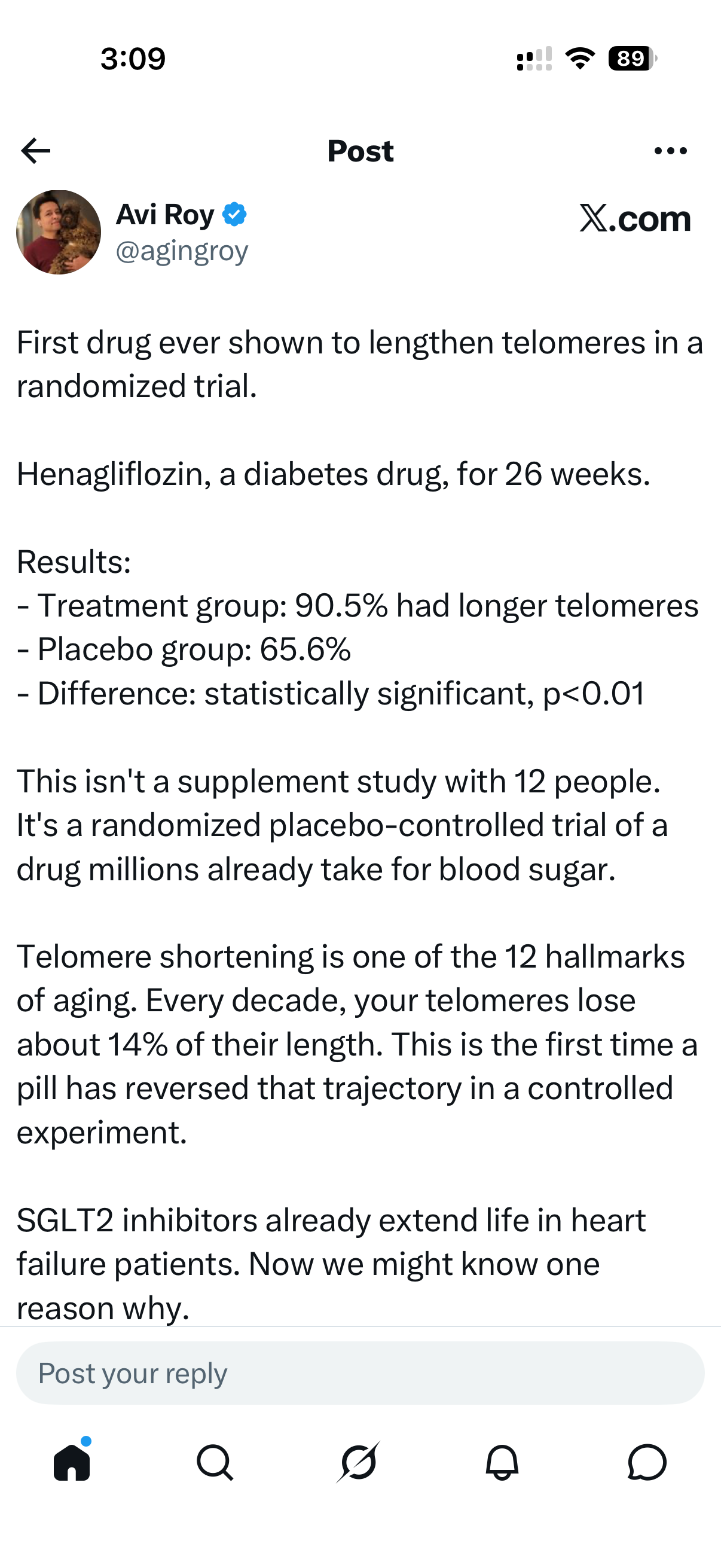
Henagliflozin (a newer, primarily Chinese-marketed SGLT2i) and dapagliflozin (a widely established global SGLT2i) provide similar HbA1c reduction and weight loss in type 2 diabetes. Both agents improve glycemic stability; however, dapagliflozin has broader, extensive evidence for reducing heart failure hospitalizations, while henagliflozin may have a higher rate of adverse effects at certain doses. [1, 2, 3, 4, 5]