Another negative finding: Sodium-glucose cotransporter 1/2 inhibition and risk of neurodegenerative disorders: A Mendelian randomization study 2024
Our study suggests that SGLT1i may confer protection against ALS and MS, whereas SGLT2i could elevate the risk of AD, PD, and MS. Additionally, elevated HbA1c levels emerged as a risk factor for PD.
The MR analyses indicated that SGLT1i exhibited a significant protective effect on ALS and MS (ALS: IVW OR = 0.37, 95%CI = 0.19− 0.71, p < .01. MS: IVW OR = 0.09, 95%CI = 0.02− 0.40, p < .01), with no significant associations observed for other neurodegenerative disorders (AD: P_IVW = 0.21. PD: P_IVW = 0.07. FTD: P_IVW = 0.20. LBD: P_IVW = 0.40). For SGLT2i, significant deleterious effects were observed on AD, PD, and MS (AD: IVW OR = 2.02, 95%CI = 1.39− 2.93, p < .01. PD: IVW OR = 9.10, 95%CI = 4.24−19.49, p < .01. MS: IVW OR = 2.84, 95%CI = 1.18− 6.84, p = .02), while no significant associations were found with ALS, LBD, or FTD (ALS: P_IVW = 0.11. LBD: P_IVW = 0.01, weighted median p = .27; FTD: P_IVW = 0.03, weighted median p = .23).
It’s a Chinese paper from a small uni (Jilin University) so it should be treated cautiously… The ORs they found are so huge (10x for PD?!) that it seems weird.
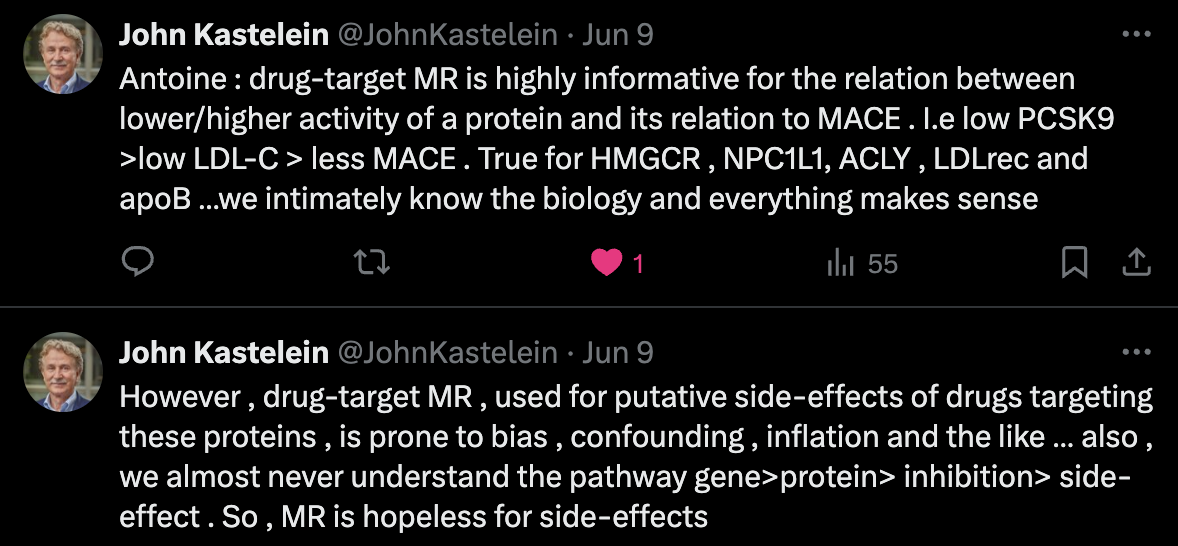
Regarding Mendelian randomization, John Kastelein (the professor behind obicetrapib) told me recently that it was “hopeless” for “for putative side-effects of drugs” (it was after I mentioned his own MR preprint paper showing that CETPi was neutral on PD and good for PDD and LBD!):

What do you think @Neo?