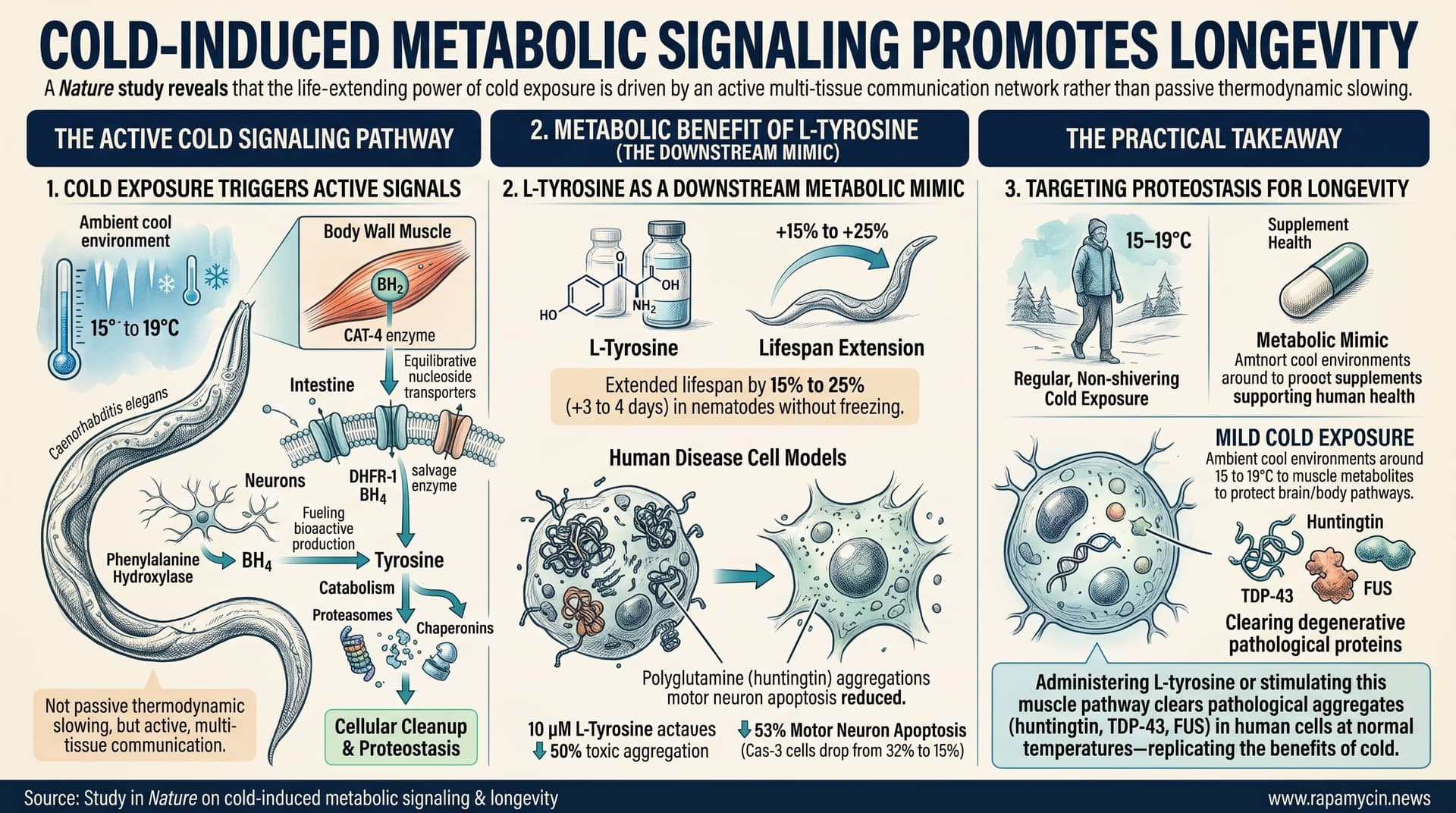
A study published in Nature reveals that the life-extending power of cold temperatures is governed by an active, multi-tissue metabolic communication network rather than passive thermodynamic slowing. Exposure to moderate cold triggers body wall muscle in Caenorhabditis elegans to upregulate the rate-limiting enzyme CAT-4, synthesizing dihydrobiopterin (BH2). Instead of acting locally, BH2 travels through equilibrative nucleoside transporters to the intestine and neurons,where the salvage enzyme DHFR-1 converts it into bioactive tetrahydrobiopterin (BH4). This active cofactor fuels phenylalanine hydroxylase, accelerating tyrosine production and its downstream catabolism to drive cellular cleanup through proteasomes and chaperonins. Strikingly, genetically stimulating this muscle pathway or administering downstream metabolites like tyrosine extends lifespan and clears pathological protein aggregates, including huntingtin,TDP-43, and FUS, in human cells at normal body temperatures, effectively replicating the physiological benefits of cold exposure without freezing.
For more than a century, science assumed that cold temperatures extend the lifespan of cold-blooded and warm-blooded animals through simple physics: cool the organism down, slow its chemical reactions, and the cellular machinery lasts longer. This passive thermodynamic view has now been decisively challenged. A research team led by David Vilchez and Hyun Ju Lee at the University of Cologne has demonstrated that longevity induced by moderate cold is not a passive slowdown. It is an actively directed metabolic program orchestrated across different organs.
The central discovery identifies skeletal muscle as an unexpected endocrine hub for cold adaptation. When animals experience moderate cooling, their muscle tissue switches on a specific metabolic gene called CAT-4, known as GCH1 in humans. This enzyme initiates the production of dihydrobiopterin, or BH2. Rather than being consumed where it is manufactured, BH2 acts as a stable, transportable chemical currency. Muscle cells pump BH2 into systemic circulation,where specialized transporter proteins deliver it to vital client organs, notably the intestine and the nervous system.
Once inside these distal tissues, a salvage enzyme named DHFR-1 converts BH2 into its unstable, biologically potent form: tetrahydrobiopterin, or BH4. This newly minted BH4 acts as a critical spark plug for phenylalanine hydroxylase, an enzyme that converts the dietary amino acid phenylalanine into tyrosine. The local surge in tyrosine drives a profound cellular cleanup effort. It stimulates the protein disposal machinery of the cell, specifically activating the proteasome and molecular chaperonin complexes to target and dismantle toxic, misfolded protein clumps.
The implications for human healthspan are substantial. One of the greatest therapeutic obstacles in longevity medicine has been the inability to replicate the molecular benefits of cold exposure without subjecting the body to extreme hypothermia. The authors showed that this metabolic cascade can be chemically engaged at standard physiological temperatures. When the researchers genetically boosted CAT-4 expression in muscle alone, the animals lived significantly longer and maintained pristine gut integrity, even in warm conditions.
Remarkably, the downstream effects translated directly to human disease models in vitro. When human cells expressing toxic aggregates responsible for Huntington’s disease and amyotrophic lateral sclerosis were treated with BH2 or tyrosine at normal body temperature, protein clumps were cleared. In motor neurons derived from patients with ALS, treatment cut cell death rates in half. Furthermore, tyrosine proved effective even under heavy oxidative stress conditions that typically neutralize BH2.
This research redefines cold adaptation as a synchronized, multi-organ survival program. By tracing the chemical telegraph wire running from shivering muscle to protected neurons, science has identified concrete metabolic targets that could allow clinicians to deliver the regenerative protections of cold therapy straight from a pill bottle.
Actionable Insights
The identification of the muscle-derived biopterin-tyrosine axis provides immediate, practical frameworks for longevity enthusiasts seeking to engage endogenous cellular cleanup systems:
First, mild cold exposure acts as an active signaling trigger rather than a thermodynamic chill. Incorporating regular, non-shivering cold exposure (such as ambient cool environments around 15 to 19 degrees Celsius) can stimulate endogenous muscle metabolite production and activate downstream proteostasis pathways.
Second, the study highlights L-tyrosine as a direct downstream metabolic mimic capable of bypassing temperature requirements. Supplementation in nematode models extended median lifespan by 15% to 25% (an absolute gain of 3 to 4 days, p < 0.0001). In human cellular disease models, 10 micromolar tyrosine reduced toxic polyglutamine aggregation by 50% (a relative reduction of 50 percentage points, p = 0.0057) and reduced motor neuron apoptosis by 53% (an absolute drop of 17 percentage points, dropping from 32% to 15% cleaved caspase-3 positive cells, p < 0.0001).
Third, because high oxidative stress disables the conversion of BH2 to bioactive BH4, individuals must manage systemic reactive oxygen species to preserve salvage enzyme activity. While direct high-dose biopterin supplementation carries complex vascular risks in mammals, supporting tyrosine metabolism represents a low-risk, pharmacologically accessible intervention to enhance proteasomal protein clearance.
Context and Source
- Open access paper: Cold activates a BH2 metabolic network promoting longevity and proteostasis
- Institutions: Institute for Integrated Stress Response Signaling; Cologne Excellence Cluster for Cellular Stress Responses in Aging-Associated Diseases (CECAD); Center for Molecular Medicine Cologne (CMMC); University Hospital Cologne, University of Cologne Country: Germany
- Journal Name: Nature
- Impact Evaluation: The impact score of this journal is 50.5, evaluated against a typical high-end range of 0 to 60+ for top general science, therefore this is an Elite impact journal.