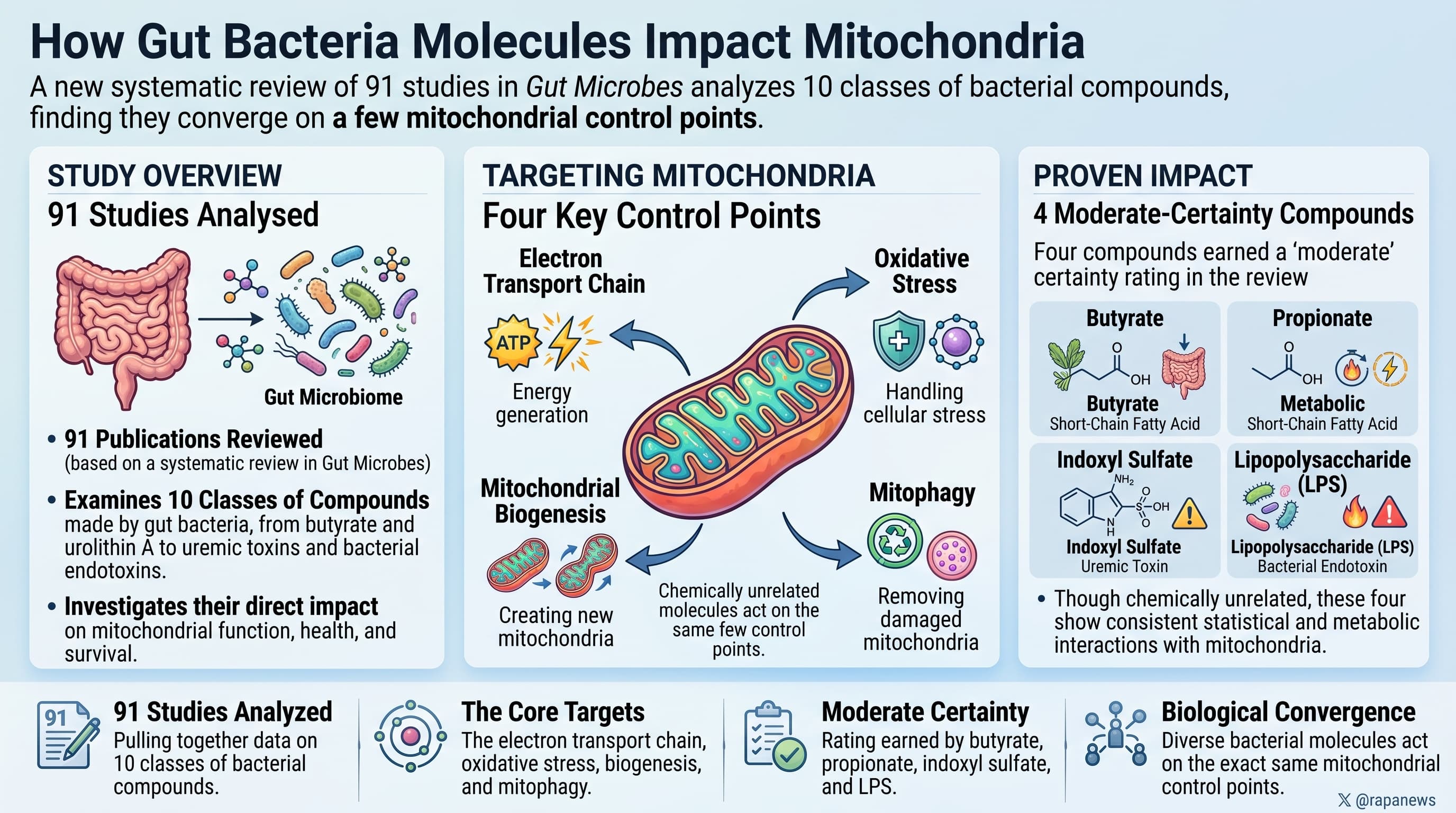
A new systematic review in Gut Microbes pulls together 91 studies on how molecules made by gut bacteria affect mitochondria. It covers ten classes of compounds, from butyrate and urolithin A to uremic toxins and bacterial endotoxin. The authors conclude that these chemically unrelated molecules act on the same few control points: the electron transport chain, oxidative stress handling, the creation of new mitochondria, and the removal of damaged ones. Only four compounds (butyrate, propionate, indoxyl sulfate and lipopolysaccharide) earned a “moderate” certainty rating, and that rating describes the direction of a lab effect, not a health benefit. Nearly all the evidence is from cells and rodents, often at doses far above what circulates in human blood.
The idea that gut microbes shape human health has been attached to almost every disease. This review asks a narrower question: when a bacterial product reaches a human cell, what does it do to the mitochondria?
Richard Frye and Daniel Rossignol searched three databases through March 2026 and screened 1,412 records down to 91 studies. They sorted the evidence into ten classes: short-chain fatty acids, secondary bile acids, tryptophan derivatives, uremic toxins and TMAO, hydrogen sulfide, lipopolysaccharide, B vitamins, polyphenol metabolites such as urolithin A, D-lactate, and polyamines such as spermidine.
Their big idea is convergence. Molecules that have nothing in common chemically keep landing on the same mitochondrial machinery. A regulator called PGC-1alpha, which controls the building of new mitochondria, appears again and again. Helpful compounds such as butyrate tend to switch it on. Harmful ones such as indoxyl sulfate, which accumulates in kidney disease, tend to shut it down.
The second theme is dose. Many of these molecules help at low concentrations and harm at high ones. Hydrogen sulfide feeds electrons into the respiratory chain below roughly 20 micromolar and blocks it, cyanide-style, above that. Propionate is a useful fuel at normal levels and jams mitochondrial metabolism when it builds up. Indole-3-propionic acid, often promoted as a beneficial metabolite, raised cellular respiration by about a fifth at a low dose and cut it by a similar amount at a high one.
The reviewers are unusually frank about the weakness of the evidence. Fifty-seven of the 91 studies used cultured cells and 28 used animals. They count only seven as human studies, and most of those measured gene activity or blood markers, not mitochondrial function. No compound achieved a “high” certainty rating. Four reached “moderate”: butyrate (generally beneficial), propionate (harmful at high doses), indoxyl sulfate (harmful) and lipopolysaccharide (mostly harmful).
Urolithin A, which is marketed on the strength of its ability to trigger mitophagy, was rated “low”. The mitophagy evidence comes from worms, mice and muscle cells. The human trial showed safety and shifts in blood and gene markers, but it never measured mitophagy itself.
The concentration problem may matter most. Butyrate experiments typically use 1 to 10 millimolar, which is realistic for the inside of the colon. Human blood contains less than 1 micromolar. Spermidine studies use doses up to 1,000 times normal plasma levels. A cell in the heart or brain never sees what a cell in a dish is given.
The result is a map of plausible mechanisms. The authors say so directly, calling the findings hypothesis-generating and the proposed therapies speculative.
Actionable Insights
Nothing in this paper proves that changing a gut metabolite improves human health or lifespan. With that stated, the practical reading is as follows.
- Fiber: Fermentable fiber is the best-supported lever, because it feeds butyrate production where butyrate acts, in the colon. Colon cells from germ-free mice had 56 percent less ATP, and butyrate restored energy production to about 70 percent of normal. That is a large effect, but it is in mouse gut cells.
- Butyrate pills: Oral butyrate is unlikely to reproduce the lab findings elsewhere in the body. Blood levels sit under 1 micromolar, more than 1,000 times below test doses.
- Urolithin A: Only 30 to 40 percent of people make it from pomegranate, berries or walnuts. Supplements changed blood markers within 28 days, but no human study has confirmed mitophagy.
- Nicotinamide riboside: A dose of 1,000 mg per day raised muscle mitochondrial DNA in a twin study, but only four twin pairs were compared against placebo.
- Kidney function: Indoxyl sulfate ran 10 to 21 times higher in dialysis and end-stage patients and tracked with weaker muscle. Protecting kidney function matters more than any supplement here.
No standardized effect sizes (such as Cohen’s d) can be calculated, because the review reports no group means or variability.
Context and Source
- Full title: Mechanistic pathways linking gut microbial metabolites, microbial structural products, and host-microbe co-metabolites to mitochondrial function
- Institutions: Autism Discovery and Treatment Foundation, Phoenix, Arizona; Rossignol Medical Center, Phoenix, Arizona and Aliso Viejo, California
- Country: USA
- Journal: Gut Microbes (Taylor and Francis), 2026, volume 18, article 2694140, published online 6 August 2026
- Impact evaluation: The impact score of this journal is 15.3, evaluated against a typical high-end range of 0 to 60+ for top general science and medicine, therefore this is a High impact journal.