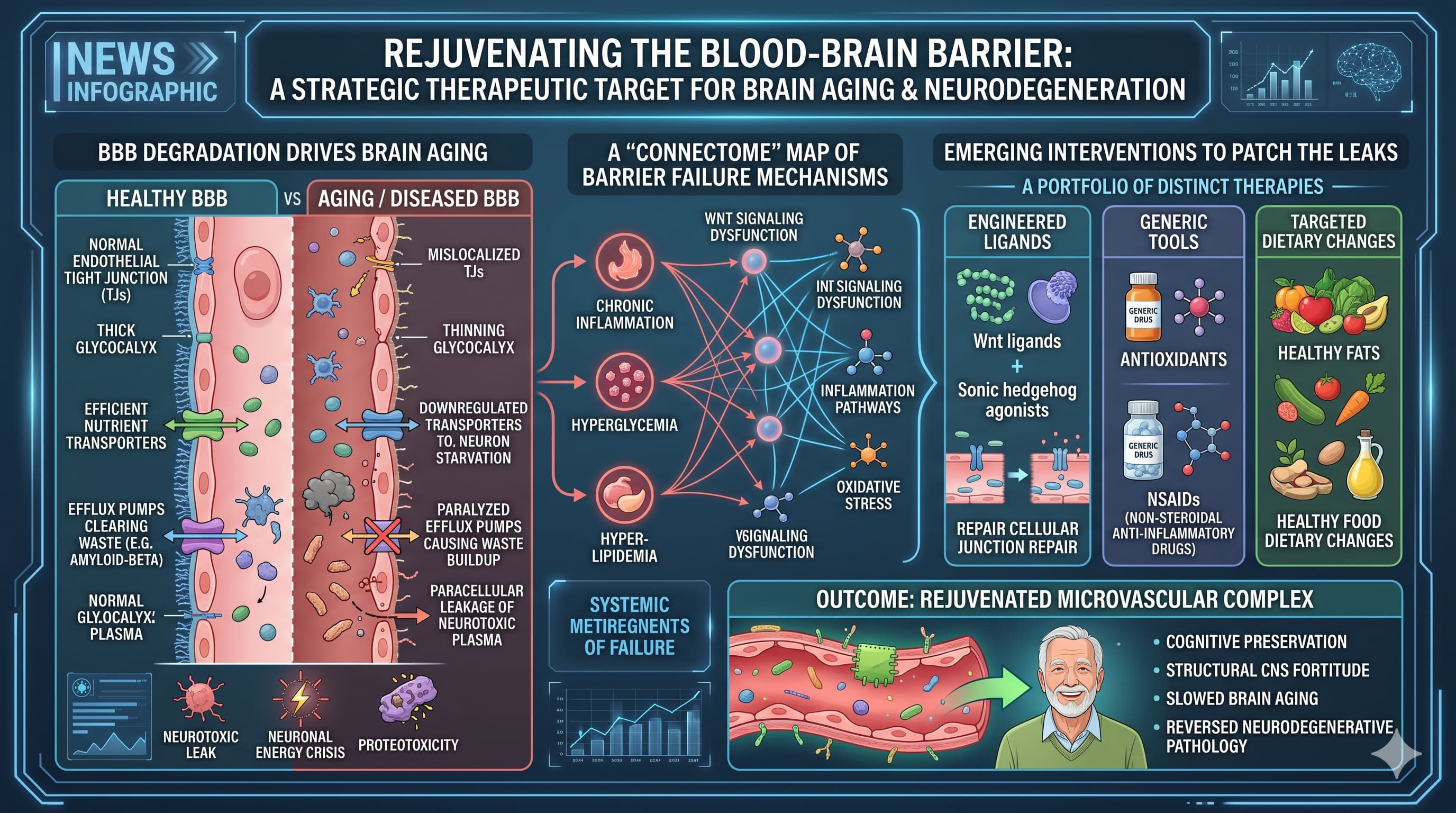
For decades, the blood-brain barrier (BBB) was viewed by neurology as a static, troublesome wall—an anatomical gatekeeper to be bypassed or forced open to deliver therapeutics into the brain parenchyma. A landmark review by researchers Peter C. Searson and William A. Banks turns this paradigm on its head, framing the BBB not as an obstacle, but as a primary, dynamic therapeutic target for slowing down brain aging and reversing neurodegenerative pathology.
The core premise is clear: the brain cannot remain healthy if its microscopic plumbing is failing. During normal chronological aging and across major neurological conditions like Alzheimer’s disease, stroke, and traumatic brain injury, the structural integrity of the BBB undergoes profound degradation. Endothelial tight junctions mislocalize or break down, the protective luminal sugar-coating known as the glycocalyx thins out, and essential nutrient transporters are systematically downregulated. This multi-pathway structural failure triggers a cascade of issues: it allows neurotoxic plasma components to leak paracellularly into the brain, starves neurons of glucose and vital amino acids, and paralyzes the efflux pumps responsible for clearing metabolic waste like amyloid-beta.
Rather than accepting this breakdown as an inevitable feature of senescence, the authors assemble a comprehensive “connectome” that maps peripheral systemic stressors—such as chronic inflammation, hyperglycemia, and hyperlipidemia—directly to specific molecular mechanisms of barrier failure. By identifying these shared nodes of dysfunction, the paper highlights a portfolio of emerging interventions capable of patching the leaks. These range from deploying engineered Wnt ligands and Sonic hedgehog agonists to repair cellular junctions, to utilizing generic, readily available tools like antioxidants, non-steroidal anti-inflammatory drugs (NSAIDs), and targeted dietary changes. Rejuvenating this microvascular complex directly could preserve late-life cognitive capacity and structurally fortify the central nervous system against systemic decay.
Actionable Insights
-
NRF2 Activation and Glutathione Restoration: Incorporate targeted compounds like N-acetylcysteine (NAC) and curcumin to stimulate NRF2 signaling and counter reactive oxygen species (ROS). Preclinical models demonstrate that NAC reverses age- and toxin-induced barrier leakage, downregulates damaging matrix metalloproteinases (MMPs), and restores structural protein levels.
-
Competitive Inhibition of the Kynurenine Pathway: Supplementing with the large neutral amino acid (LNAA) leucine can competitively block the LAT1 transporter at the BBB interface. This effectively prevents systemic, inflammation-derived kynurenine from entering the brain, offering a clear strategy to halt peripheral inflammation-driven depressive states and neuroinflammation.
-
Homocysteine Control for Barrier Integrity: Ensure optimal status of vitamins B6, B9, and B12. Severe deficiency drives hyperhomocysteinemia, which directly degrades endothelial tight junctions; conversely, clinical B-vitamin administration has been shown to reduce tau-to-albumin ratios in cerebrospinal fluid, demonstrating improved barrier baseline function.
-
Magnesium Accumulation: Optimize magnesium intake to enhance overall endothelial sheet architecture. In vitro models demonstrate that physiological magnesium increases transendothelial electrical resistance (TEER) while simultaneously accelerating the clearance of amyloid-beta via receptor-mediated transcytosis.
-
Triglyceride and Leptin Management: Maintain low systemic triglyceride levels through calorie restriction, carbohydrate control, or fibrates like gemfibrozil. Elevated triglycerides directly inhibit leptin transport across the BBB, inducing central leptin resistance and driving a feedback loop of metabolic obesity and subsequent microvascular damage.
Source:
- Paywalled Paper: Strategies for blood–brain barrier rejuvenation and repair
- Institutions: Institute for Nanobiotechnology, Johns Hopkins University, Baltimore, MD, USA ; and the Geriatrics Research Education and Clinical Center, Veterans Affairs Puget Sound Health Care System / University of Washington School of Medicine, Seattle, WA, USA.
-
Journal Name: Nature Reviews Drug Discovery.
Impact Evaluation The impact score of this journal is 122.7, evaluated against a typical high-end range of 0–60+ for top general science, therefore this is an Elite impact journal.