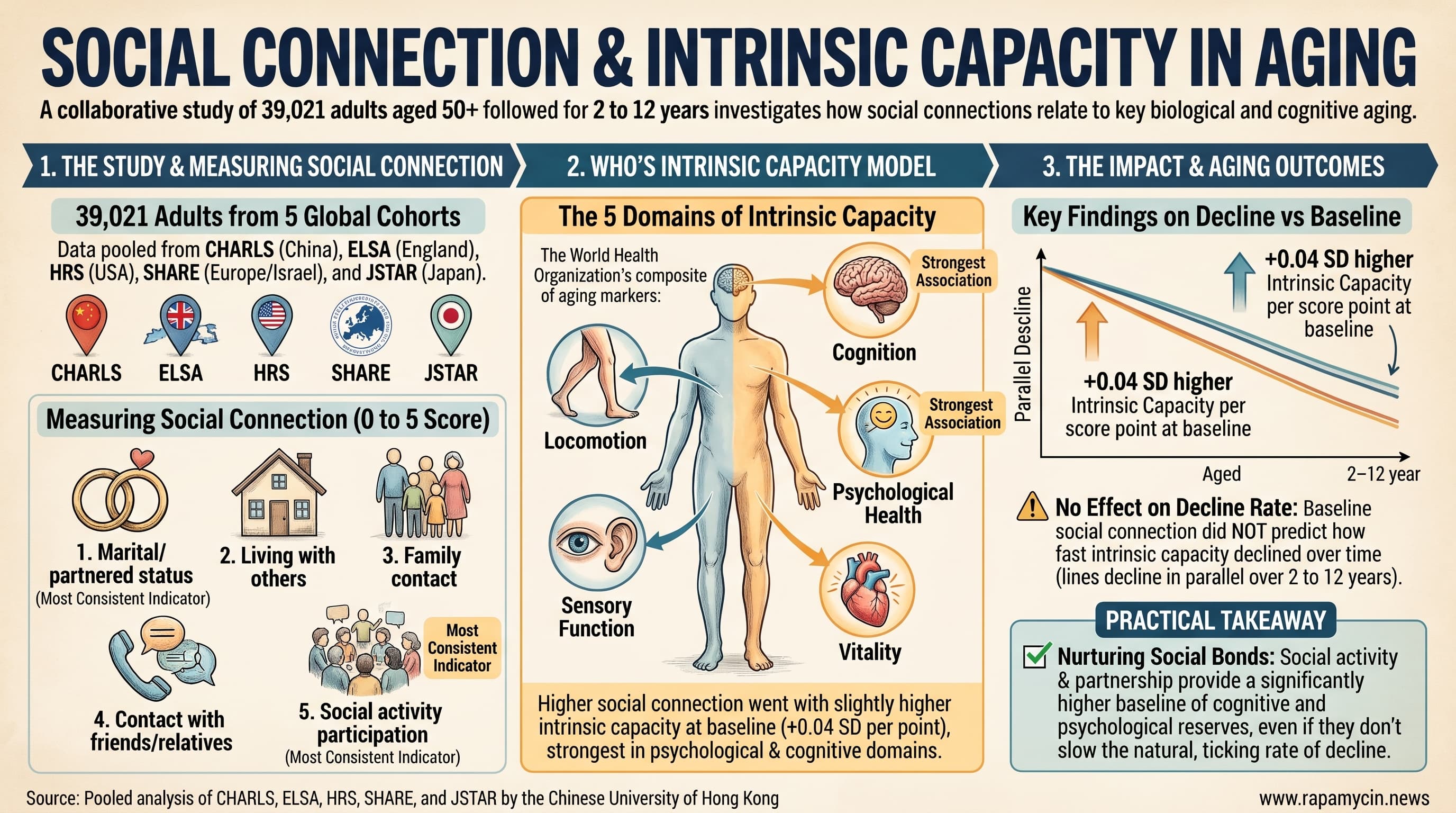
Researchers led from the Chinese University of Hong Kong pooled data from five large aging cohorts: CHARLS (China), ELSA (England), HRS (USA), SHARE (Europe and Israel) and JSTAR (Japan). In 39,021 adults aged 50 and older, they scored social connection from 0 to 5 using marital status, living with others, family contact, contact with friends or relatives, and social activity participation. They related it to intrinsic capacity, the WHO’s composite of locomotion, cognition, psychological health, sensory function and vitality, followed for 2 to 12 years. Higher social connection went with slightly higher intrinsic capacity at baseline, about 0.04 standard deviations per point. The association was strongest for psychological and cognitive domains. Social activity participation and being married or partnered were the most consistent components.
Loneliness and social isolation are increasingly treated as health risks on par with smoking and inactivity. Most evidence linking them to physical and mental decline comes from single countries using different definitions. This study tried to answer the question more rigorously by harmonizing five of the world’s major aging surveys, which share a common design that allows cross-country comparison.
The researchers built a simple social connection score from five yes-or-no indicators: being married or partnered, living with others, weekly contact with family, weekly contact with friends or relatives, and taking part in social activities such as clubs, volunteering or community groups. They measured intrinsic capacity across five domains:
- Locomotion (how well someone moves)
- Cognition
- Psychological health (largely depressive symptoms)
- Sensory function (vision and hearing)
- Vitality (a proxy for physiological reserve)
Across nearly 40,000 people, those with more social connection had higher intrinsic capacity when first assessed. The pattern held in four of the five cohorts; the US Health and Retirement Study was the exception, with an effect near zero. The links were clearest for mood and thinking, weaker for mobility, and absent for vision, hearing and vitality.
Of the five ingredients of social connection, participation in social activities stood out. It was associated with roughly three times the difference in intrinsic capacity of the composite score per point. Being married or partnered came next, with a notably strong link in Japan. Contact frequency and living arrangements were less consistent, although living with others mattered more in England.
The most important finding may be the null one. People who were more socially connected at the start did not decline more slowly over the following years. The researchers interpret this cautiously. Social connection may mark people who already have more reserve, thanks to lifelong advantages in education, health and resources. Or it may run partly in reverse: people with better mobility, hearing and mood find it easier to socialize. The study cannot distinguish between these possibilities.
The size of the associations was also small. Moving from the lowest to the highest social connection category corresponded to a difference of about an eighth of a standard deviation in intrinsic capacity. On the study’s 10-point scale, that is roughly a fifth of a point.
The authors draw measured conclusions. They suggest that social connection is a useful marker for identifying older adults with lower functional reserve, and that community programs promoting social participation are a reasonable strategy. They caution against presenting social connection as proven to slow decline. They also note that the health meaning of social ties appears to vary with culture, such as voluntary participation in the US versus obligatory participation in Japan.
Actionable Insights
- Social participation is the component most worth cultivating. It showed the strongest association: 0.13 SD higher intrinsic capacity, about 3 times the composite score’s per-point effect. On the 0 to 10 scale, that is roughly 0.2 points (computed): small, but consistent across cohorts.
- Benefits look largest for mood and cognition. Per point of social connection, psychological capacity was 0.05 SD higher and cognition 0.03 SD higher. These are very small effects individually (d of 0.03 to 0.05).
- High vs low social connection: 0.12 SD difference in intrinsic capacity, a small effect.
- For clinicians: asking about social participation and partner status is a cheap screen for lower reserve.
- Social isolation has broader evidence linking it to higher mortality in other large studies.
Context and Source
- Open Access Paper: Social connection and intrinsic capacity in later life across the USA, England, Europe, China, and Japan: a harmonised multicohort longitudinal study
-
Institutions:
- Jockey Club Institute of Ageing and Department of Medicine and Therapeutics, Chinese University of Hong Kong
- National Health Research Institutes, Taiwan
- University of Tokyo
- Institute of Health Equity, University College London
- Countries: Hong Kong SAR (China), Taiwan, Japan and United Kingdom; data from the USA, England, Europe and Israel, China and Japan
- Journal: The Lancet Healthy Longevity, published online 12 October 2026
- Impact evaluation: SciJournal lists a 2025 impact factor of about 8.9. Clarivate’s official figures for this journal have been reported higher in recent years, roughly in the low teens (from memory, not verified). The impact score of this journal is approximately 9 to 13, evaluated against a typical high-end range of 0 to 60+ for top general science, therefore this is a High impact journal.