Brain Tuning: Flashing Near-Infrared Light Re-Wires Neural Networks to Erase Age-Related Mental Decline

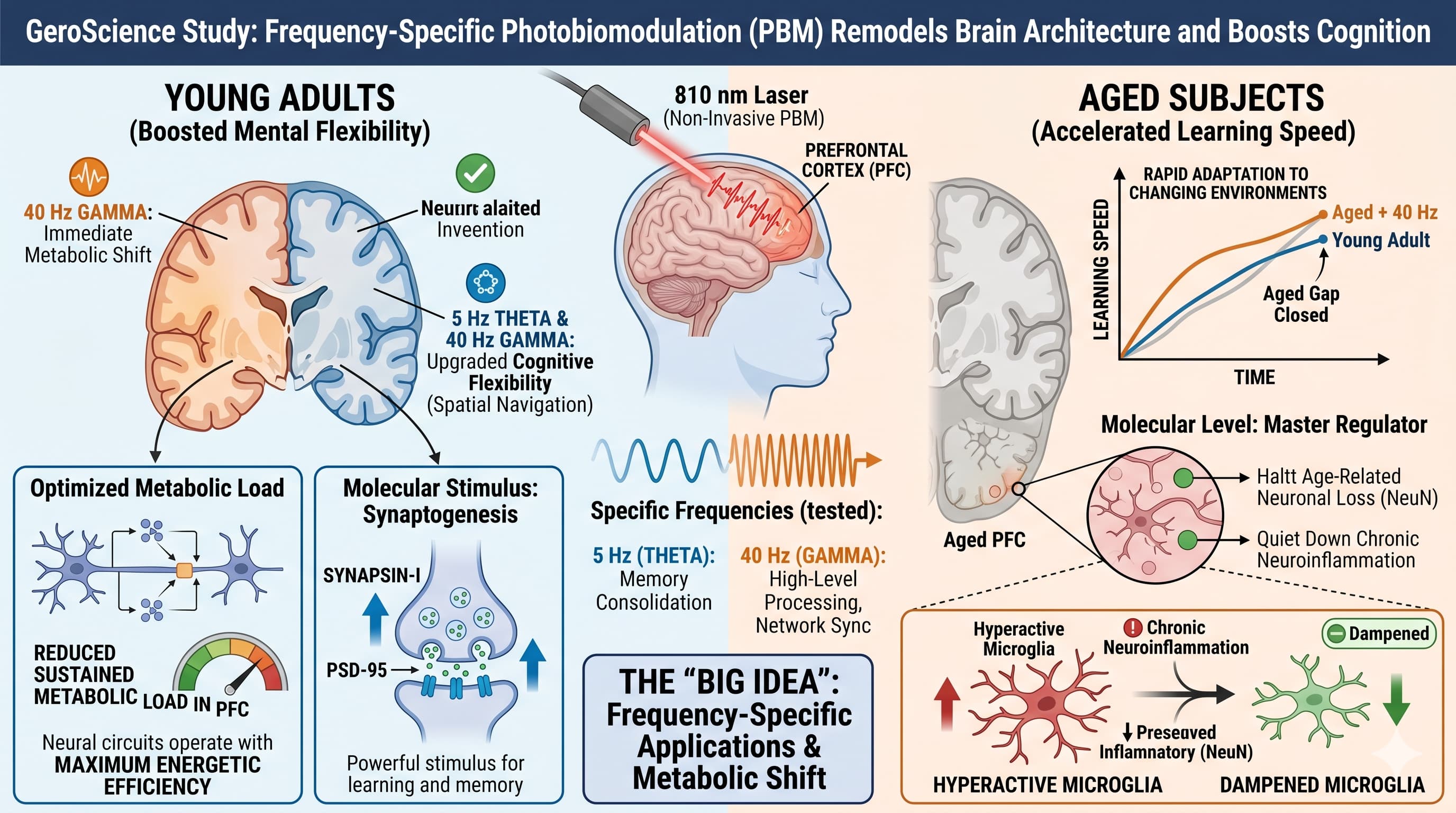
As the global population ages, finding non-invasive methods to halt cognitive decline has become a primary objective of longevity science. A new study published in GeroScience demonstrates that flashing near-infrared light through the skull at specific frequencies can fundamentally remodel the brain’s architecture, boosting mental flexibility in young adults and accelerating learning speed in aged subjects. This non-invasive technique, known as photobiomodulation (PBM), uses an 810 nm laser to deliver energy directly to the brain’s prefrontal cortex, triggering a cascade of beneficial cellular changes.

The “Big Idea” behind this research lies in its frequency-specific application. The researchers tested two distinct neural rhythms: 5 Hz (theta waves, associated with memory consolidation) and 40 Hz (gamma waves, tied to high-level cognitive processing and network synchronization). While both frequencies successfully upgraded cognitive flexibility in young models during spatial navigation challenges, 40 Hz gamma stimulation produced the most immediate and profound metabolic shifts. Surprisingly, instead of overworking the brain, 40 Hz light exposure actually reduced sustained metabolic load in the prefrontal cortex, indicating that the neural circuits had been optimized to operate with maximum energetic efficiency.

When the researchers applied this 40 Hz gamma protocol to an aging cohort, the results were striking. Aged subjects treated with the laser quickly closed the gap in learning speed, demonstrating rapid adaptation to changing environments. On a molecular level, the light therapy acted as a master regulator. In older brains, it successfully halted age-related neuronal loss and significantly quieted down chronic neuroinflammation by dampening hyperactive microglia. Meanwhile, in younger brains, the light pulses acted as a powerful stimulus for synaptogenesis, dramatically elevating key synaptic proteins like Synapsin-I and PSD-95 that are required for learning and memory. PBM appears to work via a process of cellular hormesis: it generates a mild, temporary spike in oxidative signaling that forces brain cells to adapt, upregulate protective proteins, and downregulate programmed cell death pathways. By demonstrating that the aging brain can be non-invasively re-tuned via external light frequencies, this study opens up a powerful new frontier for targeted clinical interventions aimed at extending human cognitive lifespan.

The big issue is, however, that human cranial architecture severely limits near-infrared light transmittance (1–2%), whereas rodent skulls allow significantly greater penetration (21–54%). Future studies will need to look at the level of benefits in humans of this therapeutic approach.

Actionable Insights

For longevity biohackers and clinicians looking to translate these findings into practical protocols, this study provides a precise blueprint for targeted cognitive enhancement and neuroprotection. The key take-home message is that photobiomodulation is highly parameter-dependent; simply shining any light on the head will not suffice. To replicate the study’s structural and cognitive benefits, protocols should utilize an 810 nm near-infrared laser or high-output LEDsystem. This specific wavelength falls within the optical window capable of penetrating cranial tissue to reach the frontal cortex.

Target Frequency ──> 40 Hz (Gamma) for acute processing & microglial clearing
5 Hz (Theta) for specific synaptic plasticity pathways
Target Fluence ──> 33 J/cm² cumulative dose over a 12-minute session`

Practitioners should configure their devices to emit pulsed waves at 40 Hz with a 50% duty cycle, targeting a total cumulative tissue dose of 33 J/cm² over a 12-minute session. Clinicians can confidently utilize 40 Hz pulsed PBM to systematically reduce microglial activation (marked by lowered Iba-1 levels) and preserve active neuronal density in older populations. For younger individuals, alternating between 5 Hz and 40 Hz can be deployed to systematically drive synaptogenesis and boost structural remodeling.

Feasibility & ROI

  • Sourcing: High feasibility. The required hardware is widely commercialized as an off-the-shelf consumer wellness device or research-grade medical hardware (e.g., Vielight Neuro Gamma or Neuronic devices). It does not require a prescription (Rx) or access to restricted research chemicals.
  • Cost vs. Effect: Targeted consumer headsets range from 1,500 USD to 5,000 USD upfront. Amortized over a multi-year treatment lifecycle, the ongoing monthly cost is under 50 USD. Given that this physical modality bypasses gastrointestinal absorption limits, avoids systemic organ toxicity, preserves active prefrontal neuronal density, and downregulates microglial activation across the lifespan, it could yield a high return on investment (ROI) if the research translates to humans.

Context & Impact Evaluation

2 Likes

Critical Limitations

  • Severe Translational Headwinds: The most significant flaw is the dramatic variance in cranial penetration between species. The authors explicitly state that rat skulls permit approximately 0.8% to 21–54% light transmission depending on configuration, whereas the massive structural thickness of human cranial anatomy limits near-infrared penetration to a mere 1% to 2%. This creates massive scale and dosing uncertainty when trying to map human biohacking protocols directly from rodent fluences.

  • Omission of Aged 5 Hz Arm: The experimental architecture failed to include a 5 Hz theta-pulsed cohort within the 18-month-old aged arm. Consequently, any claims regarding frequency-specific longevity interventions are strictly confined to young animals; it remains entirely unknown whether theta-pulsed light holds any therapeutic or detrimental effects in aging brains.

  • Underpowered Molecular Sub-cohorts: With a group size of n=7 animals per arm, the study operates on the edge of statistical statistical power for complex proteomic and Western blot evaluations. Subtle molecular variations and effect-size precision could easily be skewed by individual animal outliers.

  • Complete Exclusion of Female Sex Bio-models: The study was conducted exclusively on male Wistar rats. Given that age-related neuroinflammatory trajectories, microglial priming patterns, and endocrine-driven neuroplasticity parameters vary dramatically between sexes, these molecular findings cannot be generalized to female biology without dedicated validation studies.

  • Lack of Long-term Washout Kinetics: The researchers sacrificed the animals a mere 90 minutes following their final behavioral test. Because there is no long-term longitudinal data tracking the stability of these changes, it is impossible to determine whether the observed synaptogenesis and microglial clearing represent permanent structural rewiring or fleeting, temporary shifts that wash out shortly after treatment stops.

1 Like

Transcranial Photobiomodulation (tPBM) Hardware and Pricing Matrix

The market for brain-directed photobiomodulation (tPBM) hardware spans entry-level consumer wellness caps, full-coverage multi-wavelength helmets, and highly programmable clinical research devices. The table below identifies key manufacturers, device specifications, baseline costs, and direct links to product pages.

Device Profiles and Direct Sourcing Links

Manufacturer Device / Hardware Model Primary Specifications Price (USD) Direct Sourcing Link
Hooga Health Red Light Therapy Hat 150 Dual-Chip LEDs, 660nm Red and 850nm Near-Infrared, continuous wave delivery $299.00 Hooga Red Light Hat Product Page
Hooga Health ColorWave Light Therapy Hat 150 Quad-Chip LEDs, 415nm Blue, 520nm Green, 660nm Red, 850nm Near-Infrared, 10Hz pulse option $299.00 Hooga ColorWave Hat Product Page
SYMBYX Biome SYMBYX Neuro General wellness helmet designed and clinically tested for neurodegenerative baseline support $1,450.00 SYMBYX Neuro Product Page
Neuronic Neuronic LIGHT 291 1070nm LEDs + 9 High-Power LEDs, app-controlled variable pulsing protocols $1,795.00 Neuronic Store Page
Vielight Neuro Gamma 4 Targeted node array, 810nm wavelength focused on Default Mode Network (DMN), fixed 40Hz Gamma pulsing $1,799.00 Rehabmart Vielight Neuro 4 Product Page
Vielight Neuro Alpha 4 Targeted node array, 810nm wavelength focused on DMN, fixed 10Hz Alpha pulsing $1,799.00 Rehabmart Vielight Neuro 4 Product Page
Mito Red Light MitoMIND Helmet 256 810nm LEDs, variable pulsing (1Hz to 20,000Hz), 6 preset wave profiles $2,199.00 MitoMIND Helmet Product Page
Vielight Neuro Duo 4 Dual-pulsing capability combining both 10Hz Alpha and 40Hz Gamma pulse configurations in one console $2,399.00 Rehabmart Vielight Neuro 4 Product Page
Weber Medical Original Infrared Helmet 320 LEDs emitting at 810nm wavelength, general cortical coverage, 16W output capacity $3,200.00 MyHealth1st Weber Helmet Product Page
Neuronic Neuradiant 1070 256 1070nm LEDs, 4-quadrant control, custom programmable pulsing up to 10,000Hz $3,395.00 Neuronic Neuradiant 1070 Product Page
Weber Medical WeberBrain HOME Helmet 228 pure laser diodes, multi-spectral array (650nm, 808nm, 1064nm), up to 36W output power $4,900.00 MyHealth1st Weber Helmet Product Page

Summary of Sourcing and Shipping Costs

  • Neuronic: Features worldwide free shipping. Domestic deliveries to the US and Germany take approximately 3 to 5 business days, while international shipments to other regions take 5 to 7 business days. Buyers remain entirely responsible for regional customs duties or localized import taxes.
  • Vielight (via Rehabmart): Includes standard domestic free shipping inside the continental United States.
  • Mito Red Light (via Recovery for Athletes): Explicitly guarantees free and fast shipping for all in-stock domestic orders within the United States.
  • SYMBYX Biome: Provides free express shipping to all global orders via Australia Post (1 to 7 business days), Royal Mail Express (2 to 5 business days), or DHL/FedEx International (3 to 10 business days). International orders outside the US, UK, and Australia may be subject to localized VAT or import duties upon destination arrival.
  • Hooga Health: Offers free domestic shipping inside the United States on all standard orders that exceed a base purchase total of $100.00.
1 Like

Surprised https://gembared.com/ isn’t on the list. Could you ask why not?

Direct Rationale for Exclusion

GembaRed is not included in the primary selection matrix because they do not design or manufacture specialized, brain-targeted transcranial photobiomodulation (tPBM) hardware.

The previous assessment strictly evaluated off-the-shelf helmets, caps, and localized cluster arrays specifically engineered with neuro-pulsing logic (such as 10Hz Alpha or 40Hz Gamma wave modulators) and deep-penetrating cortical wavelengths (810nm or 1070nm) designed to overcome human cranial attenuation.

Key Technical Distinctions in Hardware Architecture

  • Broad Systemic vs. Targeted Cortical Form Factors: GembaRed’s engineering focus is dedicated to flat LED body panels, ambient red-light bulbs, and task lighting. These systems are optimized for broad systemic bioenergetic support, topical skin exposure, or environmental circadian optimization rather than precise skull-mapping contours.

  • Absence of Integrated Brainwave Oscillators: Achieving the neural circuit optimization highlighted in recent geroscience studies requires pulsed wave delivery paired with specific temporal patterns. GembaRed arrays are engineered primarily as continuous-wave, static delivery systems. They completely lack the spatial node placement, intranasal applicators, and programmable pulse-frequency generators required for targeted prefrontal-hippocampal network entrainment.

To review their available catalog of broad-body panels and lighting systems directly, visit the GembaRed Light Therapy Collection or examine their full array of components on the GembaRed All Products Page.