Blueberry Compound Pterostilbene Clears Muscle Fat

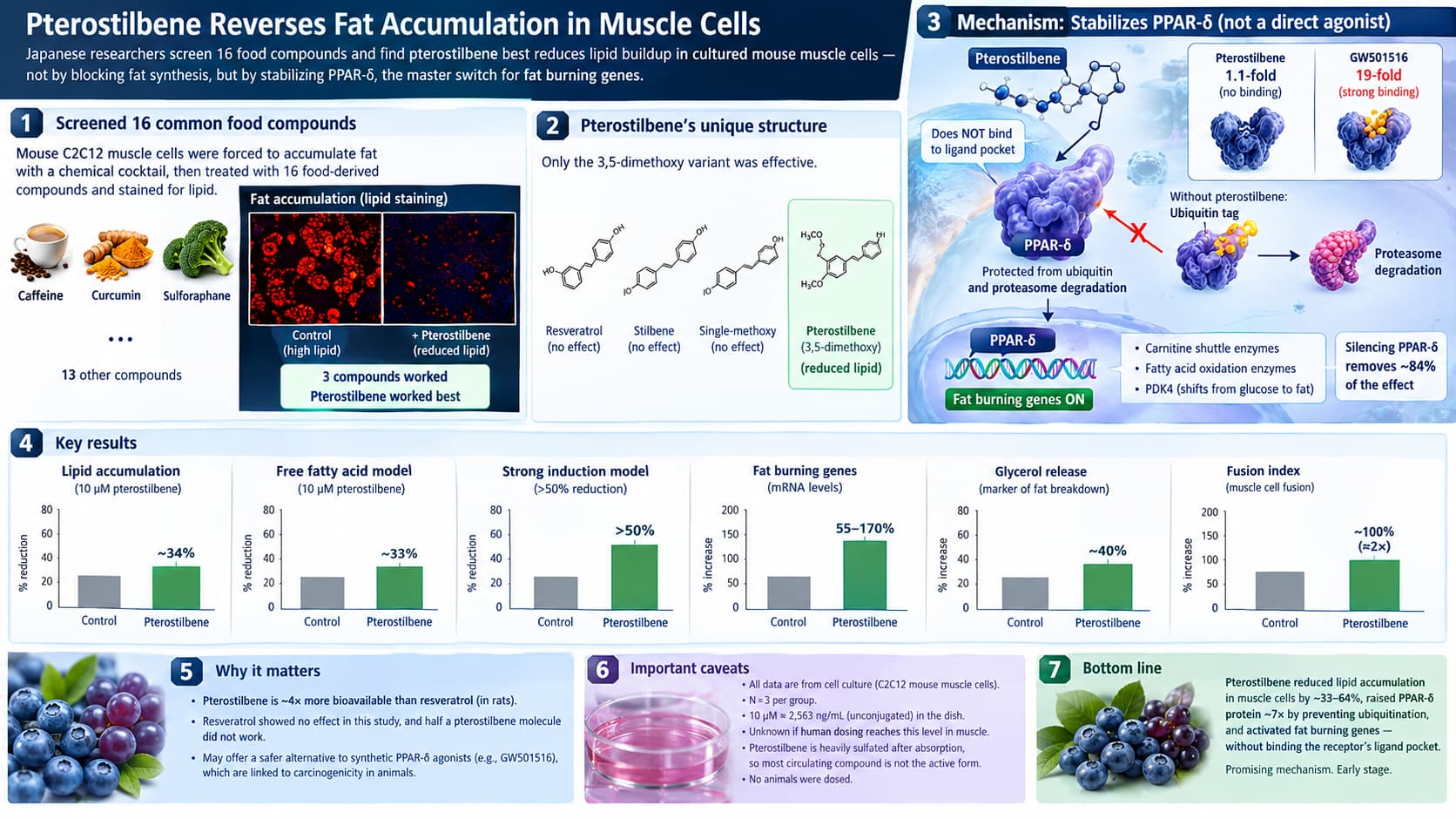
Japanese researchers screened sixteen common food compounds for the ability to stop cultured mouse muscle cells from filling up with fat, and pterostilbene, a naturally methylated cousin of resveratrol found in blueberries and grapes, came out on top. It cut lipid accumulation by roughly a third at 10 micromolar and by more than half in the strongest induction model. The mechanism is the interesting part. Pterostilbene did not shut down fat synthesis, and it did not stop fat from entering the cell. Instead it raised the protein level of PPAR-delta, the nuclear receptor that switches on fat burning genes, by about sevenfold, and it did so without binding to the receptor’s ligand pocket at all. Rather than acting as a drug-like agonist, pterostilbene appears to protect PPAR-delta from being tagged with ubiquitin and shredded by the proteasome. Knocking down PPAR-delta erased roughly 84 percent of the effect. Everything here is cell culture, sample sizes are three per group, and no animal was dosed.

For twenty years the stilbene story in longevity has been the resveratrol story, and the resveratrol story has been a disappointment. The compound is poorly absorbed, cleared within minutes, and its headline mechanism, SIRT1 activation, has been argued over since 2005. Pterostilbene has drifted along in its shadow as the more bioavailable relative, absorbed roughly four times better in rats, but has mostly been assumed to do the same things by the same routes. This paper suggests that assumption is wrong, at least in muscle.

The team at Shinshu University started with a blunt screen. They forced mouse C2C12 muscle cells to accumulate fat using a chemical cocktail, then threw sixteen food-derived compounds at them and stained for lipid. Caffeine did nothing. Curcumin did nothing. Sulforaphane did nothing. Three compounds worked, and pterostilbene worked best.

Then they did the experiment that makes the paper worth reading. They tested pterostilbene’s structural relatives side by side at the same concentration. Resveratrol itself did not reduce lipid. Plain stilbene did not. Neither single-methoxy variant did. Only the compound carrying methoxy groups at both the 3 and 5 positions had the effect. Whatever pterostilbene is doing in muscle, resveratrol does not do it, and half a pterostilbene molecule does not do it either.

The mechanism turned out to run through PPAR-delta, a nuclear receptor that acts as the master switch for fat oxidation in muscle. Pterostilbene raised PPAR-delta protein about sevenfold and turned on a coordinated set of fat burning genes: the carnitine shuttle enzymes that carry fatty acids into mitochondria, the enzymes that chop them up once inside, and PDK4, which pushes the cell away from burning sugar and toward burning fat. Silencing PPAR-delta removed most of the benefit.

The surprise came in the last figure. The researchers ran a binding assay comparing pterostilbene against GW501516, the synthetic PPAR-delta agonist that bodybuilders once bought as Cardarine and that regulators eventually flagged for carcinogenicity in animals. GW501516 lit up the receptor’s ligand pocket nineteenfold. Pterostilbene produced a 1.1-fold signal, which is to say nothing at all. It never touches the pocket.

What it appears to do instead is interfere with the receptor’s disposal. PPAR-delta that is not bound to a ligand gets tagged with ubiquitin and fed to the proteasome within hours. Pterostilbene reduced that tagging, so the receptor survives longer and accumulates. It is a difference between pressing the accelerator and removing the brake on the accelerator’s supply chain, and it may matter for safety, since the toxicity concerns around synthetic PPAR-delta agonists come from forcing the receptor into sustained maximal activation.

There is also something the paper did not chase. Cells treated with pterostilbene roughly doubled their fusion index, meaning they merged into muscle fibers more readily. That was reported and left alone.

Notably, the cells did not build more mitochondria. Mitochondrial DNA copy number and the biogenesis machinery were unchanged. This is not an exercise mimetic that expands capacity. It is a signal that tells existing mitochondria to work on a different fuel.

Actionable Insights

It is cell culture, and the working concentration of 10 micromolar equals about 2,563 nanograms per milliliter of unconjugated pterostilbene in the dish. Whether a human taking a capsule reaches anything close to that inside a muscle fiber is unknown. Pterostilbene is heavily sulfated after absorption, so most of what circulates is not the active molecule.

What the effect sizes do tell you is the shape of the claim if it holds. At 10 micromolar the fat reduction was about 34 percent, and in the free-fatty-acid model about 33 percent, which removed roughly 64 percent of the fat the cells had just taken on. Fat burning genes rose 55 to 170 percent. Glycerol release, a marker that stored fat is being broken apart, rose about 40 percent. Large changes statistically, but drawn from three samples per group, which inflates apparent precision considerably.

Three things are worth carrying forward. First, if you take pterostilbene, you are not taking a more bioavailable resveratrol, because resveratrol did nothing in this system. Second, the target here is intramuscular fat, a real and underrated aging problem distinct from body fat. If using pterostilbene you need to watch how much it raises your LDL lipid levels.

Context and Source

  • Paywalled Paper: Pterostilbene suppresses intracellular lipid accumulation in C2C12 myocytes via PPARδ stabilization
  • Institutions: Division of Food Science and Biotechnology, Graduate School of Science and Technology, Shinshu University, Nagano, Japan; Department of Food Science, Ishikawa Prefectural University, Ishikawa, Japan; Department of Agricultural and Life Sciences, Faculty of Agriculture, Shinshu University, Nagano, Japan
  • Country: Japan
  • Journal: Food Bioscience (Elsevier), Volume 83, 2026.
  • Impact evaluation: The impact score of this journal is 5.9 (most recent Journal Citation Reports release; the 2023 JIF was 4.8, five-year JIF 6.1), evaluated against a typical high-end range of 0-60+ for top general science, therefore this is a Medium impact journal.
2 Likes

An interesting observation from nature - migrating birds which make a huge journey from arctic and subarctic regions to tropical zones, thousands of miles. The journey is a gigantic effort of sustained wing beating for days on end, a feat of muscle exertion human physiology is not capable of. Well, apparently these birds prepare for the journey for weeks by feeding voraciously on seasonal northern berries, including blueberries - they go for these preferencially, as if stocking up on polyphenols in those colorful berries.

This has given rise to a lot of speculation - does the special diet impact that muscle performance in these migrating birds?

Many different polyphenols were focused on, and different functions - one of which was speculation that such high levels of exertion must burn a lot of calories and result in epic amounts of oxidation and perhaps there’s a need for antioxidants and so on.

But perhaps pterostilbene is also an agent here, helping with the muscle performance? In any case, I have been consuming berries daily for years - maybe it does some good, and this finding here might be yet another mechanism. YMMV.

5 Likes

Actionable Intelligence

The Translational Protocol

Feasibility & ROI

  • Sourcing: Pterostilbene is widely available over the counter as a dietary supplement. It does not require a prescription.
  • Cost vs. Effect: The cost to achieve a theoretical HED of 200 to 250 mg is very low, typically 15 to 30 $USD per month. However, the return on investment is questionable. While the in vitro muscle fat clearance is impressive, the established clinical side effect of elevated LDL cholesterol directly conflicts with the foundational longevity goal of ApoB reduction. If trying this supplement, test for LDL-C levels and APO-B levels.

Part 5: The Strategic FAQ

  1. Question: How can you justify translating this intervention given that human trials show pterostilbene increases LDL cholesterol? Answer: The localized benefit of clearing myosteatosis would have to be weighed against the systemic risk of elevated ApoB. Clinically, this requires concurrent use of lipid-lowering therapies (like ezetimibe or statins) if pterostilbene is utilized.

  2. Question: Is it pharmacokinetically possible to reach the effective 10 micromolar tissue concentration in human skeletal muscle via oral supplementation? Answer: Highly unlikely without exceeding the currently tested clinical safety limit of 250 mg per day. Achieving 10 micromolar locally would likely require massive, potentially toxic oral doses.

  3. Question: By inhibiting the ubiquitin-proteasome pathway to stabilize PPARdelta, aren’t you risking the toxic accumulation of other cellular proteins? Answer: Yes, off-target protein stabilization is a significant risk. If pterostilbene broadly inhibits proteasome function, it could lead to toxic protein aggregation, which is detrimental to cellular health.

  4. Question: How does this specific mechanism interact with standard longevity pathways like AMPK? **Answer:**Pterostilbene is a known AMPK activator. While this study isolated the PPARdelta mechanism, AMPK and PPARdelta signaling functionally converge in skeletal muscle to drive oxidative metabolism.

  5. Question: Does pterostilbene force the creation of new mitochondria to handle the increased fatty acid oxidation?Answer: No. The data clearly shows no increase in mitochondrial DNA copy numbers or biogenesis genes like Tfam; the compound strictly upregulates the functional capacity of existing mitochondria.

  6. Question: Could this compound be used as an exercise mimetic for bedridden patients? Answer: While it induces fat oxidation genes similar to exercise, it lacks the mechanical loading required to build muscle mass. It might clear fat, but it will not prevent disuse atrophy.

Interaction Check

  • Rapamycin: Both pterostilbene and rapamycin modulate cellular nutrient sensing. Additive effects could occur, but off-target proteasome inhibition by pterostilbene could interfere with autophagy processes induced by rapamycin.
  • Metformin: Both activate AMPK. Combining them could aggressively lower blood glucose but might risk lactic acidosis or severe cellular energy stress in frail patients.
  • SGLT2 Inhibitors: SGLT2 inhibitors increase systemic fat utilization. Pterostilbene could theoretically complement this by enhancing skeletal muscle fat oxidation, though compounding LDL-raising effects are a concern.
  • Acarbose, 17-alpha estradiol, PDE5 inhibitors: No direct metabolic conflicts identified in the literature, but the lipid-raising profile of pterostilbene counteracts the general cardiovascular protection sought by these longevity interventions.

Pterostilbene Procurement Analysis (example)

Pterostilbene is a dimethylated analog of resveratrol. It demonstrates greater lipophilicity, resulting in higher oral bioavailability and a longer half-life compared to its unmethylated counterpart. Current scholarly debates regarding pterostilbene in the context of longevity center on identifying optimal human dosing regimens capable of activating caloric restriction pathways, such as sirtuins, without inducing undesirable off-target effects. Some clinical data suggest that high doses may elevate LDL cholesterol levels, highlighting a critical knowledge gap; robust, long-term human pharmacokinetic trials are required to definitively establish its safety and efficacy profile for lifespan extension.

Below is the real-time procurement data for the top 10 most cost-effective sources of pterostilbene, ranked by the lowest cost per 100mg dose.

Rank Product/Brand Name Vendor Total Weight (Original Unit & Grams) Total Price (USD) Cost Per 100mg of Pterostilbene Dose Requirement for 100mg
1 Pterostilbene 99% Powder NutriVitaShop 1 kg (1,000 g) $550.00 $0.055 ($550.00 / 1,000,000 mg * 100) Dose: 100 mg powder
2 Pterostilbene - Powder PureBulk 250 grams (250 g) $255.95 $0.102 ($255.95 / 250,000 mg * 100) Dose: 100 mg powder
3 Pterostilbene - 200mg Veg. Caps PureBulk 120 capsules (24 g) $26.95 $0.112 ($26.95 / 24,000 mg * 100) Number Capsules Needed: 0.5
4 Pterostilbene Antioxidant Active Bulk Naturals 250 grams (250 g) $287.36 $0.115 ($287.36 / 250,000 mg * 100) Dose: 100 mg powder
5 NusaPure 180 Veggie Caps of Pterostilbene 150mg Walmart (NusaPure) 180 capsules (27 g) $35.50 $0.131 ($35.50 / 27,000 mg * 100) Number Capsules Needed: 0.67
6 Nutricost Pterostilbene 100mg, 120 Capsules Walmart (Nutricost) 120 capsules (12 g) $21.95 $0.183 ($21.95 / 12,000 mg * 100) Number Capsules Needed: 1
7 Pure Pterostilbene Supplement (10g) DynaBind 10 grams (10 g) $18.95 $0.189 ($18.95 / 10,000 mg * 100) Dose: 100 mg powder
8 Pterostilbene Pro 250 (250 mg, 60 capsules) ProHealth Longevity 60 capsules (15 g) $29.15 $0.194 ($29.15 / 15,000 mg * 100) Number Capsules Needed: 0.4
9 Pterostilbene - 60 x 100 mg capsules Target (Double Wood) 60 capsules (6 g) $19.95 $0.332 ($19.95 / 6,000 mg * 100) Number Capsules Needed: 1
10 Swanson Pterostilbene 50 mg 30 Veggie Capsules Walmart (Swanson) 30 capsules (1.5 g) $8.19 $0.546 ($8.19 / 1,500 mg * 100) Number Capsules Needed: 2

Shipping Cost Summary

  • NutriVitaShop: Free domestic shipping typically applies to bulk orders over $150.
  • PureBulk: Shipping is calculated at checkout based on destination; free domestic shipping is frequently available for orders exceeding $49.
  • Bulk Naturals: Shipping is calculated dynamically at checkout; larger bulk weights may incur heavier standard parcel fees.
  • Walmart & Target (NusaPure, Nutricost, Double Wood, Swanson): Typically offer free shipping on orders over $35 or for subscribers to their respective membership programs.
  • DynaBind: Standard shipping rates apply based on location.
  • ProHealth Longevity: Free standard shipping is provided on orders over $99 or via active auto-ship subscriptions.

Looking deeper into the bioavailability issue… not much data, the best tests have only been done in rats.

Pterostilbene Bioavailability in Humans

An Evidence Review: What Is Actually Measured, What Is Inferred, and What Is Marketing

Compiled 10 September 2026


The Short Version

There has never been a published dedicated human pharmacokinetic study of pterostilbene. Not one. No published trial has reported a plasma concentration curve, a Cmax, a Tmax, a half-life, or an absolute oral bioavailability figure in human subjects.

The widely repeated claim that pterostilbene is “80 percent bioavailable” comes from a single rat study published in 2010. A second rat study published in 2013, using an ordinary oral suspension rather than a solubilizing vehicle, measured 16 percent, and under fasting conditions less than 5.5 percent. The only formal attempt to estimate the human figure is a physiologically based pharmacokinetic model, which predicted 9.6 percent.

The one thing that has been directly measured in humans is that pterostilbene sulfate, the conjugated metabolite rather than the parent compound, reaches whole blood and skeletal muscle tissue after 200 mg per day. That measurement was reported in arbitrary units, not in concentration units.

Two small human bioavailability trials have completed in Spain. Neither has published results.

[Confidence: High that no dedicated human PK study is published as of this writing]


Part 1: Direct Human Measurements

The single study that measured pterostilbene in human tissue

Jensen JB, Dollerup OL, Møller AB, et al. A randomized placebo-controlled trial of nicotinamide riboside and pterostilbene supplementation in experimental muscle injury in elderly individuals. *JCI Insight.*2022;7(19):e158314. JCI Insight - A randomized placebo-controlled trial of nicotinamide riboside and pterostilbene supplementation in experimental muscle injury in elderly individuals Open access. PMID 35998039. PMCID PMC9675477.

This is the most informative human exposure data that exists, and it comes as a secondary compliance measurement inside a trial designed to answer a different question.

Design: 32 individuals aged 55 to 80, randomized to 1,000 mg nicotinamide riboside plus 200 mg pterostilbene daily, or matched placebo. Supplementation began two weeks before an electrically induced eccentric muscle injury. Muscle biopsies were taken before injury, 2 hours after, and at 2, 8, and 30 days.

What was measured: whole blood and skeletal muscle were analyzed by ultra-high performance liquid chromatography with mass spectrometry on a Bruker timsTOF Pro. Pterostilbene sulfate was identified by fragmentation spectra.

What was found:

  • Pterostilbene sulfate rose significantly in whole blood after supplementation, confirming absorption
  • Pterostilbene sulfate was measurable in skeletal muscle tissue after supplementation, confirming tissue penetration
  • NAD+ rose in whole blood but not in skeletal muscle

The methodological detail that matters most, quoted from the paper’s methods section: NAD+ metabolite concentrations were expressed in micromolar, but “pterostilbene sulfate abundance was assigned with method specific arbitrary unit.” In muscle, peak areas were normalized to internal standard and tissue mass and again assigned arbitrary units.

So the study establishes presence and direction of change. It does not establish concentration. And it tracked only the sulfate conjugate. Free unconjugated pterostilbene, which is the species that matters for any mechanism worked out in a cell culture dish, was not reported at all.

The efficacy result is worth stating plainly alongside this, because it bears on whether the exposure achieved is functionally meaningful: NRPT produced no improvement in muscle stem cell content or proliferation, no improvement in strength recovery, no improvement in regeneration markers, and no reduction in muscle damage markers. The supplement got into the muscle. Nothing measurable happened there. [Confidence: High for both the detection and the null efficacy result]

Human trials that dosed pterostilbene and measured no pharmacokinetics

Riche DM, Riche KD, Blackshear CT, et al. Analysis of safety from a human clinical trial with pterostilbene. Journal of Toxicology. 2013;2013:463595. https://onlinelibrary.wiley.com/doi/10.1155/2013/463595 Open access. PMID 23431291.

80 adults, up to 250 mg per day, 6 to 8 weeks. No adverse drug reactions on hepatic, renal, or glucose markers. Completion rate 91.3 percent. No plasma concentrations measured.

Riche DM, Riche KD, Blackshear CT, et al. Pterostilbene on metabolic parameters: a randomized, double-blind, and placebo-controlled trial. Evidence-Based Complementary and Alternative Medicine. 2014;2014:459165.https://onlinelibrary.wiley.com/doi/10.1155/2014/459165 Open access. PMID 25057276. ClinicalTrials.gov NCT01267227.

Same cohort, efficacy endpoints. Four arms of 20: pterostilbene 125 mg twice daily, 50 mg twice daily, 50 mg twice daily plus 100 mg grape extract, or placebo. Material was pTeroPure, greater than 99 percent all-trans-pterostilbene, supplied by ChromaDex.

Results, and these are worth knowing for reasons beyond bioavailability:

Outcome Effect p value
LDL, pterostilbene monotherapy vs placebo +17.1 mg/dL 0.001
Total cholesterol, low dose +18.1 mg/dL 0.026
Total cholesterol, high dose +16.4 mg/dL 0.043
Systolic BP, high dose -7.8 mmHg <0.01
Diastolic BP, high dose -7.3 mmHg <0.001
Systolic BP, low dose plus grape extract -6.7 mmHg 0.016
Triglycerides, all arms no change 0.82 to 0.95
BMI, subgroup not on cholesterol medication -0.62 kg/m2 0.012

No plasma pterostilbene was measured.

The relevance to bioavailability is indirect but real, and it is the strongest inferential argument that oral pterostilbene reaches systemic circulation at pharmacologically meaningful levels in people. A blood pressure reduction of 7.8 mmHg systolic is not a subtle effect. It is roughly what a low-dose thiazide achieves. Something absorbed and did something.

The LDL increase of 17.1 mg/dL runs in the opposite direction to the compound’s reputation and is rarely mentioned in supplement marketing. Take it seriously as a real finding rather than a curiosity.

Part 2. The Rodent Data That Everything Else Rests On

Where the “80 percent bioavailable” number comes from

Kapetanovic IM, Muzzio M, Huang Z, Thompson TN, McCormick DL. Pharmacokinetics, oral bioavailability, and metabolic profile of resveratrol and its dimethylether analog, pterostilbene, in rats. Cancer Chemotherapy and Pharmacology. 2011;68(3):593-601. Pharmacokinetics, oral bioavailability, and metabolic profile of resveratrol and its dimethylether analog, pterostilbene, in rats | Cancer Chemotherapy and Pharmacology | Springer Nature Link PMID 21116625. Free full text at PMC3090701.

Male CD rats. Oral gavage at 56 or 168 mg/kg/day for 14 days, plus single intravenous doses. Oral vehicle was 0.5 percent aqueous methylcellulose containing 0.2 percent Tween 80. Result: resveratrol approximately 20 percent bioavailable, pterostilbene approximately 80 percent. Pterostilbene Cmax was reported elsewhere as roughly 36 times higher than resveratrol at equimolar dosing.

Three things about this study are routinely dropped when the 80 percent figure is quoted:

  1. It is a rat, not a human.
  2. The oral vehicle contained Tween 80, a surfactant. Pterostilbene is poorly water soluble, and the vehicle matters enormously, as the next study demonstrates.
  3. The dose was 56 mg/kg. Converting by standard body surface area scaling, that is a human equivalent dose of about 9 mg/kg, or roughly 630 mg for a 70 kg person. Typical supplement doses of 50 to 250 mg correspond to 0.7 to 3.6 mg/kg, well below that.

The rat study that contradicts it

Yeo SCM, Ho PC, Lin HS. Pharmacokinetics of pterostilbene in Sprague-Dawley rats: the impacts of aqueous solubility, fasting, dose escalation, and dosing route on bioavailability. *Molecular Nutrition and Food Research.*2013;57(6):1015-1025. https://onlinelibrary.wiley.com/doi/abs/10.1002/mnfr.201200651 PMID 23417986.

This is the most useful pharmacokinetic study in the entire pterostilbene literature and it is far less cited than it should be.

Condition Dose Oral bioavailability
Oral suspension 15 mg/kg 15.9 percent, SD 7.8
Oral suspension, fasted 15 mg/kg less than 5.5 percent
Solution in hydroxypropyl-beta-cyclodextrin 15 mg/kg 59.2 percent, SD 19.6
Oral, dose escalated 60 mg/kg roughly double the 15 mg/kg value
Sublingual 2.5 mg/kg 25.8 percent, SD 13.1

Intravenous parameters at 2.5 mg/kg: clearance 68.2 mL/min/kg, terminal half-life 93.9 minutes. At 25 mg/kg intravenous, clearance fell roughly twofold to 36.4 mL/min/kg, indicating saturable elimination.

The authors’ conclusion is the key sentence in this whole literature: aqueous solubility is the barrier to oral bioavailability. Pterostilbene is not reliably well absorbed. It is well absorbed when it is dissolved, and poorly absorbed when it is not.

This has direct practical consequences. An ordinary powder-in-a-capsule supplement is an oral suspension, which is the 15.9 percent condition. Taking it fasted, which many people do, is the under 5.5 percent condition. The variability is also worth noting: a standard deviation of 7.8 on a mean of 15.9 means individual animals ranged widely, and human variability would be expected to be larger.

The only formal human estimate: PBPK modeling

Phansalkar PS. Preclinical pharmacokinetic studies of pterostilbene, and its human pharmacokinetic prediction using physiologically based pharmacokinetic modeling. Doctoral dissertation, Virginia Commonwealth University, 2021. "Preclinical Pharmacokinetic Studies of Pterostilbene, and its Human Ph" by Palak S. Phansalkar

A PBPK model built from in vitro metabolism data and validated against rat pharmacokinetics, predicting rat Cmax, AUC, and volume of distribution within twofold error, then scaled to human physiology.

Predicted human values:

  • Oral bioavailability: 9.6 percent
  • Intestinal availability: 13 percent
  • Hepatic availability: 72 percent

The model also identified glucuronidation as the major intestinal metabolic pathway, with roughly triple the clearance of sulfation at that site.

The structure of that prediction is informative. Hepatic availability of 72 percent means the liver is not the main problem. Intestinal availability of 13 percent means the gut wall is. Pterostilbene appears to be conjugated during absorption, before it ever reaches the portal vein in quantity.

This is a doctoral dissertation, and I could not locate a peer-reviewed publication of the human prediction. Treat 9.6 percent as an informed estimate with real uncertainty, not an established value. But note that it sits much closer to Yeo’s 15.9 percent suspension figure than to Kapetanovic’s 80 percent.

Incidentally, boreal blueberries are eaten not just by birds, but by animals you would have never expected. How about… wolves? These northern blueberries are seasonally quite abundant and can form over 80% of a wolf’s diet! That is astonishing!

Clearly there is something in those blueberries that is highly beneficial to the point of co-evolution for wolves and blueberries. Because it goes both ways. Blueberry seeds preferentially sprout from wolf shit and it is an important cycle in the ecosystem. Even if you are not a wolf, but consume boreal blueberries (available frozen from your local TJ’s) regularly, consider selecting a suitable part of your garden to crap in. You might start a nice little bush colony of blueberries in addition to the carrots you grow - think of how Matt Damon grew potatoes on Mars for survival.

Blueberry seeds pulled out of five wolf scats in northern Minnesota germinated at 96 percent against 69 percent for seeds taken straight from the fruit, and half of them had sprouted by day 19 rather than day 26

1 Like

We add this knowage to…

Asian palm civet (Paradoxurus hermaphroditus ), which produces Kopi Luwak (also known as civet coffee or cat poop coffee). The civet selectively eats the ripest coffee cherries, and as the beans pass through its digestive tract, enzymes break down proteins that cause bitterness, resulting in a smoother, less acidic flavor.

The process typically involves harvesting the beans from the animal’s excrement, washing them thoroughly, and roasting them to create the final product. Due to high demand, ethical concerns have arisen regarding the caging and force-feeding of civets, making wild-sourced coffee the preferred option for many consumers.

Above copy posted is AI-generated.

Please verify critical facts.

1 Like