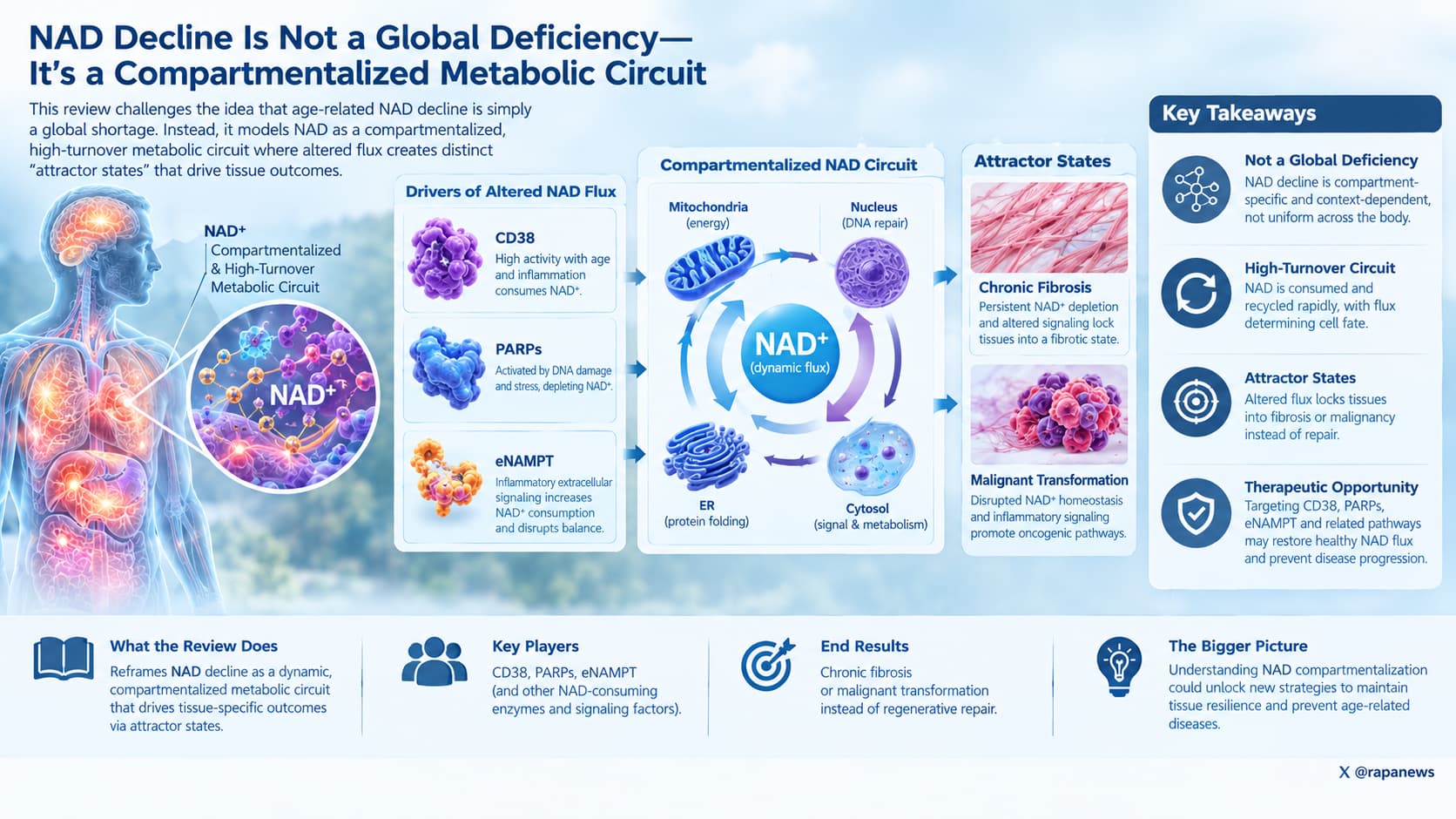
This review fundamentally challenges the prevailing consensus that age-related nicotinamide adenine dinucleotide (NAD) decline is a simple global deficiency. Instead, the authors model NAD as a compartmentalized, high-turnover metabolic circuit where altered flux creates distinct “attractor states” that govern tissue trajectories. Driven by intense consumption from enzymes like CD38 and PARPs, alongside inflammatory extracellular signaling via eNAMPT, these circuits lock aged and injured tissues into chronic fibrosis or malignant transformation rather than regenerative repair.
The prevailing biohacking paradigm treats NAD as a single reservoir that passively drains with age, suggesting that oral precursors like nicotinamide riboside (NR) or nicotinamide mononucleotide (NMN) simply refill the tank. This paper dismantles that model. The authors demonstrate that NAD operates as a highly compartmentalized circuit split across nuclear, cytosolic, and mitochondrial domains. In aged or diseased states, low intracellular NAD is rarely a primary synthetic defect; it is a compensatory response to overwhelming metabolic demand from DNA repair enzymes (PARP1) and calcium-signaling hydrolases (CD38).
The most critical conceptual shift is the decoupling of intracellular from extracellular NAD signaling. Inside the cell, upregulation of the salvage enzyme NAMPT (iNAMPT) is an adaptive survival mechanism that sustains mitochondrial oxidative phosphorylation. Outside the cell, secreted eNAMPT acts independently of its enzymatic function as a danger-associated molecular pattern (DAMP). By agonizing Toll-like receptor 4 (TLR4), eNAMPT drives severe inflammation and endothelial dysfunction. Therefore, simply flooding the system with NAD precursors while leaving extracellular inflammatory cascades active is metabolically inefficient and potentially dangerous.
The review identifies a transient “pro-repair NAD window” occurring immediately after acute injury. If intracellular NAD turnover is maintained during this window, tissues can regenerate. However, if PARP and CD38 hyperactivation plunge NAD below a critical threshold, the tissue collapses into a “fibrotic attractor state”. Once this scar-dominant environment is established, sustained systemic NAD elevation may inadvertently stabilize the very myofibroblasts driving the pathology, or worse, feed the metabolic resilience of emerging tumors.
Actionable Insights
- Prophylactic Timing is Critical: In acute injury models, taking NAD precursors proactively yields vastly superior tissue protection compared to reactive dosing. Specifically, NMN administered 30 minutes prior to a cardiac ischemic event resulted in a 44% absolute reduction in tissue necrosis, whereas administration delayed until the reperfusion phase only yielded a 29% reduction.
- Delayed Central Nervous System Penetration: Biohackers targeting neuroprotection must adjust their time horizons. While human trials show 3000 mg/day of NR achieves a massive 500% relative increase (5-fold) in circulating blood NAD within weeks, translating this into the brain is painfully slow. Detectable increases in cerebral NAD metabolites require at least four continuous weeks of high-dose oral supplementation.
- Restrict NAD in Active Oncology: Systemic NAD boosting in the presence of active malignancies, particularly tumors with high NAMPT expression, provides metabolic buffering that supports tumor survival and DNA repair against chemotherapeutics.
- Modulate Consumption Over Supply: In states of chronic inflammation, repairing the “leak” is more vital than turning up the tap. Strategies targeting CD38 inhibition or eNAMPT neutralization will likely yield higher therapeutic efficacy for established fibrosis than isolated precursor loading.
Context/Source
- Paywalled Paper: NAD circuits in aging, tissue repair and fibrosis, Published 2026 Aug 17.
- Institution: Tulane University School of Medicine
- Country: USA
- Journal Name: Ageing Research Reviews
- Impact Evaluation: The impact score of this journal is 15.5, evaluated against a typical high-end range of 0–60+ for top general science, therefore this is a High impact journal.