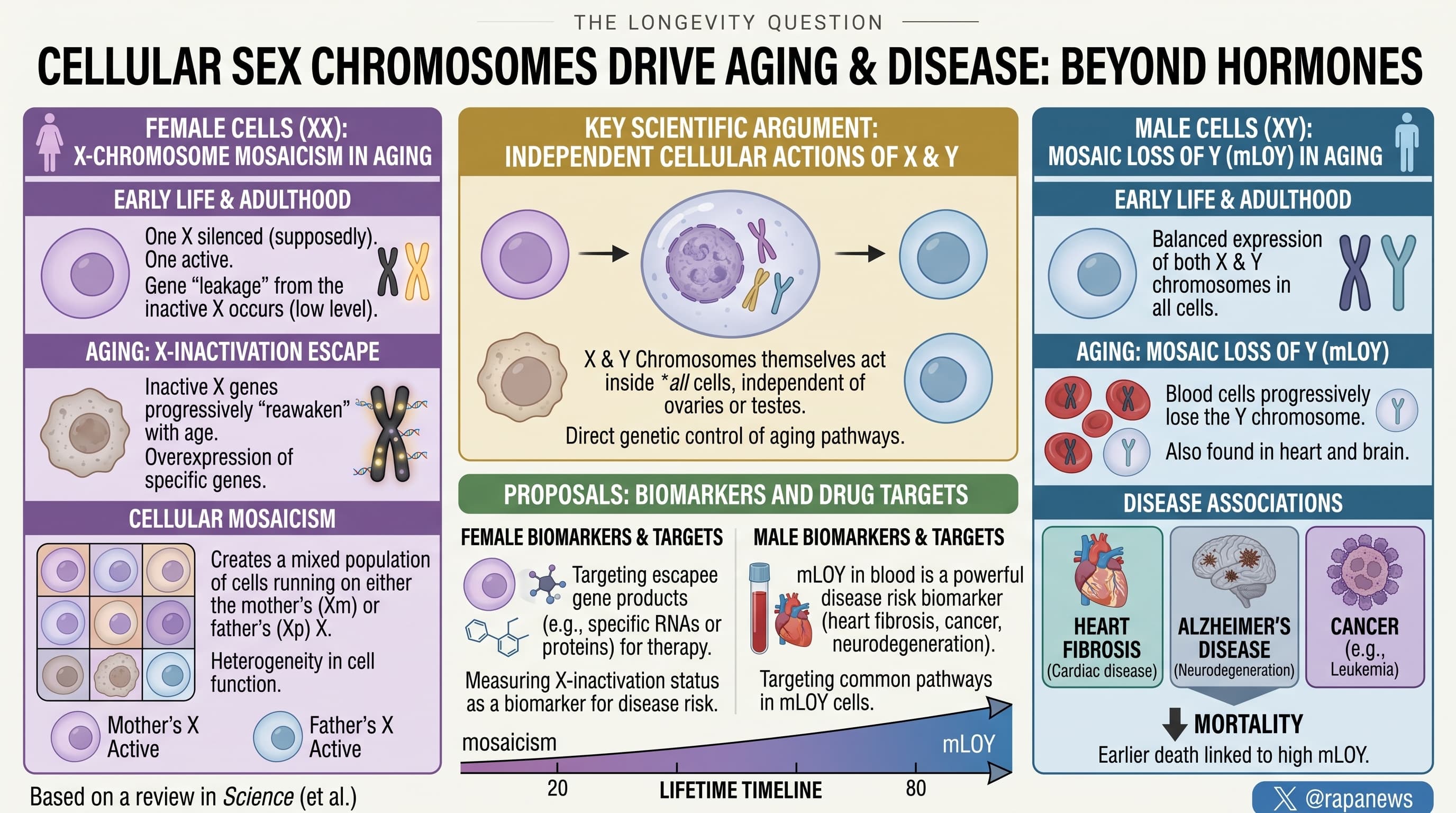
This Science review argues that sex differences in aging and disease are not only hormonal. The X and Y chromosomes themselves act inside cells, independent of ovaries or testes. In women, a supposedly silent second X leaks gene activity, reawakens further with age, and creates a mixed population of cells running on either the mother’s or father’s X. In men, blood cells progressively lose the Y chromosome, which is linked to heart fibrosis, cancer, Alzheimer’s disease and earlier death. The authors propose these features as biomarkers and drug targets.
Women outlive men almost everywhere, including through famines and epidemics. The usual explanation is hormones. This review, from four US research groups, makes the case that a large part of the answer sits in the chromosomes themselves.
The evidence starts with an engineered mouse. In the “four core genotypes” model, the gene that triggers testis development is moved off the Y chromosome, so researchers can breed XX animals with testes and XY animals with ovaries. This separates chromosomes from hormones. In these mice, having two X chromosomes extends survival whichever gonads the animal has.
Why would a second X help? Textbooks say one X in every female cell is switched off. That turns out to be only partly true. In humans, roughly 15 to 30 percent of genes on the “inactive” X stay switched on, giving female cells a higher dose of those genes. One of them, KDM6A, controls how DNA is packaged. Higher KDM6A activity is tied to cognitive resilience in Alzheimer’s disease in people, and boosting it rescued memory in mouse models, including in males.
The silent X also wakes up with age. In old female mice, a myelin gene called Plp1 reactivates on the inactive X in the brain, and raising Plp1 improved cognition in aged mice of both sexes. A third mechanism is mosaicism. Female tissue is a patchwork of cells using either the maternal or paternal X, while male cells have only the maternal copy. In mice, skewing the patchwork toward the maternal X accelerated brain aging.
The second X has costs. The same extra gene dose appears to drive autoimmunity, which is far more common in women. In mice, two X chromosomes also worsen injury after a heart attack or stroke and promote weight gain and fatty liver on a high-fat diet.
For men, the story is loss. With age, a growing fraction of white blood cells drop the Y chromosome entirely. This is the most common acquired chromosome change in aging men, and it tracks with cardiovascular disease, cancers, severe infections and Alzheimer’s disease. Mouse experiments suggest it is not just a bystander: giving mice Y-deficient blood cells caused heart scarring and shortened their lives. Smoking is the strongest known driver, and its effect is partly reversible. In tumors, Y loss predicts worse outcomes but a better response to checkpoint immunotherapy.
The authors want sex chromosome measurements built into diagnostics and clinical trials, and they see drug targets that could help both sexes. That is a proposal, not a result. The paper is a narrative review with no new data, the strongest causal evidence is in mice, and the human findings are mostly correlations. Y loss is even more common in centenarians, so it remains unsettled whether it harms, marks aging, or does both.
Actionable Insights
Very little here is actionable today, and the paper does not claim otherwise.
The one modifiable factor is smoking. It is the strongest known driver of Y chromosome loss in men’s blood and is linked to X loss in women. The review gives no numbers, but the primary study it cites reported, as I recall it, that current smokers had roughly 2.4 to 4.3 times the odds of Y loss, and that former smokers looked similar to never-smokers. Quitting appears to undo much of the excess.
To gauge why Y loss matters: in the UK Biobank study cited, men missing the Y in more than 40 percent of white cells had about a 31 percent higher risk of death from circulatory disease. If a man’s ten-year risk were 5 percent, that would mean about 6.5 percent. This is a modest association, not proof of cause.
There is no validated consumer test for Y loss, X-skew or X reactivation, and no threshold that would change your care. There is also no supplement or drug shown to raise KDM6A or PLP1 safely in humans.
Context and Source
- Open Access Paper: X and Y chromosomes as determinants of aging and disease, 1 Oct 2026.
- Institutions: University of California, San Francisco (Weill Institute for Neurosciences and Bakar Aging Research Institute); Spaulding Rehabilitation Hospital and Harvard Medical School; Oklahoma Medical Research Foundation and Oklahoma City VA Medical Center; University of Arizona Comprehensive Cancer Center
- Country: USA
- Journal: Science (AAAS)
- Impact evaluation: The impact score of this journal is 45.8 (Journal Impact Factor, 2025 listing), evaluated against a typical high-end range of 0 to 60+ for top general science, therefore this is an Elite impact journal.