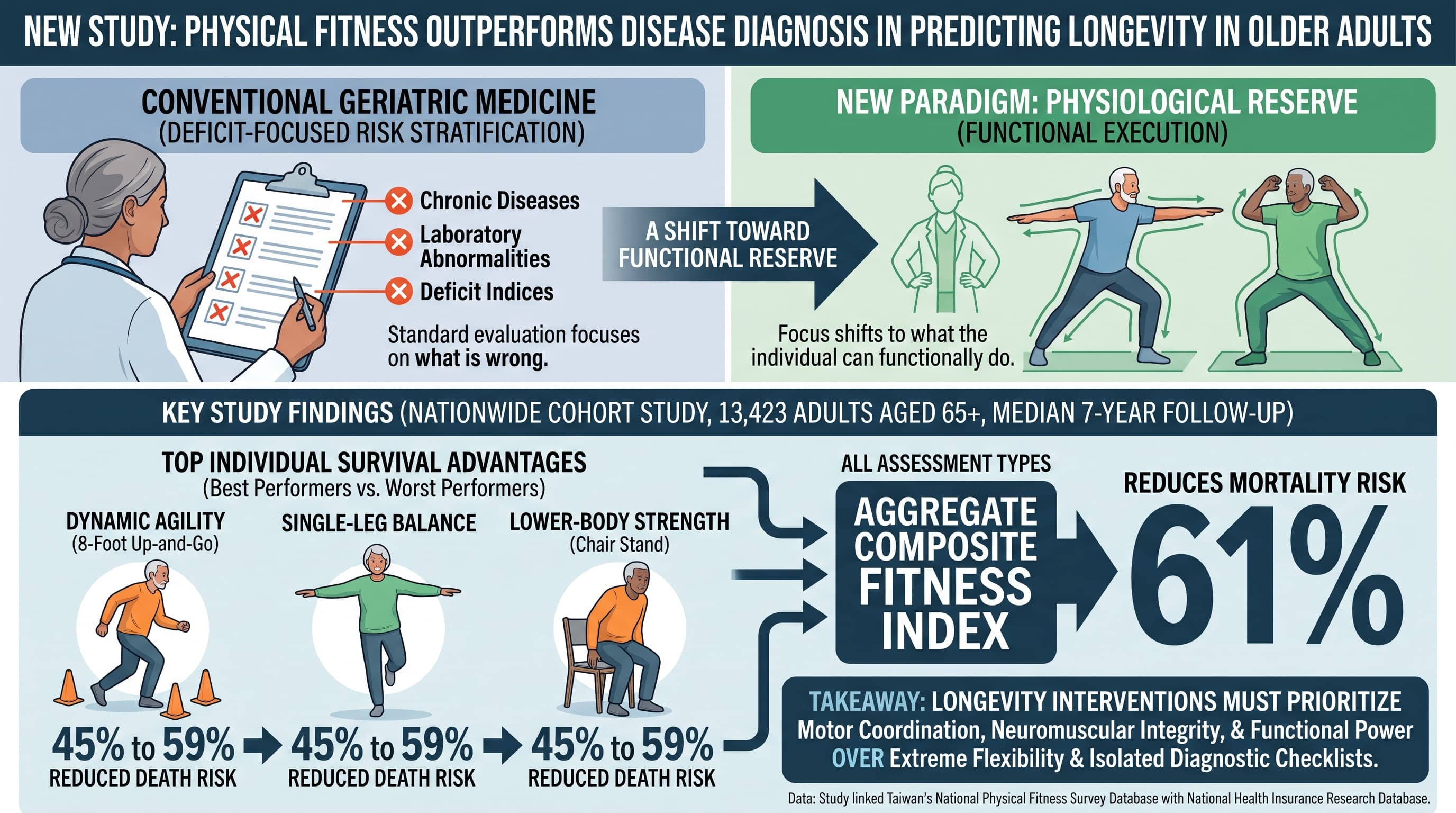
A nationwide cohort study of 13,423 older adults demonstrates that objectively measured physical fitness is an independent predictor of all-cause mortality, outperforming conventional disease-focused risk stratification. Over a median seven-year follow-up, high performance in dynamic agility, single-leg balance, and lower-body strength reduced the risk of death by 45% to 59%, while a composite multi-domain fitness score reduced mortality risk by 61%.
Standard geriatric medicine evaluates mortality risk by cataloging chronic diseases, laboratory abnormalities, and deficit indices. This study shifts the paradigm toward physiological reserve, evaluating what an individual’s neuromuscular and cardiopulmonary systems can functionally execute. Researchers linked Taiwan’s National Physical Fitness Survey Database with the mandatory single-payer National Health Insurance Research Database to track 13,423 community-dwelling adults aged 65 and older over a median follow-up of 7.0 years. During this timeframe, 1,631 participants died.
Participants underwent seven standardized physical assessments evaluating cardiorespiratory endurance, upper-body strength, lower-body strength, flexibility, dynamic agility, and static balance. The findings demonstrate that functional performance robustly predicts survival even after extensive adjustment for age, sex, socioeconomic status, baseline body mass index, ten major chronic medical conditions, and self-reported physical activity.
The strongest individual survival advantages belonged to dynamic agility and balance. Older adults in the top 20% of the 8-foot up-and-go test and the one-leg balance test experienced less than half the mortality rate of those in the lowest 20%. Combining all assessments into an aggregate composite fitness index yielded the steepest gradient, cutting the overall hazard of death by 61%.
The dose-response analysis uncovered critical non-linear dynamics. Survival gains did not advance indefinitely across all domains. For flexibility, such as reaching behind the shoulder blades, mortality risk plummeted when moving out of extreme stiffness but plateaued entirely past a baseline threshold of functional reach. Lower-body power exhibited similar saturation beyond 15 repetitions on the 30-second chair stand test.
These findings indicate that longevity interventions should prioritize motor coordination, neuromuscular integrity, and functional power over extreme flexibility or isolated diagnostic checklists.
Actionable Insights
For clinicians and health-conscious adults, this study provides clear physical benchmarks that translate directly into survival advantages.
-
Prioritize Lower-Body Power: Participants in the top tier of the 30-second chair stand test reduced their mortality risk by 45% (Adjusted Hazard Ratio [AHR] = 0.55; 95% CI, 0.46-0.65) compared to the lowest performers. In absolute terms, death rates dropped from 3.62 to 1.03 deaths per 100 person-years. Aim for at least 15 unassisted chair stands in 30 seconds.
-
Train Balance and Neuromuscular Agility: The highest performers in dynamic agility (8-foot up-and-go) achieved a 59% reduction in death rate (AHR = 0.41; 95% CI, 0.33-0.51; 0.72 vs 4.07 deaths per 100 person-years). Superior static balance (one-leg stance) cut mortality risk by 50% (AHR = 0.50; 95% CI, 0.42-0.59). Target an 8-foot rise-walk-sit time under 7 seconds and a single-leg stance of 15 to 30 seconds.
-
Maintain Moderate Aerobic Endurance: Cardiorespiratory fitness (2-minute step test) showed a 42% risk reduction (AHR = 0.58; 95% CI, 0.49-0.68).
-
Avoid Over-Investing in Flexibility: Extreme stiffness increases mortality risk, but flexibility gains past a basic functional range provide no additional survival dividend. Once basic range of motion is achieved, dedicate training volume to resistance, power, and balance.
Context and Source
- Open Access Paper: Physical Fitness and All-Cause Mortality in Older Adults
- Institutions: National Yang Ming Chiao Tung University, National Taiwan University of Sport, Chung Yuan Christian University, Fu Jen Catholic University, National Sun Yat-sen University, National Taiwan Normal University, Ton Duc Thang University, Chung Shan Medical University
- Country: Taiwan
- Journal Name: JAMA Network Open
- Impact Evaluation: The impact score of this journal is 11.7, evaluated against a typical high-end range of 0–60+ for top general science, therefore this is a High impact journal.