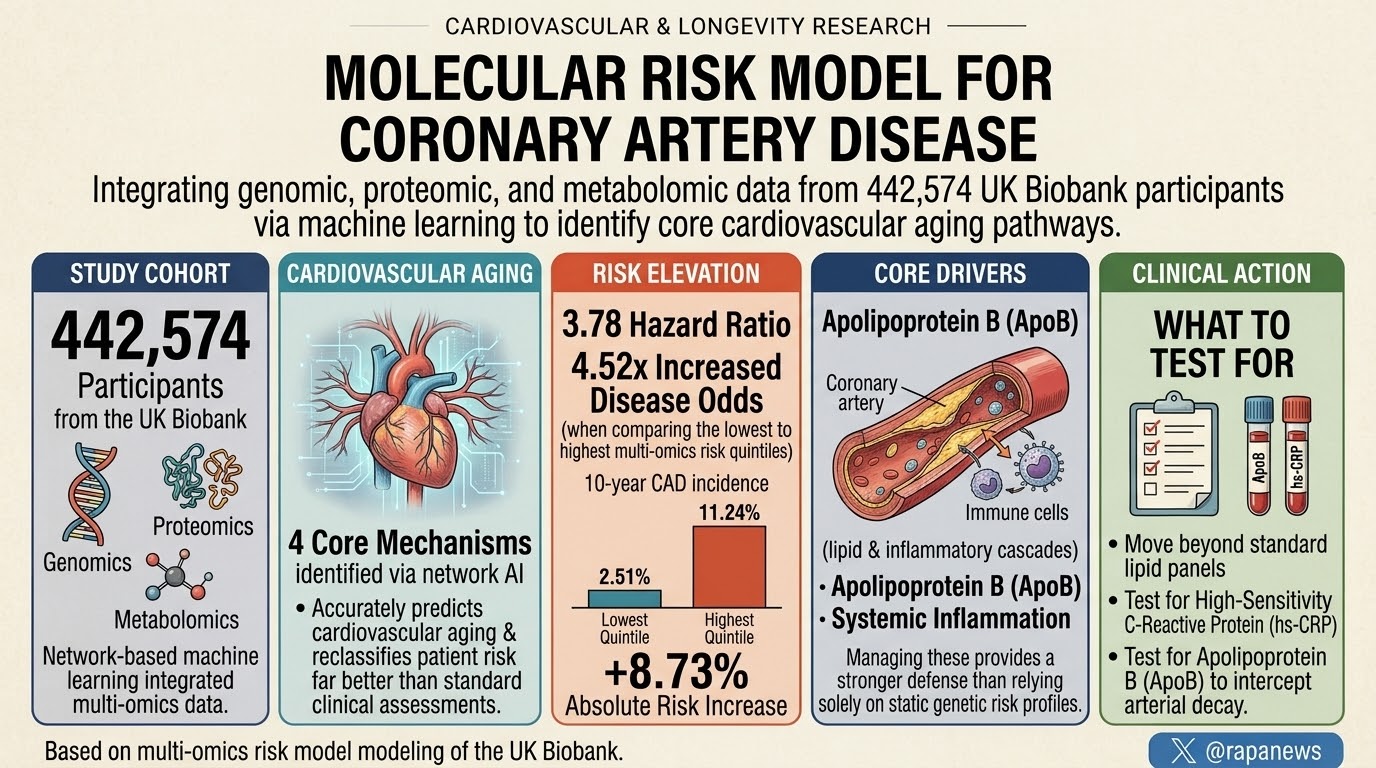
Researchers developed a comprehensive molecular risk model for coronary artery disease by integrating genomic, proteomic, and metabolomic data from 442,574 UK Biobank participants. The team used network-based machine learning to identify four core biological mechanisms driving cardiovascular aging and proved that this combined approach reclassifies patient risk far more accurately than standard clinical assessments.
Cardiovascular risk assessment usually relies on blunt tools. Clinicians look at age, cholesterol, and blood pressure to guess the biological health of a patient’s arteries. This paper outlines a method using genetics, circulating proteins, and metabolic markers to predict heart disease risk with molecular precision. The authors mathematically fused data from nearly half a million individuals to create a unified risk gradient. They found that combining these three distinct biological layers accurately reclassified patient risk profiles much better than standard clinical checklists alone.
The researchers pinpointed four primary drivers of heart disease: vascular dysfunction, lipid metabolism, inflammatory response, and cardiac remodeling. This framework breaks the disease down into measurable molecular pathways. Proteins circulating in the blood provided the strongest individual predictive value. This aligns with practical longevity science because circulating proteins act as direct readouts of current physiological stress, whereas inherited genetic sequences only show baseline predisposition.
The clinical reality is that standard risk calculators miss a lot of people. A patient might appear healthy on paper but harbor silent molecular damage. The integrated multi-omics model caught these hidden cases. It correctly identified high-risk individuals who were previously categorized as intermediate risk. People falling into the highest 20 percent of this multi-omics score faced an 11.24 percent actual 10-year incidence of heart disease, compared to a baseline of 2.51 percent for those in the lowest bracket. This represents a massive gradient in real-world risk.
There are structural compromises in the study architecture. Proteomics and metabolomics were only measured in small subsets of the total population. The authors used a zero-substitution method for missing data, assuming unmeasured components fall exactly at the population average. While they validated this approach internally, applying it broadly in a clinic remains challenging because it requires actual comprehensive testing to work effectively at the individual level.
Actionable Insights
For individuals focused on maximizing healthspan, this research shifts the target from basic cholesterol management to a multi-system approach. The data confirms that managing apolipoprotein B and systemic inflammation provides a stronger defense against cardiovascular aging than relying on static genetic risk profiles. The effect size of these mechanisms is substantial. Moving from the lowest to the highest quintile of multi-omics risk yields a hazard ratio of 3.78, representing a 4.52-fold increase in disease odds. In absolute terms, the 10-year disease incidence jumps from 2.51 percent to 11.24 percent, which is an absolute risk increase of 8.73 percentage points. You can act on this by moving beyond standard lipid panels and testing for inflammatory markers like high-sensitivity C-reactive protein alongside apolipoprotein B. Controlling these factors directly intercepts the lipid and inflammatory cascades responsible for arterial decay.
Context/Source
- Paywalled Paper: Precision medicine breakthrough: Multi-omics integration elevates CAD risk prediction, 2026 Aug 18.
- Institution: Jiangbin Hospital of Guangxi Zhuang Autonomous Region, Guilin People’s Hospital, Nanchang University
- Country: China
- Journal Name: Ageing Research Reviews
- Impact Evaluation: The impact score of this journal is 13.1, evaluated against a typical high-end range of 0 to 60+ for top general science, therefore this is a High impact journal.