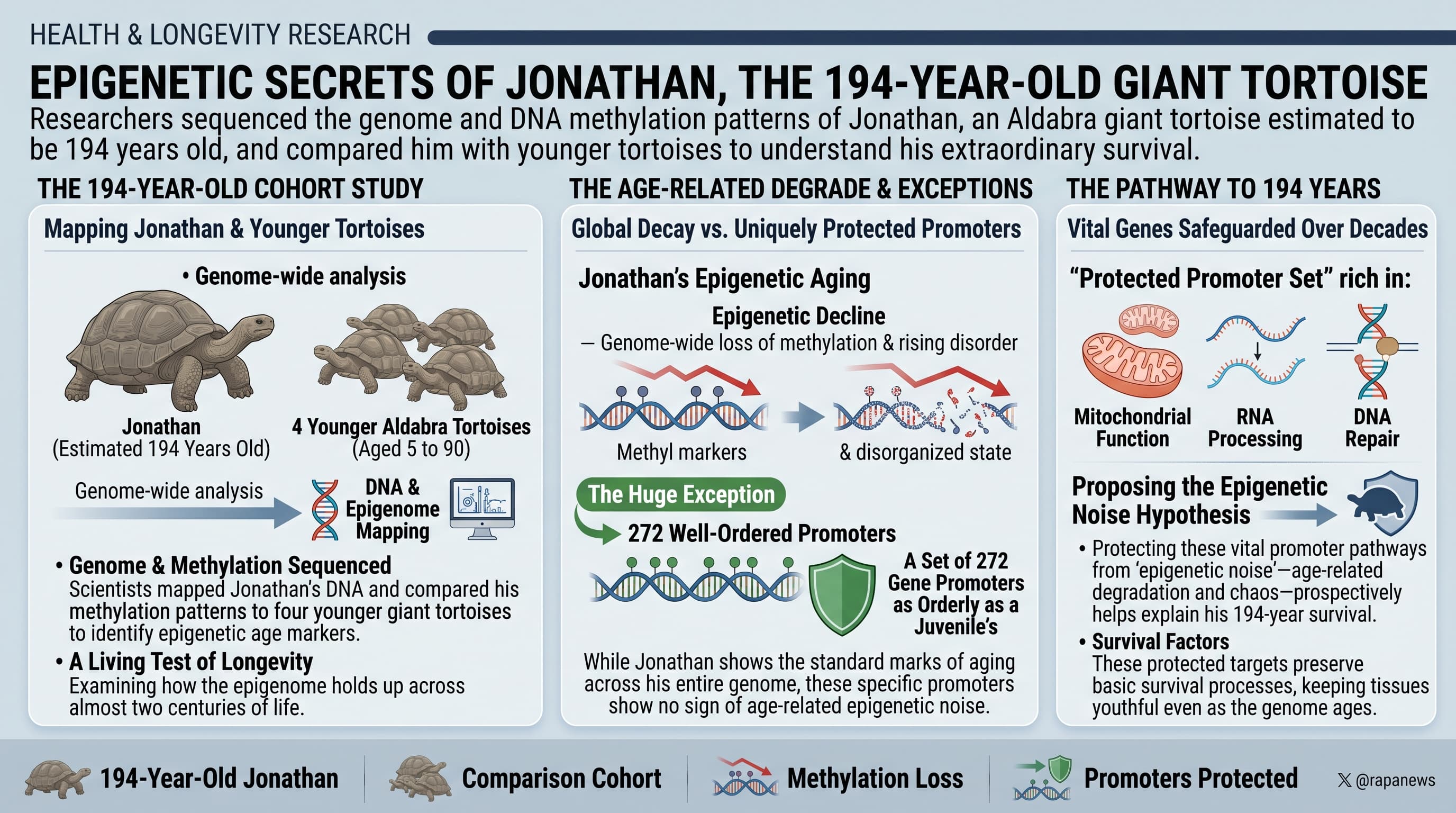
Researchers sequenced the genome and DNA methylation pattern of Jonathan, an Aldabra giant tortoise estimated to be 194 years old, and compared his methylation with four other Aldabras aged 5 to about 90. Jonathan shows the usual marks of epigenetic aging: genome-wide loss of methylation and rising disorder in his methylation pattern. The exception is a set of 272 gene promoters where his pattern is as orderly as a juvenile’s, and that set is rich in mitochondrial, RNA-processing and DNA-repair genes. The authors propose that protecting these promoters from epigenetic noise helps explain his survival.
Jonathan, an Aldabra giant tortoise living on the South Atlantic island of St Helena, is thought to be 194 years old. That makes him the oldest known land animal and roughly a century past the usual upper limit for his species. A team led by the Kallel Foundation in Nashville has now read both his genome and his methylome, the pattern of chemical tags on DNA that helps decide which genes are switched on.
The headline result is less flattering than the tortoise’s reputation suggests. Jonathan has not escaped epigenetic aging. Compared with a 5-year-old juvenile, his DNA has lost methylation across most of the genome, and about 91 percent of the regions that differ between the two animals carry fewer tags in Jonathan. Genes that guide embryonic development have gained tags instead. Both changes are textbook signs of aging in mammals, humans included.
The researchers also measured methylation entropy, a score of how disordered the tagging pattern has become. Tidy patterns are a feature of young cells. Disorder accumulates over time and, when it reaches the control regions of genes known as promoters, it is linked to erratic gene activity. Across five tortoises aged 5 to 194, whole-genome entropy rose in step with age, and Jonathan sat at the top.
The interesting part is the exception. In 272 gene promoters, Jonathan’s entropy was as low as that of the two youngest animals, while two tortoises of about 90 showed clear disorder. That set of 272 was unusually rich in genes that build and run mitochondria, the cell’s power plants, including parts of the respiratory chain and the scaffolding that shapes the inner mitochondrial membrane. Genes for RNA processing and DNA repair also featured.
From this the authors sketch a model: orderly promoters keep mitochondrial genes firing steadily, a steady energy supply pays for DNA repair, and good repair in turn keeps those promoters orderly. A similar promoter pattern has been reported in long-lived Chinese people, which gives the idea some support from a second species.
The genome itself yielded a long list of candidates. Jonathan carries 770 genes flagged as positively selected and 287 genes with protein-changing variants not seen in the other tortoises examined, many in DNA repair, telomere maintenance and insulin signaling. Like other giant tortoises, he has a duplicated copy of LAMTOR4, a gene in the mTOR growth pathway that rapamycin targets.
The caveats are large. This is one exceptional animal compared with four others, using cheek swabs because St Helena officials would not allow a blood draw. No one measured gene activity, mitochondrial performance or anything else that would show the tidy promoters matter. The 272 genes were selected precisely because they fit the pattern the authors were looking for, and only about a tenth of the tortoise’s promoters could be read at all. The authors acknowledge their data cannot establish cause.
What the study offers is a hypothesis worth testing in other long-lived animals: that surviving to an extreme age may depend less on stopping the epigenetic clock than on protecting a small set of genes from its noise.
Insights
There is nothing in this paper you can take, eat or do. What it does offer is a sense of scale and a direction. Jonathan’s 194 years are about 2.1 times the estimated upper limit for his species (93.7 years) and 2.4 times the mean (80.5 years). The human equivalent would be someone living well past 200. Yet his overall epigenetic disorder still rose with age, so extreme survival did not require a stopped clock.
The one distinctive signal covers 272 of 2,895 readable gene promoters, or 9.4 percent. Of those, 35 (13 percent) are mitochondrial. In that subset, the two tortoises of about 90 showed roughly three to four times Jonathan’s entropy (values read from the figure). The subset was chosen to show exactly that contrast, so the gap is inflated.
The practical reading is modest. The result adds weak, indirect support to the view that preserving mitochondrial function matters in late life. The interventions with human evidence for that remain the familiar ones, chiefly regular aerobic and resistance exercise. This paper does not test them and does not strengthen the case for any supplement.
Context/Source
- Open Access Paper: Epigenetic insights into extreme longevity in the world’s oldest terrestrial animal, Jonathan
- Lead institutions: Kallel Foundation (Nashville), Igenbio Inc. (Chicago) and Vanderbilt University Medical Center, with collaborators at UCLA, Harvard Medical School, University of Minnesota, Technical University of Munich, University of Cambridge, University of Copenhagen and the St Helena Government
- Country: USA (lead), with Germany, UK, Denmark and St Helena
- Journal: Science Advances, published 7 October 2026
- Impact evaluation: The impact score of this journal is 13.9 (Journal Impact Factor, 2025 data year, released June 2026), evaluated against a typical high-end range of 0 to 60+ for top general science, therefore this is a High impact journal.