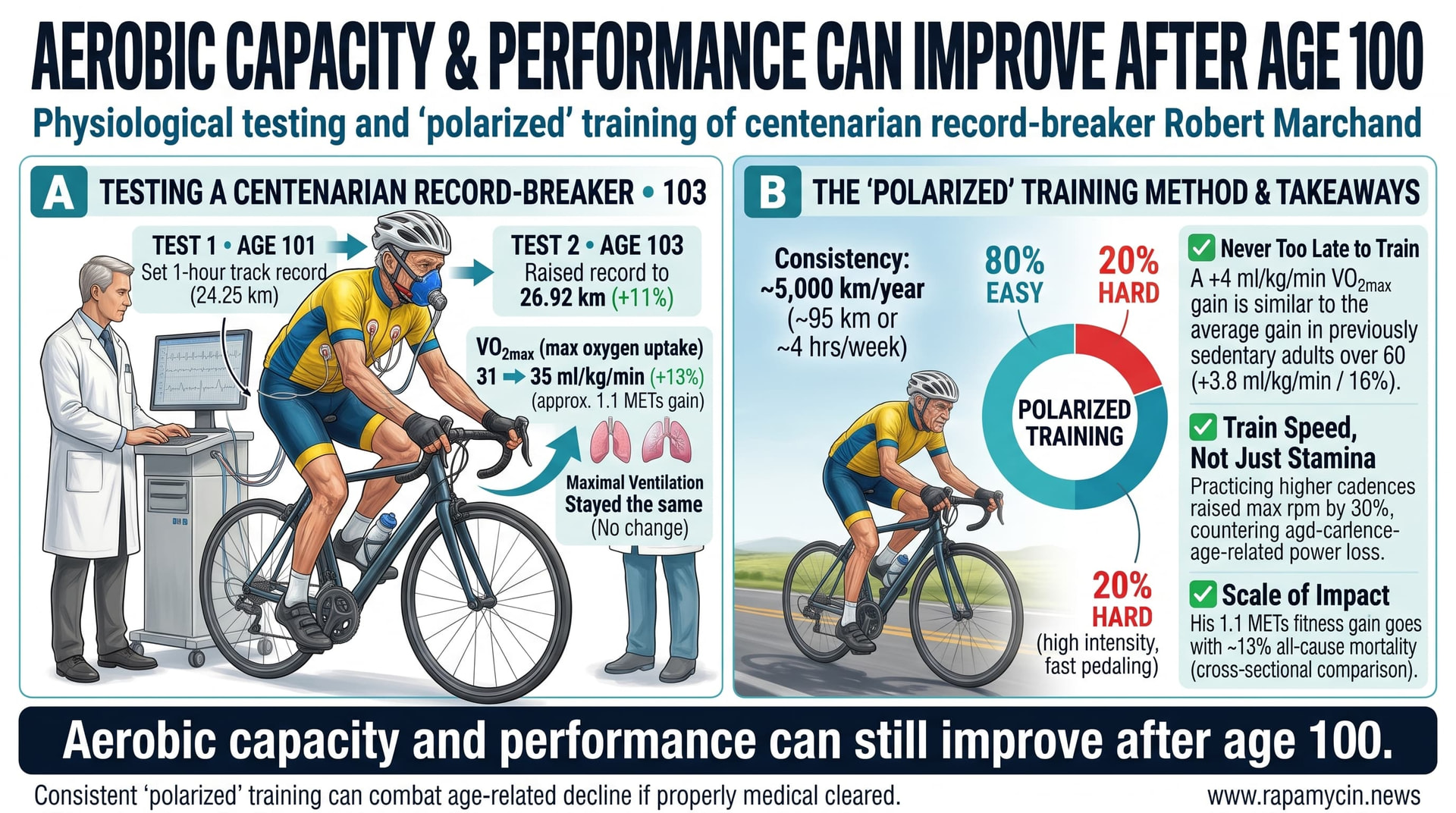
French physiologists tested Robert Marchand, a 101-year-old amateur cyclist, before he set the one-hour track record for riders aged 100 and over (24.25 km). They tested him again two years later, before he raised it to 26.92 km at age 103. In between he rode about 5,000 km a year using “polarized” training: roughly 80% of his distance at an easy perceived effort and 20% at a hard effort, with an emphasis on faster pedaling. His weight-adjusted maximal oxygen uptake (VO2max) rose from 31 to 35 ml/kg/min (13%). His peak power rose from 90 to 125 W (39%), largely because his maximal pedaling rate increased from 69 to 90 rpm. Maximal ventilation rose 23%, while maximal heart rate stayed the same. The authors conclude that aerobic capacity and performance can still improve after age 100.
Aerobic fitness is among the strongest predictors of survival and independence in later life, and it falls steeply with age. In healthy adults the decline speeds up from a few percent per decade in early adulthood to more than 20% per decade after 70, even in people who stay active. That makes a simple question hard to answer: by the tenth decade, can the body still respond to training at all?
Robert Marchand offered a rare chance to find out. Born in 1911, he raced as a teenager, gave up cycling for most of his working life as a gardener and wine merchant, and returned to it in retirement. In 2012, at 100, he set the first hour record for centenarians. Véronique Billat’s team at the Université d’Evry tested him in the laboratory before that attempt at 101 and again two years later.
Over those two years he followed a structured plan built on perceived effort, not heart rate or power meters. Most of his riding was easy. About a fifth was hard. Every session focused on keeping his pedaling cadence relatively high, because older riders tend to drift toward slow, grinding cadences.
The results were striking for a man of his age. His VO2max rose 13%, to 35 ml/kg/min. That is roughly the level of an inactive 50-year-old, or an endurance-trained 80-year-old. Most of the gain came from a real increase in oxygen use, not just from losing a little body fat. His maximal heart rate did not change, which means the heart pumped more blood per beat, the muscles extracted more oxygen from it, or both. His maximal breathing capacity rose by almost a quarter.
The largest change was in power. His peak output on the lab bike rose 39%, mainly because he could spin the pedals much faster at maximum effort. Aging muscle loses speed and power faster than endurance, so a gain in movement speed after 100 is notable. On the track he rode 11% farther than before, while working at a smaller share of his new maximum.
This was not a trial. There was one subject, no comparison group, and no muscle biopsies, blood tests or heart imaging. The two hour records were ridden on different tracks with different bikes. The first lab test may not have pushed him fully to his limit, and some reported values do not agree with each other. Marchand was also exceptional in every way: very lean, free of disease and medication, and among the oldest people alive.
Two years after the second test, at 105, he rode 22.5 km in an hour, about 16% less than at 103. Training seems to have bought him a temporary rise above his aging trajectory, not an escape from it. He died in 2021 at 109.
Even so, the case makes a point worth taking seriously: the cardiovascular, respiratory and neuromuscular systems can still respond to a well-designed training stimulus after a century of aging.
Actionable Insights
- It is not too late to train. Marchand’s VO2max rose by 4 ml/kg/min. That is about the same as the average gain (3.8 ml/kg/min, or 16%) in trials of previously sedentary adults over 60, and it came at 101 from a man who was already trained.
- Make most training easy and some of it hard. His plan was about 80% easy and 20% hard by perceived effort. That needs no monitor or meter, just an honest sense of “conversational” versus “hard.”
- Train speed, not just endurance. Practicing higher cadences raised his maximal pedaling rate by 30%. Since aging erodes power faster than stamina, include some faster movement in your training.
- Consistency mattered. About 5,000 km a year averages roughly 95 km a week, or about 4 hours of riding.
- Scale: his gain was about 1.1 METs. In meta-analyses comparing people, each 1-MET higher fitness level goes with about 13% lower all-cause mortality. That is a between-person comparison, not proof that an individual’s gain buys the same benefit.
- Get checked first. He had an ECG twice a year and cleared a cardiac exam before maximal testing. Anyone starting hard training late in life should do the same.
Context and Source
- Open Access Paper: Case Studies in Physiology: Maximal oxygen consumption and performance in a centenarian cyclist, Published 2017, Mar 1.
- Institutions:
- Unit of Integrative Biology of Adaptations to Exercise (EA 7362), Université d’Evry Val d’Essonne, Genopole, Evry (lead)
- Hôpital Henri Mondor, Université Paris-Est Créteil
- Université Sorbonne Paris Cité
- Centre de Médecine du Sport CCAS, Paris
- Country: France
- Journal: Journal of Applied Physiology, Published by the American Physiological Society.
- Impact evaluation: The impact score of this journal is 5.9 (Scopus CiteScore), evaluated against a typical high-end range of 0-60+ for top general science, therefore this is a Medium impact journal.