Hi Karl. For what you say, I see that there are some parts of the story that maybe you don’t know, so I will tell you about it. The “substance” was a secret for 3 and half years, until October 2023, when Katcher published an article in the journal Geroscience describing the whole isolation process, so then we learnt that the “substance” was extracellular particles containing small extracellular vesicles from young pigs plasma. Also, when that article was published in 2023, Steve Horvath had already updated his epigenetic age clocks, so the rejuvenation wasn’t of 54% anymore, but of 67%. You say that the company started, and then “it all just falls trough the cracks”. An important fact is that according to Google Patents, the patent wasn’t granted yet. Also, Katcher is 81 years old. So, what happened with the company is plausible. However, I agree that the whole story is odd. At the same time, there are many elements in the story that indicates that it’s possible that those extracellular particles really rejuvenated the rats, including the many scientific articles published by other scientific groups in recent years showing that small extracellular vesicles (even from other species) could rejuvenate mammals. So, it’s precisely the ambiguity of this research that led my wife and I to start this initiative of reproducing the experiment, in a non-profit environment, with total transparency of materials, methods and results, without seeking any intelectual property. We want to know if it’s true, you see? I’m in doubt about the original experiment of Katcher since I read his article for the first time more than 5 years ago. And I’m still in doubt. Our experiment exists precisely because of this doubt.
Hi Hamtaro. The doubts about Sima experiment are well explained in your post. So, as I just explained to Karl, those doubts are an example of what drives my wife and I to reproduce Katcher’s seminal experiment. I see many people in the rejuvenation field that either think that Katcher’s experiment results are real or think they are not real. I don’t think that those are the only two alternatives. In my case, I’m in doubt, because at the same time that there are strange elements in the story, there are many indications that it’s true. So, I can’t simply continue with this doubt, since if the experiment was valid, the whole world could change. This needs to be clarified as soon as possible.
@nico_cher You and your wife are doing a courageous scientific experiment. I am interested in seeing your results, and I am sure many people here are too. I wish you all the best and I hope you can beat Sima’s record!
a new video and interview Nicolás @nico_cher and Nina
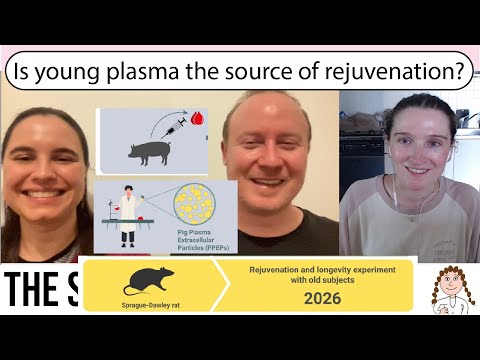
The video explores efforts to reproduce pig plasma experiments that claim to reverse aging in rats.
Here are the key points from the video “Reproducing Rejuvenation: Inside the Pig Plasma Longevity Experiments”:
Background and Motivation
- The video features an interview with Nicolás and Nina from the Rejuvenation Science Institute in Brazil, who are working to reproduce headline-making results from experiments where concentrated plasma fractions from young pigs were injected into aging rats.
- The original research suggested dramatic rejuvenation effects, including up to 54% epigenetic age reversal in rats, but was based on a small sample and lacked detailed methodology, prompting skepticism and a need for independent replication.
- The Rejuvenation Science Institute was founded to openly reproduce these experiments and share all results, positive or negative, to advance longevity science.
Scientific Rationale
- The approach is inspired by heterochronic parabiosis (connecting the circulatory systems of young and old animals), which has shown that young blood can rejuvenate older animals.
- The pig plasma experiments aim to isolate and concentrate youth-promoting factors from young pig blood, then inject them into old rats to see if aging can be reversed at the molecular and functional level.
- The theory behind the experiments is that aging is regulated by systemic signaling, and that plasma contains factors capable of resetting cellular aging programs.
Experimental Details
- The plasma fraction is prepared by centrifuging pig blood, precipitating extracellular particles, and further purifying them through chromatography and dialysis.
- Initial safety tests showed no acute toxicity or immune reaction in rats, and the next phase will test for actual rejuvenation effects.
- The upcoming experiment (scheduled for June 2026) will use 40 rats in four groups (old treated, old control, young treated, young control) and measure epigenetic age, organ function, and behavioral outcomes over several months.
- If positive results are seen, the team plans to extend the study to longevity experiments and further molecular characterization.
Open Science and Collaboration
- The institute is committed to transparency, publishing all methods and results, and collaborating with other scientists and organizations.
- Funding is provided through donations and crowdfunding, with a goal of making the research accessible and reproducible by others.
- The team invites scientists and supporters to visit Brazil and observe the experiments firsthand.
Implications and Cautions
- If the results are reproducible, it could represent a major breakthrough in aging research, potentially leading to therapies that systemically reduce age-related disease risk.
- However, the team and other scientists caution that results in rats may not translate directly to humans due to species differences.
- The ultimate goal is to identify the signaling mechanisms behind rejuvenation, which could allow for synthetic or targeted interventions in the future.
On January 7, from Josh Mitteldorf’s blog: “As of a month ago, Harold had received funding to go into production creating enough E5 to treat a human, perhaps himself. He had hired a lab technician and was training the person.”
Hi, I kindly ask you to post the mentioned link to Josh Mitteldorf’s blog comment as I can’t find it there. Thank you.
This is great news! Thank you so much for sharing, argonaut.
I hope Harold can see some incredible effects on himself and that the whole idea can be further validated - and hopefully confirmed and scaled. I also remember that his treated hand looked really good with E5 applied.
I bought some Bluegel a few years ago, and it was a great product. So, I’m hoping for the best 
They can get started right away! They won’t have to wait for him to age.
what is bluegel? Thanks
It’s a topical skin care product with GHK-cu in it.
I ordered some a couple years ago but it was too heavily scented for me to use.
So I make my own skin care products without any added scents for friends and family
I think they went into this market to generate some income to finance the E5 program. I don’t think they make it anymore. Skin care / cosmetics is a very competitive market and if you are not prepared to pay $50 to acquire each new customer, it will fail. It’s a marketing driven space, dominated by major brands and celebrities.
Yes Steve is right, it was a skin care product with a high percentage of GHK-cu.
As I recall, the purpose of making blue gel was to make profit to use in developing E5. I lost track of how long it’s been since E5 was started and died on the vine.
I had never heard of GHK-cu, but I looked it up, and it appears to be great for the skin.
The Brazilian replication is starting in April:
Executive Summary
Thesis: The transcript details a critical independent replication study of the “E5” protocol (young porcine plasma fraction), originally developed by Dr. Harold Katcher. Katcher’s 2023 study (GeroScience) claimed a staggering 67% reduction in epigenetic age across multiple tissues in rats, a magnitude of effect unprecedented in longevity literature.
Core Argument: The interviewee, Nicolas Chernavsky (Rejuvenation Science Institute, Brazil), argues that aging is driven by circulating signal molecules (“Aging by Signaling” hypothesis) rather than purely stochastic damage accumulation. By replacing the “old” signaling environment with a “young” one derived from piglets, the study aims to trigger endogenous repair mechanisms (similar to partial reprogramming) without the oncogenic risks of OSKM factors.
Critical Analysis: While the premise relies on the well-established biology of heterochronic parabiosis, the claim of 67% rejuvenation rests heavily on specific epigenetic clocks (Horvath’s mammalian array) which may not perfectly map to functional lifespan extension. The “Sima” rat from the original study lived ~47 months (a record, but not a 67% extension of maximum lifespan), suggesting a potential decoupling between clock readings and mortality. This replication is vital to validate whether E5 is a true rejuvenation therapy or a clock-hacking artifact.
Insight Bullets
- Replication Target: The study aims to reproduce the results of Katcher et al. (2023), specifically the 67% epigenetic age reduction observed in Sprague-Dawley rats.
- Compound Identity (PEPs): The therapeutic agent is “Pig Plasma Extracellular Particles” (PEPs), previously termed “E5.” It is not whole plasma but a fraction concentrated for exosomes/nanoparticles.
- Source Material: Plasma is harvested from 6-month-old post-adolescent pigs (standard slaughter age), leveraging the high developmental signaling of young animals.
- Cross-Species Efficacy: The protocol bets on the high conservation of biological signaling; pig exosomes are hypothesized to be non-immunogenic and functional in rats (and potentially humans).
- Dosing Schedule: 4 injections over 8 days (Days 1, 3, 5, 7), followed by a 90-day washout, then a second round. This pulsatile dosing mimics the “hit-and-run” nature of epigenetic reprogramming.
- Specific Fractionation: The protocol uses PEG (Polyethylene Glycol) precipitation followed by Size Exclusion Chromatography (SEC) to isolate nanoparticles, removing immunogenic proteins and platelets.
- Clinical Endpoints: Primary: Epigenetic Age (Horvath Clock). Secondary: Grip strength, memory (spatial), and blood panel (10 markers).
- Lifespan Extension: Unlike Katcher’s original study (which sacrificed rats for tissue), this study will keep treated rats alive to measure maximum lifespan, the “gold standard” of longevity.
- Interim Readouts: Grip strength and memory data will be available as early as May/June 2026, offering leading indicators before the final epigenetic analysis in Dec 2026.
- “Aging by Signaling”: The theoretical framework posits that cells retain the capacity for youth but are suppressed by “pro-aging” signals (or lack of “pro-youth” signals) in the blood.
- Operational Pivot: The start date was moved up to April 2026 due to unexpected mortality in the 23-month-old control group, highlighting the frailty of the aged animal model.
- Funding Model: The study is crowdfunded ($75k) via the Heales Foundation and DoNotAge, adopting a “radically open science” approach to avoid IP silos (contrast with Calico/Altos Labs).
- Regulatory Loophole: By characterizing the agent as a “natural biological fraction” rather than a synthetic drug, the path to clinic could theoretically be faster, though safety remains the primary hurdle.
- Sima’s Legacy: The original “Sima” rat lived 47 months. For this replication to be a success, treated rats must statistically exceed the ~36-month standard maximum lifespan of Sprague-Dawley rats.
Adversarial Claims & Evidence Table
| Claim from Video | Scientific Reality (Current Data) | Evidence Grade | Verdict |
|---|---|---|---|
| “Katcher… reports a rejuvenation of 67% epigenetically… in all rats.” | Validated in literature. Katcher et al. (2023) reported substantial clock reversal. However, “rejuvenation” of function (lifespan) was significant but less dramatic than the clock suggested. | Level B (Animal RCT) | Strong Support (Clock Data Only) |
| “Exosomes from young pigs had a rejuvenation effect on older rats.” | “Young blood” benefits are well-established (heterochronic parabiosis). Exosome-specific transfer is supported by recent data (e.g., Small 2024, Nature Aging). | Level B (Animal Data) | Plausible |
| “Preparation… is filtering of nanoparticles… includes exosomes but it’s not only exosomes.” | Accurate. PEG + SEC isolation yields a heterogeneous population of Extracellular Vesicles (EVs), protein aggregates, and coronas. It is not “pure” exosomes. | Level D (Biochem) | Verified |
| “We injected… pig plasma particles… into rats [with] no immune reaction.” | Cross-species EV administration is surprisingly well-tolerated due to high homology of exosomal surface proteins (CD63, CD81), but repeated dosing risks anaphylaxis or antibody formation. | Level D (Prelim Safety) | Safety Warning |
| “Aging is determined by signaling in the blood… not accumulation of damage.” | This is the “Programmed Aging” vs. “Damage” debate. Heterochronic parabiosis supports signaling, but entropy/damage is still a factor. It is likely a mix of both. | Level E (Theory) | Speculative |
| “Embryo rejuvenates… we already know rejuvenation exists.” | Biologically true. The “ground zero” event in embryogenesis resets the epigenetic clock (Gladyshev et al.). The challenge is replicating this soma-wide in adults. | Level A (Dev Biology) | Fact |
Key Study Cited:
- Katcher, H., et al. (2023). “Reversal of biological age in multiple rat organs by young porcine plasma fraction.” GeroScience. PubMed Link
Actionable Protocol (Research & Monitoring)
WARNING: The following is an experimental laboratory protocol for rodent research only. Do not attempt to process or inject porcine blood products at home. Zoonotic disease risk (HEV, PERVs) and severe immunogenic shock are lethal risks.
Investigational Protocol (For Lab Replication)
- Source: Plasma from 6-month-old pigs (Post-pubertal/Young Adult).
- Fractionation Steps (The “E5” Method):
- Preparation: Centrifuge whole blood to remove RBCs and Platelets (Platelet-Poor Plasma).
- Precipitation: Add PEG 6000 (Polyethylene Glycol) to plasma. Incubate at 4°C overnight to precipitate high-molecular-weight complexes and EVs.
- Clarification: Centrifuge to pellet the precipitate. Discard supernatant. Resuspend pellet in PBS.
- Purification: Run resuspended solution through a Size Exclusion Chromatography (SEC) column (e.g., Sepharose CL-2B or commercial qEV) to isolate the nanoparticle fraction (30-150nm range).
- Concentration: Use dialysis membranes to remove excess PEG and concentrate the “PEP” fraction.
- Dosing (Rat Model):
- Intravenous (tail vein) or Intraperitoneal (IP).
- Schedule: 4 doses total, administered every other day (Day 1, 3, 5, 7).
- Cycle: Repeat every 90 days.
Analyst Monitoring Strategy
To validate this intervention without waiting for the 2027 final report, track these Interim Signals:
- May 2026 (Month 1): Look for the “Grip Strength” report. In the original study, treated old rats matched young controls almost immediately. If this fails, the epigenetic data is likely irrelevant.
- July 2026 (Month 3): Look for “Spatial Memory” data (Barnes Maze or Morris Water Maze). Cognitive restoration is the hardest phenotype to fake.
- Rat Mortality: Monitor the control group survival curve vs. treatment. If treated rats start dying at 26-30 months alongside controls, the “67% rejuvenation” is a clock artifact, not true biological reversal.
Technical Mechanism Breakdown
The intervention operates on the “Epigenetic Remodeling via Circulating Factors” pathway.
- The Payload (EVs): Young porcine plasma contains Extracellular Vesicles (EVs) loaded with “pro-youth” cargo:
- miRNAs: Small non-coding RNAs (e.g., miR-21, miR-126) that silence pro-inflammatory and senescence-associated genes.
- Proteins: Factors like GDF11, TIMP2, and possibly Yamanaka-like pluripotency factors (Oct4/Sox2) in trace amounts.
- The Target (Epigenome): Upon injection, these EVs fuse with recipient cells. The cargo enters the cytoplasm and translocates to the nucleus.
- The Effect (DNA Methylation): The factors recruit Ten-Eleven Translocation (TET) enzymes. TET enzymes catalyze the demethylation of specific CpG sites (cytosines followed by guanines) that have become hypermethylated with age.
- The Outcome (Transcriptional Reset): This removes “epigenetic noise,” restoring the gene expression profile to a youthful state. The result is improved mitochondrial function, reduced senescence (SASP), and restored stem cell regenerative capacity. The study essentially tests if exogenous signaling can trigger this endogenous reset.
Looking forward to the results. If I were running it I couldn’t help myself but apply some topically to my own skin as a mini experiment.
I did something crazy about 1.5 years ago. I tried to replicate it by flooding my system with exosomes, but that’s kind of impossible—so I ended up with about the same amount of exosomes that are already circulating in my blood instead of 4×. I did this for a few days. But I do not recommend it. I’m still unsure whether it hurt or helped me.
We’ll have to be patient with this.
Katiii,
I read through this discussion and I’m sure that I must have just missed it, but can you tell me where you got these exosomes and how you administered them. And, are you referring to E5 type exosomes or something else?
Thanks,
Jay
Great questions, Jay! I’m neither a doctor nor a slaughterer, so there was no blood involved.  There are different sources and methods (e.g. centrifugation). But no matter the route, you need an insane amount of raw material, and there’s no safe way to go further and administer this to yourself. And you don’t even know whether it could work at all.
The risk–reward profile isn’t great.