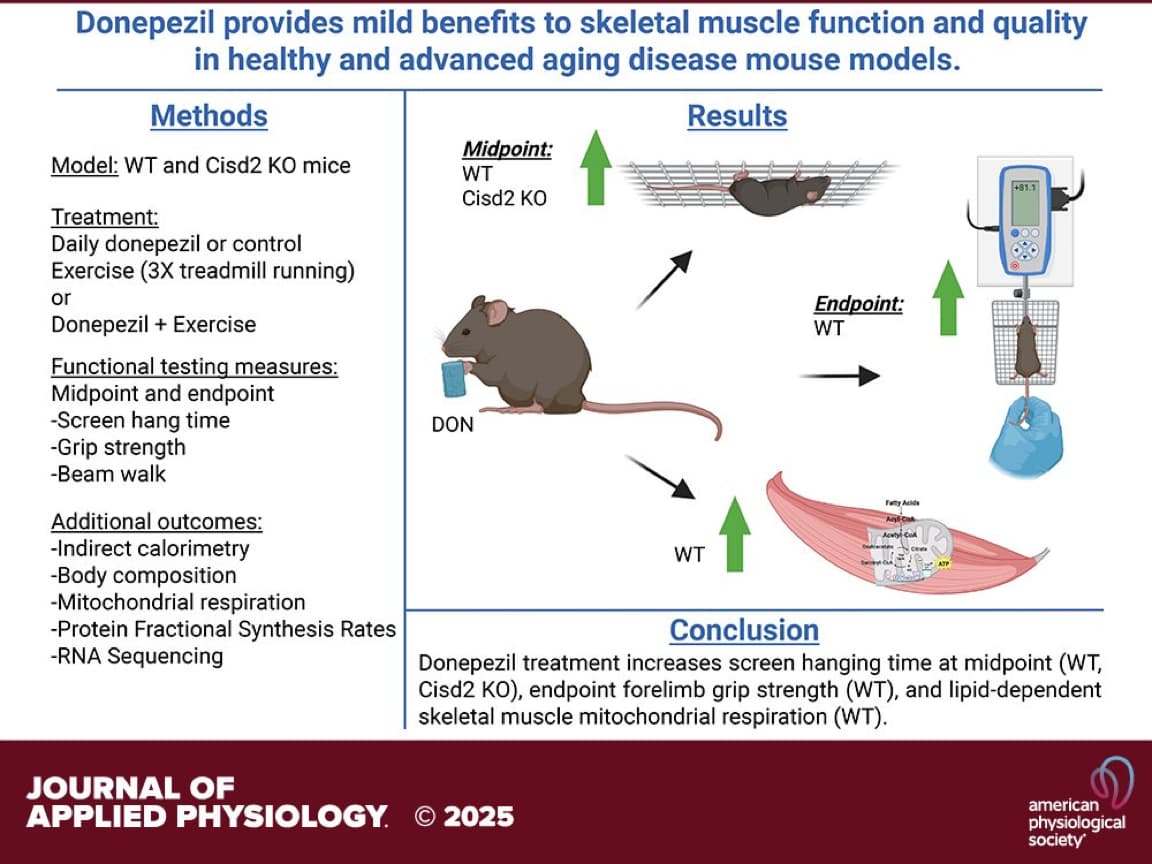
Researchers at the University of Kansas Medical Center gave young healthy mice and Cisd2 knockout mice (a premature aging model) the Alzheimer’s drug donepezil for 11 weeks, with or without treadmill training. In healthy mice, donepezil produced modest gains in forelimb grip strength, longer midpoint screen hanging, about 8% higher non-resting energy expenditure, and changes in muscle mitochondrial respiration and lipid-metabolism genes. Combined with exercise, it increased quadriceps mass and reduced balance-beam slips. In the knockout mice, benefits were minimal, and donepezil reduced absolute muscle mass. The authors call the evidence preliminary.
Muscle loss with age is one of the strongest predictors of frailty, falls and death, and medicine has almost nothing to offer beyond exercise. A team at the University of Kansas Medical Center thinks part of the answer may sit at the junction where nerves meet muscle, and that an old dementia drug might help.
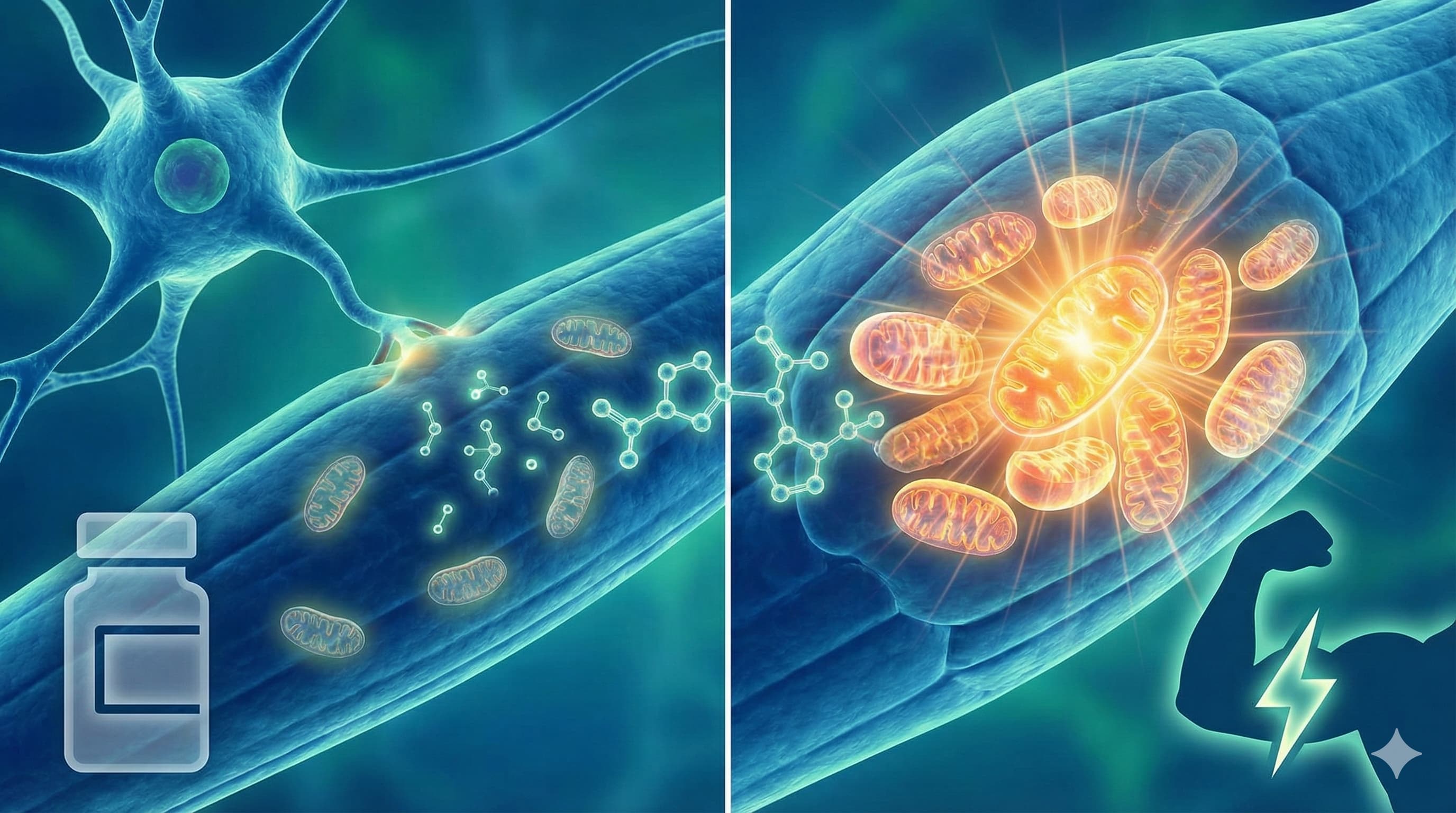
The idea came from an unexpected observation. In an earlier human study, the same group found that older adults with mild cognitive impairment who happened to be taking donepezil had better muscle mitochondrial respiration than untreated patients with the same diagnosis. Donepezil blocks acetylcholinesterase, the enzyme that clears acetylcholine. That is how it helps memory in the brain, but acetylcholine is also the chemical messenger that tells muscles to contract. Slowing its breakdown at the neuromuscular junction could, in theory, strengthen every nerve signal to the muscle.
To test this, the researchers fed donepezil-laced treats daily to young mice for 11 weeks, starting at about one month of age. Half of the animals also ran on a treadmill three times a week. Two types of mice were used: normal mice and mice lacking the Cisd2 gene, which develop weak muscles, faulty mitochondria and other features that resemble early aging.
In normal mice, the drug produced measurable but modest changes. Forelimb grip strength rose by roughly 7 to 8% by the end of the study. Every treated mouse reached the 30-minute maximum on an upside-down screen hanging test at the midpoint, compared with about 20 minutes for untreated controls. Treated mice moved around more and burned about 8% more energy during activity. Muscle fibers from treated mice showed altered mitochondrial respiration with fat as fuel, and genes for fat transport and burning were switched on.
The most intriguing result came from combining the drug with exercise. Treadmill-trained mice on donepezil had about 10% heavier quadriceps than trained mice without it, and they slipped about two thirds less often on a narrow balance beam. Donepezil alone did the opposite on quadriceps mass, lowering it by about 9% in sedentary mice. That pattern hints that the drug may amplify the training signal rather than build muscle on its own.
The aging-model mice were a disappointment. Donepezil improved midpoint hanging time and reduced late-study beam slips, but it lowered absolute leg muscle mass and did not correct the underlying defects. Not every finding pointed in a good direction either. Donepezil increased the share of muscle fibers lacking dystrophin, a structural protein whose loss is linked to muscle damage. In knockout mice, the drug combined with exercise worsened a memory test score.
The bigger picture is a proof of concept, not a prescription. These were young animals, not old ones, and many of the gains were small, inconsistent between the midpoint and endpoint, or did not reach statistical significance. Still, the study puts a new target on the map. If supporting the nerve-muscle connection can make exercise work harder, it could matter for older people who struggle to train enough to hold on to their strength. The next step is testing in naturally aged animals, where the neuromuscular junction is already in decline.
Source:
- Open Access Paper: Donepezil treatment, alone or combined with exercise, enhances skeletal muscle function in healthy and advanced aging disease mouse models
- Institution: University of Kansas Medical Center, USA.
- Journal: Journal of Applied Physiology.
- Impact Evaluation: The impact score of this journal is 3.3 (JIF) / 6.0 (CiteScore), evaluated against a typical high-end range of 0–60+ for top general science, therefore this is a Medium impact journal. (It is a respected, specialized physiology journal, though not a broad-reach “glamour” journal).
Part 2: The Biohacker Analysis
Study Design Specifications
- Type: In vivo (Murine model).
-
Subjects:
- Species: Mouse (Mus musculus).
- Strains: C57BL/6J (Wild Type - WT) and Cisd2 knockout (Cisd2KO - a model of premature aging/mitochondrial dysfunction).
- Sex: Male and Female.
- N-number: 10–12 mice per group (Total ~44–48).
- Duration: 11 weeks (Treatment ran from age 4 weeks to 15 weeks).
- Lifespan Data: None reported. The study endpoint was 15 weeks of age (young adult). This was a functional healthspan study, not a mortality study.
Mechanistic Deep Dive
The authors hypothesized that increasing acetylcholine availability via Donepezil (DON) would improve neuromuscular junction (NMJ) stability and mitochondrial quality.
- Mitochondrial Respiration: DON treatment significantly increased State 3 respiration (ADP-stimulated) using palmitoylcarnitine (lipid substrate). This indicates an enhanced capacity for Fatty Acid Oxidation (FAO) in the gastrocnemius muscle.
- Neuromuscular Junction (NMJ): RNA-seq analysis revealed DON altered gene expression specifically related to NMJ integrity and synaptic transmission, potentially countering the “dying back” of motor neurons seen in sarcopenia.
- Systemic Metabolism: DON increased non-resting energy expenditure in WT mice, suggesting a systemic metabolic upregulation, likely driven by the increased mitochondrial demand.
- Dystrophin Modulation: The study noted alterations in dystrophin expression, a structural protein critical for muscle fiber integrity, though the directionality (reduced in WT, distinct in KO) suggests a remodeling process rather than simple upregulation.
Novelty
- Peripheral vs. Central: We know DON works in the brain. This paper provides rare in vivo evidence that DON acts peripherally on skeletal muscle mitochondria, independent of exercise.
- Mitochondrial “Unlocking”: The finding that an acetylcholinesterase inhibitor specifically rescues lipid-based respiration is novel. It suggests the cholinergic system is a gatekeeper for metabolic flexibility in muscle tissue.
- Cisd2 Rescue: Efficacy in the Cisd2KO model (which mimics mitochondrial-driven aging) validates the drug’s potential in treating mitochondrial frailty, not just generic weakness.
Critical Limitations
- Age of Subjects: This is the most glaring weakness. The mice were treated from 4 to 15 weeks old. These are developing/young adult mice. The “aging” model was genetic (Cisd2KO), not chronological. We have zero data from this paper on whether DON reverses sarcopenia in naturally aged (e.g., 24-month-old) mice.
- Supratherapeutic Dosing: The dose (~5 mg/kg) translates to a very high human dose (see Part 3). The effects seen might be pharmacological artifacts of high dosing rather than physiological restoration.
- Thermal Stress Confounder: The authors admit behavioral testing was done at room temperature (22°C), which is cold stress for mice (thermoneutrality is ~30°C). Cholinergic drugs affect thermoregulation; the “increased energy expenditure” could partially be an enhanced shivering/thermogenic response to cold.