Not sure if I buy that. Here in Hong Kong, we experience numerous typhoons (there’s a super typhoon tomorrow, which is closing work and school for two days!). Yet we have one of the highest life expectancies anywhere.
I haven’t watched the video, but I’m not sure if I think inclement weather causes people to die earlier unless it unleashes some kind of bacteriological disaster.
Overall, no significant associations were found between PM2.5, NO2 exposure, and PD onset for this cohort, or in males, females, and those aged 50+ years. However, we found some evidence of a statistically significant association between air pollution exposure and PD onset, using our prescriptions-based proxy, among under-50s. In the absence of alternative measures of PD onset for this cohort, it remains unclear how to interpret this estimated association.
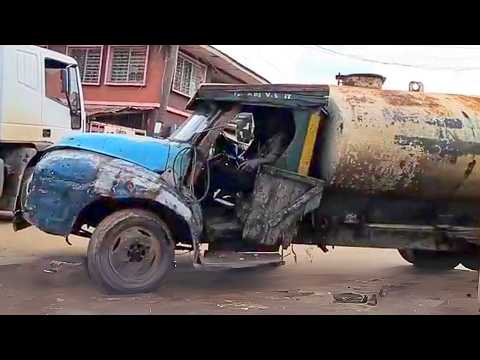
This is not directly related, but speaking of air pollution, it also depends on the car exhaust control technology as in this example - pretty amazing:
10 Most Broken Cars Still Driving in Africa (Turvoi)
E.P.A. to Stop Considering Lives Saved When Setting Rules on Air Pollution
In a reversal, the agency plans to calculate only the cost to industry when setting pollution limits, and not the monetary value of saving human lives, documents show.
For decades, the Environmental Protection Agency has calculated the health benefits of reducing air pollution, using the cost estimates of avoided asthma attacks and premature deaths to justify clean-air rules.
Not anymore.
Under President Trump, the E.P.A. plans to stop tallying gains from the health benefits caused by curbing two of the most widespread deadly air pollutants, fine particulate matter and ozone, when regulating industry, according to internal agency emails and documents reviewed by The New York Times.
It’s a seismic shift that runs counter to the E.P.A.’s mission statement, which says the agency’s core responsibility is to protect human health and the environment, environmental law experts said.
Analysis of postmortem brains from children & young adult from fine particulate matter (PM2.5)-exposed metropolitan Mexico City (n=189, avg age=26yrs) finds 37% of under 17yrs had evidence of Alzheimer’s & Parkinson’s-associated neuropathological markers.
The California Air Resources Board recommends portable mechanical air cleaners with a high-efficiency particulate air (HEPA) filter that collects very small particles and does not emit ozone or other harmful substances.
Make a ‘clean air room’ — and keep it cool
The EPA suggests designating a ‘clean air room’ in your home, one you can quickly seal off from any outside air and in which you can run a portable clean air filter. If excessive heat is a concern where you live, and you have a room with an air conditioner, this room might be best to select — just be sure to keep the fresh-air intake closed on any air conditioners to prevent outdoor smoke from getting inside. If it’s not feasible to designate a single clean air room, consider purchasing multiple portable air purifiers and ensure your home is properly sealed to outside air.
During heat waves, pay attention to temperature forecasts and know how to stay safe in the heat. Even if you don’t have air conditioning, keep doors and windows closed. This can reduce pollutant levels by 50%, according to the EPA. If you can’t stay cool at home or at a friend or relative’s house, the EPA suggests seeking relief at a clean air shelter or other large building with air conditioning and good filtration.
Stock up on filters for your air purifiers now
Whether for portable air purifiers or a central HVAC system (if you have one), it’s a good idea to stock up on replacement air filters before the need arises. If you wait until smoky air descends, the EPA warns, supplies may be out of stock or may not arrive in time to be helpful.
If you’re using a central HVAC system, make sure to purchase high-efficiency filters rated MERV-13 or higher.
As for N95 masks with exhalation valves, it’s worth noting that these masks work well for wildfire smoke and may be easier to breathe through longer-term. But they’re less effective at stopping the spread of diseases like COVID — even with tape over the valve.
When we had air index reaching 460 for 2 days in July because of Canadian fires smoke I was wearing a portable hepa filter. It’s an N95 mask with a flexible tube attached that connects to hepa filter hanging near chest. Worked very well, supplied strong flow of clean air, but…looked ridiculous (not that I cared much). After two days of that hell I had to leave the area for a few days. Air pollution gets pricier and pricier.
I have an older levoit and a Coway Omega Mighty I bought last year. This is my first test of the Coway in smoke and what I found interesting and worth sharing is the house smells like an ashtray, yet the auto detection still has it running on low and the air quality light is blue (for good air). The Levoit auto mode didn’t detect anything either.
Claude Fable told me that happens and is to be expected. (And yes, I’m overriding it)
I also learned from Fable I had wrongly sized my air purifiers for my house due to large rooms PLUS high ceilings. I was not thinking about ceiling heights!
I now have 3 large Blueair Signatures on the way. I hesitated spending so much money, but I after fighting with myself, I realized spending all this money on supplements but being frugal on my air quality is exactly the wrong move. It still hurts my soul!!!
Researchers at the Icahn School of Medicine at Mount Sinai have found that wildfire smoke may carry greater health risks than equivalent amounts of air pollution from other sources.
Two large-scale studies examined long-term exposure to wildfire-related fine particulate matter (PM2.5), finding stronger associations with cardiovascular and respiratory hospitalisations, as well as poorer survival among people with lung cancer.
The research, led by first author Min Zhang, PhD, and senior author Yaguang Wei, PhD, compared wildfire-related PM2.5 with pollution from non-wildfire sources.
Together, the findings suggest that the source of air pollution may matter as much as the amount people are exposed to.
Wildfire-related PM2.5 was linked with greater health risks per unit of exposure, suggesting that wildfire smoke represents a distinct environmental health concern rather than simply another source of particulate pollution.
Wildfire smoke and lung cancer survival
The first study investigated the relationship between long-term wildfire-related PM2.5 exposure and survival among older adults diagnosed with lung cancer.
Researchers analysed data from 414,016 people aged 65 and over using the SEER-Medicare database.
Researchers estimated exposure to wildfire and non-wildfire PM2.5 based on where participants lived, using total ambient PM2.5 estimates developed by the researchers alongside wildfire-specific estimates produced by Stanford University researchers.
Full story:
New Research Papers referenced in the news story:
Cardiopulmonary hospitalization risks from wildfire-specific and non-wildfire PM2.5 in 20 US states