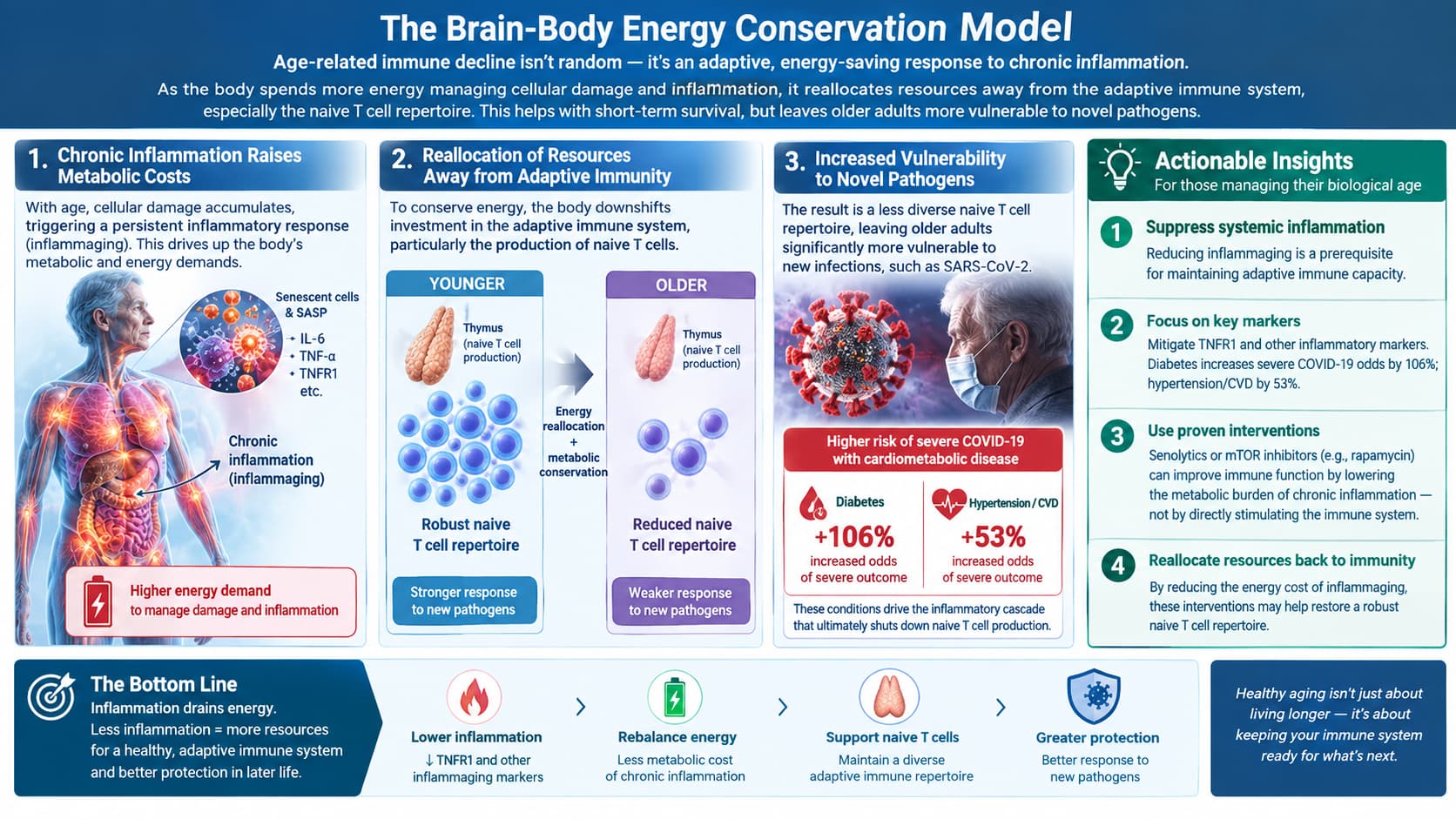
A new theoretical framework, the Brain-Body Energy Conservation model, suggests that age-related immune decline is not simply a random failure of bodily systems but an adaptive, energy-saving response to the rising metabolic costs of chronic inflammation. As the body expends energy to manage accumulating cellular damage, it reallocates resources away from maintaining the adaptive immune system, specifically the naive T cell repertoire. While this strategy promotes short-term survival, it leaves older adults significantly more vulnerable to novel pathogens like the virus responsible for COVID-19.
The aging process is characterized by two distinct but concurrent immune phenomena: inflammaging, the steady rise of chronic, sterile systemic inflammation, and immunosenescence, the progressive decline of adaptive immunity. For decades, researchers have viewed these processes as parallel dysfunctions. However, recent data from two massive human cohorts, the US Health and Retirement Study and the UK Biobank, strongly suggests a direct, resource-driven link between the two.
The Brain-Body Energy Conservation model views the human body as a closed economic system with a finite metabolic budget. In later life, total and basal energy expenditures actually decrease. Yet, the accumulation of senescent cells creates a highly energetically demanding environment due to their continuous senescence-associated secretory profile signaling. To fund the high metabolic cost of managing this chronic cellular damage, the body must divest energy from other systems. The primary victim of this biological budget cut is the adaptive immune system.
Maintaining a robust naive T cell repertoire through the thymus is an expensive investment in future protection. When resources are tight, the body prioritizes immediate survival over future defense. This results in thymus involution and a sharp drop in naive T cells. The data reveals that markers of inflammaging, specifically Tumor Necrosis Factor Receptor 1 (TNFR1), directly mediate the decline in naive T cells. As TNFR1 levels rise, naive T cell counts fall.
Furthermore, this energy conservation response is governed by specific signaling molecules. The metabolic stress marker GDF-15 and the anti-inflammatory cytokine IL-10 both increase with age and chronic disease. These molecules act as metabolic brakes, suppressing the immune response to conserve energy. The real-world consequence of this trade-off is stark. Individuals with higher levels of these exact markers prior to the pandemic experienced significantly higher rates of hospitalization and death from COVID-19. The body’s attempt to survive the chronic stress of aging left it defenseless against a novel acute threat.
Actionable Insights
For individuals actively managing their biological age, the primary takeaway is that suppressing systemic inflammation is a prerequisite for maintaining adaptive immune capacity.
First, mitigating inflammaging markers, particularly TNFR1, is critical. The data shows that having diabetes increases the odds of severe COVID-19 outcomes by 106 percent, while hypertension or cardiovascular disease increases the odds by 53 percent. These cardiometabolic diseases drive the inflammatory cascade that ultimately shuts down naive T cell production.
Second, the reliance on GDF-15 as a key mediator of immune suppression highlights the importance of managing metabolic stress. Each standard deviation increase in GDF-15 was associated with significantly reduced naive T cell counts and higher vulnerability to novel infections.
Finally, interventions known to reduce the senescence-associated secretory profile, such as senolytics or mTOR inhibitors like rapamycin, likely improve immune function not by stimulating the immune system directly, but by reducing the energetic burden of inflammaging. By lowering the metabolic cost of chronic inflammation, these interventions may allow the body to reallocate resources back toward maintaining a robust naive T cell repertoire.
Context/Source
- Paywalled Paper: Evidence for an energy conservation model of inflammaging and immunosenescence in the US Health and Retirement Study and UK Biobank.
- Institutions: Arizona State University (USA), University of Sherbrooke (Canada), Columbia University (USA).
- Journal: The Journals of Gerontology, Series A: Biological Sciences and Medical Sciences.
- Impact Evaluation: The impact score of this journal is 5.1, evaluated against a typical high-end range of 0 to 60+ for top general science, therefore this is a Medium impact journal.