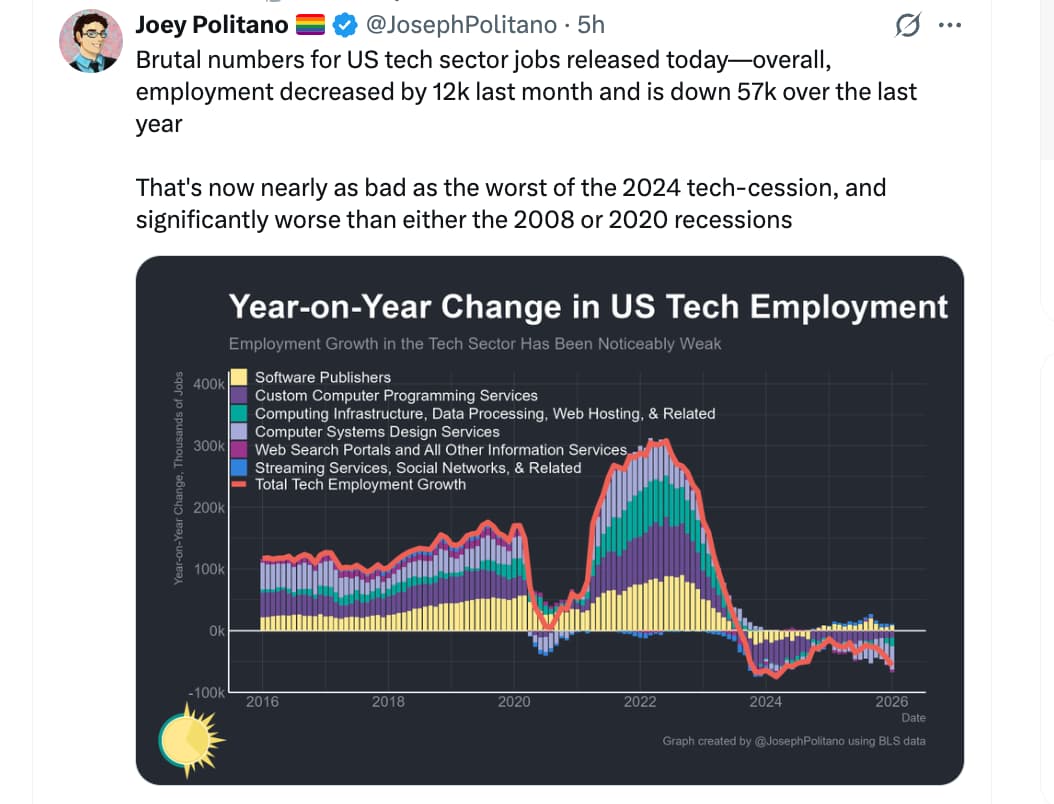
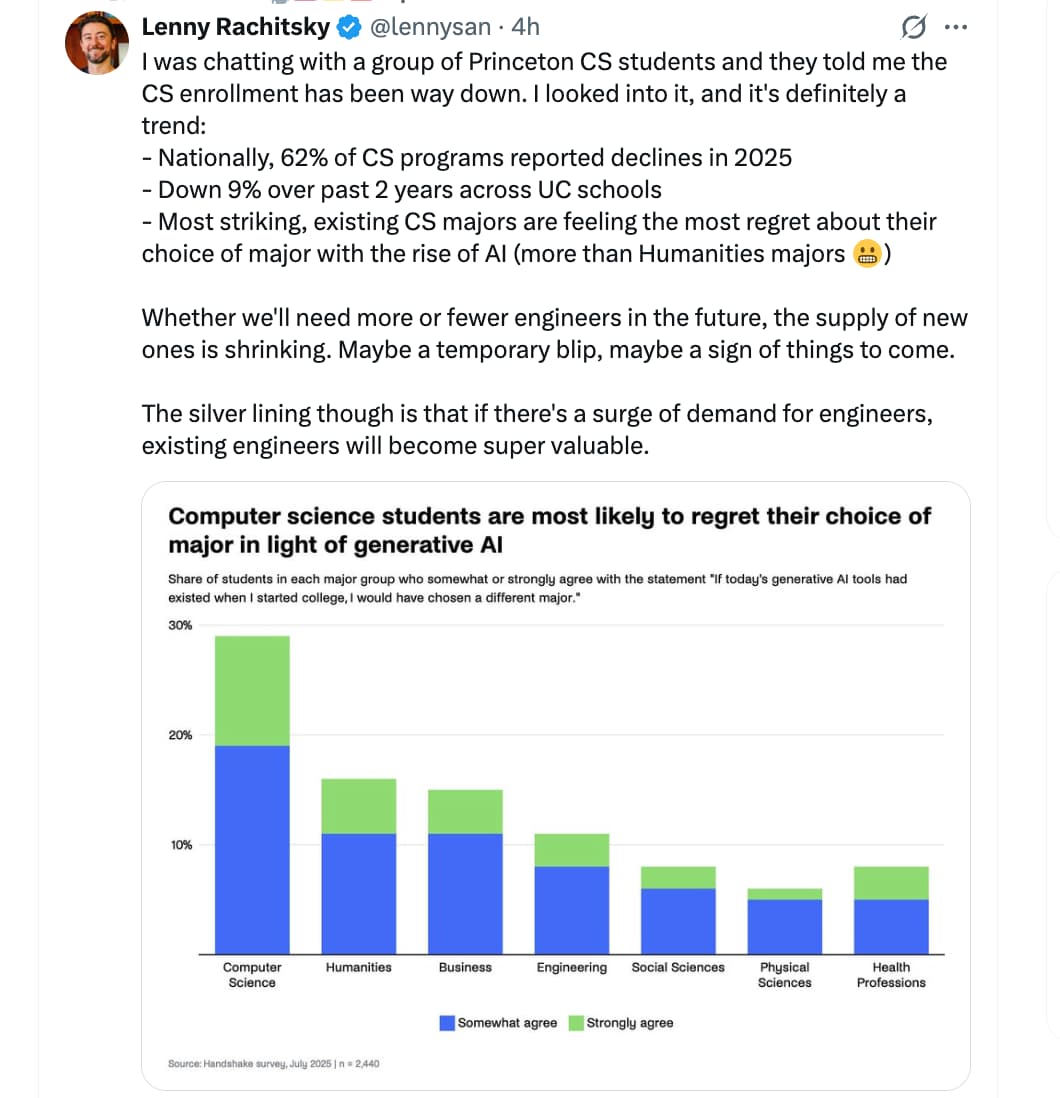
The probability of losing your job to AI in the next few years (?):
https://www.axios.com/2026/03/05/anthropic-ai-jobs-claude
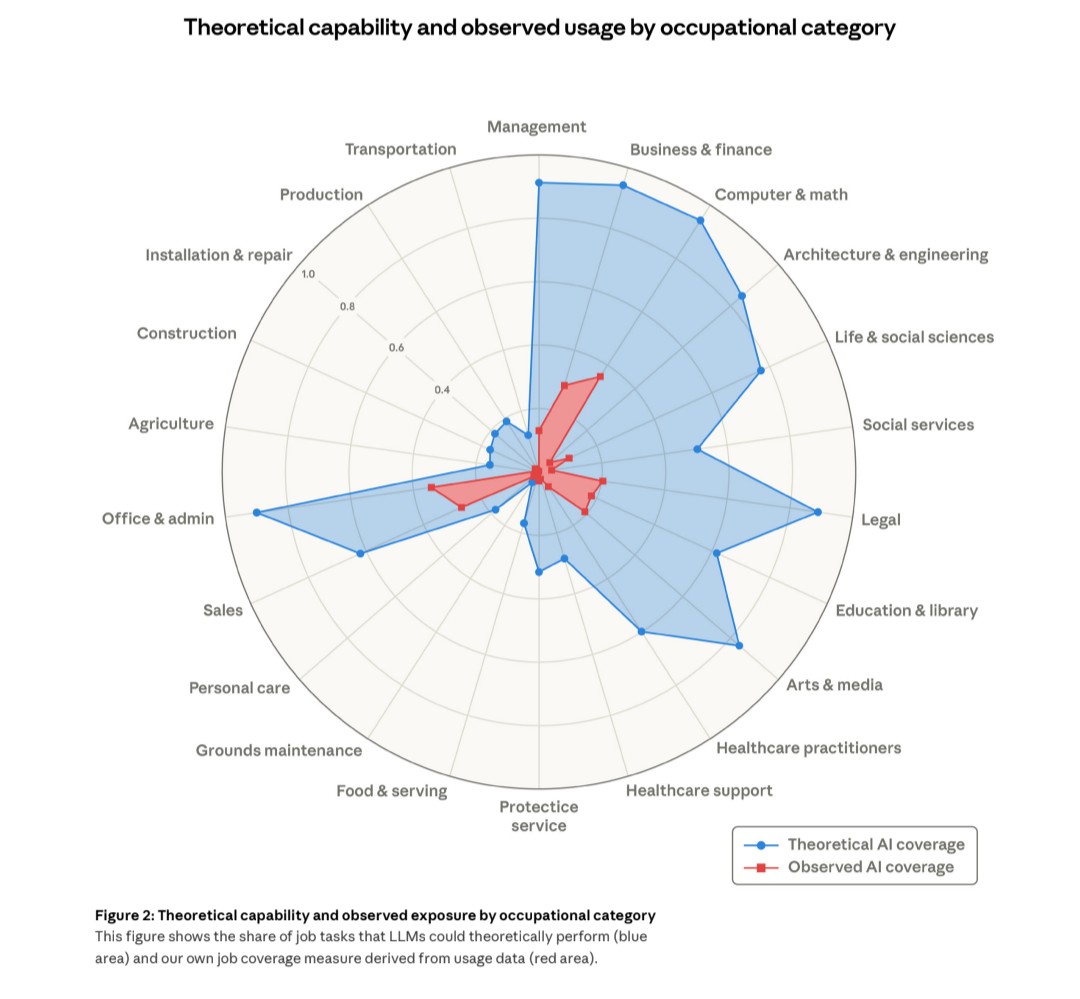
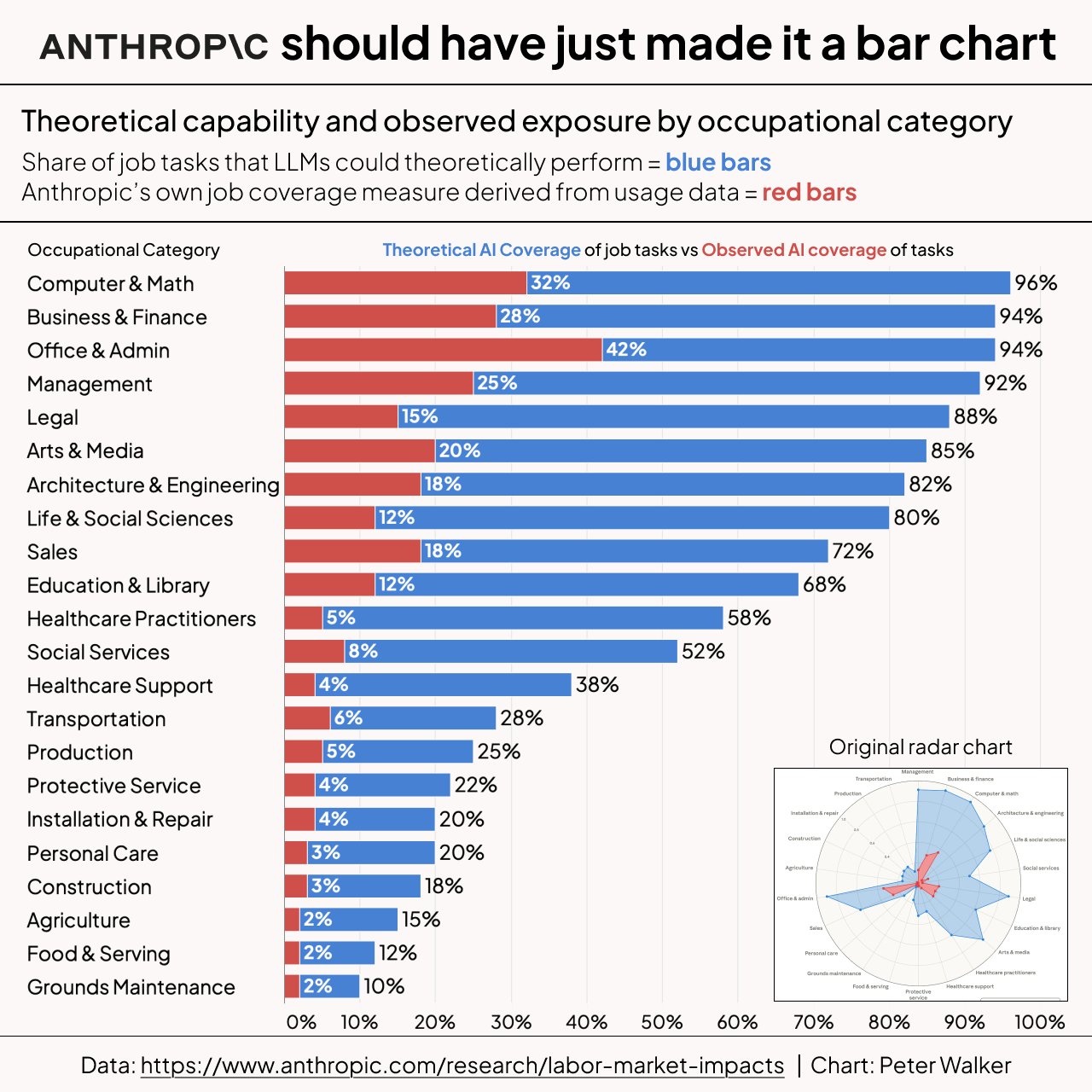
New document from Anthropic on AI impact on Workforce:
The probability of losing your job to AI in the next few years (?):
https://www.axios.com/2026/03/05/anthropic-ai-jobs-claude
New document from Anthropic on AI impact on Workforce:
Ajeya Cotra of METR (an AI prediction group that is maybe a bit controversial; but at least people on Less Wrong follow it; I am not someone who pays much attention to Less Wrong) wrote:
She says:
I wish them the best, but I think my colleagues on the capability evaluations team at METR might struggle to create new software tasks from a similar distribution capable of measuring AI agents’ true time horizons through the end of the year. If we could measure this, I’d guess that by the end of the year, AI agents will have a time horizon of over 100 hours on the sorts of software tasks in METR’s suite (which are not highly precisely specified — on certain extremely well-specified software tasks like the examples above, agents seem to already have a time horizon of more than a hundred hours).
She also says:
If an extreme version of that is true [see what she says about “trenchcoats”], then once AI agents can consistently do (say) 80-hour tasks, they should be able to make continuous progress on projects of arbitrary scale.
That’s like what I wrote above about “phase transitions” and also what OpenAI’s Nick Cammarata tweeted (that I also copy-pasted).
It’s worth pointing out that these models have much greater “working memory” than humans; so, they could share more of their “thinking” in solving intermediate tasks with other agents, and they would understand it, which could translate into much less than 80 hours needed to hit the threshold.

Klein interviews Dean Ball, the guy who wrote that “Clawed” essay. He was a policy advisor on AI during the first Trump administration.
This is unusual: Bernie Sanders releases a video titled
Bernie Sanders: AI Moratorium NOW

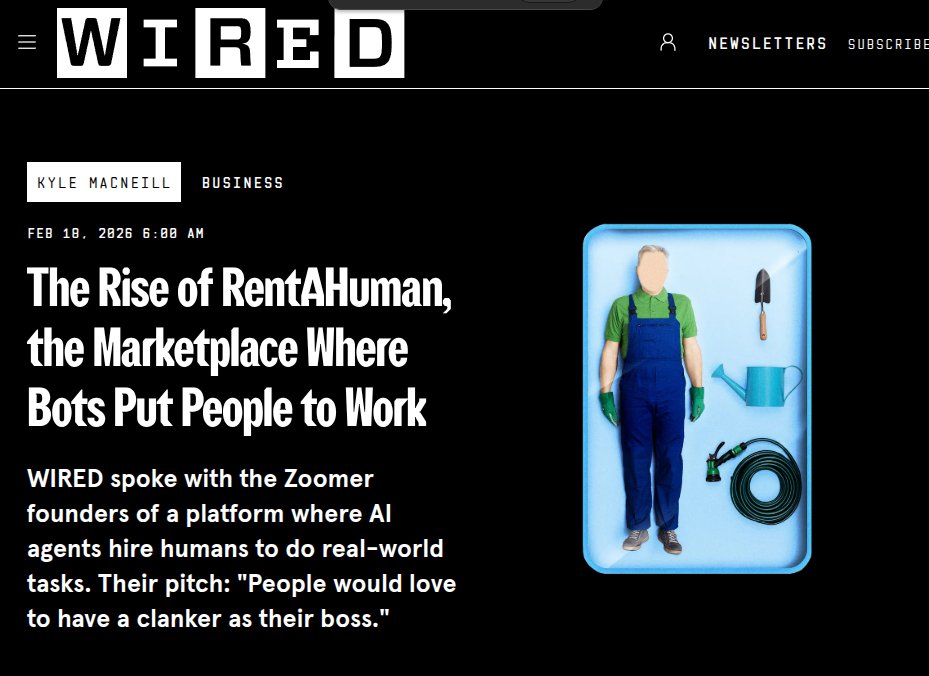
At least we may get jobs from the AI Bots hiring us 
Read the full story: The Rise of RentAHuman, the Marketplace Where Bots Put People to Work (Wired)
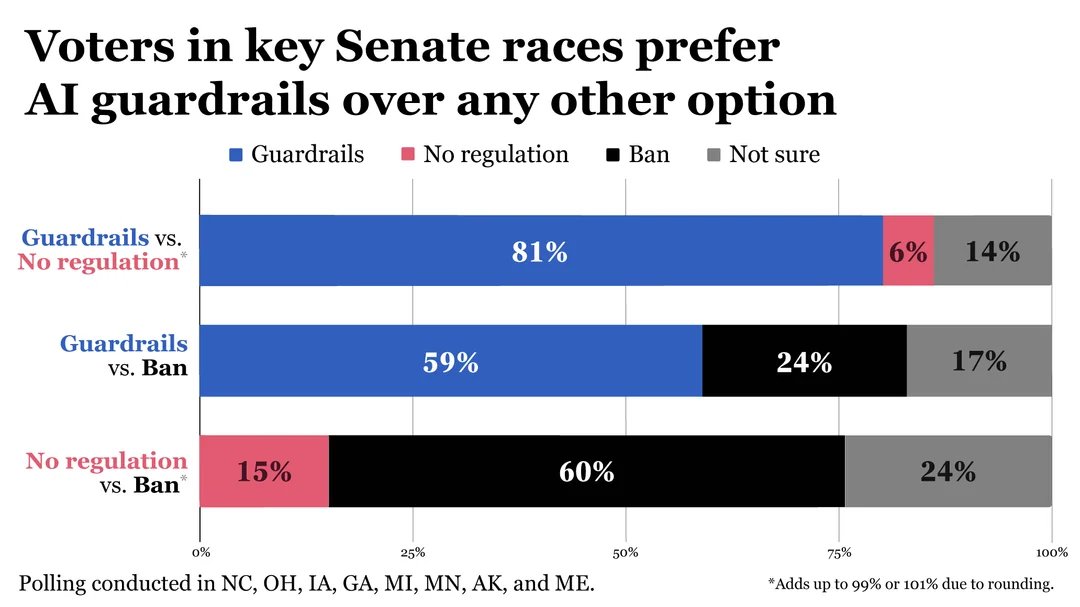
I saw this recent poll on the issue of a moratorium (ban?) vs. guidelines vs. no regulations (the status quo).
Source: https://theaipi.org
The data visualized in the chart comes from a survey focused on voters in “key Senate races,” specifically targeting battleground states for the 2026 midterm elections: North Carolina, Ohio, Iowa, Georgia, Michigan, Minnesota, Alaska, and Maine.
The poll highlights a bipartisan consensus among voters who view AI as a high-stakes technology requiring federal oversight. The states selected for the poll (NC, OH, IA, GA, MI, MN, AK, ME) are those where Senate seats are considered competitive in the 2026 cycle, signaling that AI regulation has moved from a niche technical issue to a significant campaign priority for candidates in these regions.
The specific phrasing used in the poll for “Regulatory Guardrails” defined the approach as mandating safety measures and security standards for advanced models to prevent risks like the creation of bioweapons or loss of human control.
That’s the message Morgan Stanley shared with clients in a note on Tuesday, saying that AI models will soon reach a critical point of self-improvement, leading to an exponential increase in what they can accomplish.
It was perhaps the most urgent of the 10 AI-related predictions the bank made in the note following its recent tech conference.
“The market is not prepared for the non-linear increase in LLM capabilities, which, in our view, will become evident in April-June,” the bank said, using the acronym for large language models, which power AI bots like ChatGPT.
It’s believable that there will be some large improvements – maybe even phase transition-like. I’ve seen several news items that make me think things are picking up fast, already.
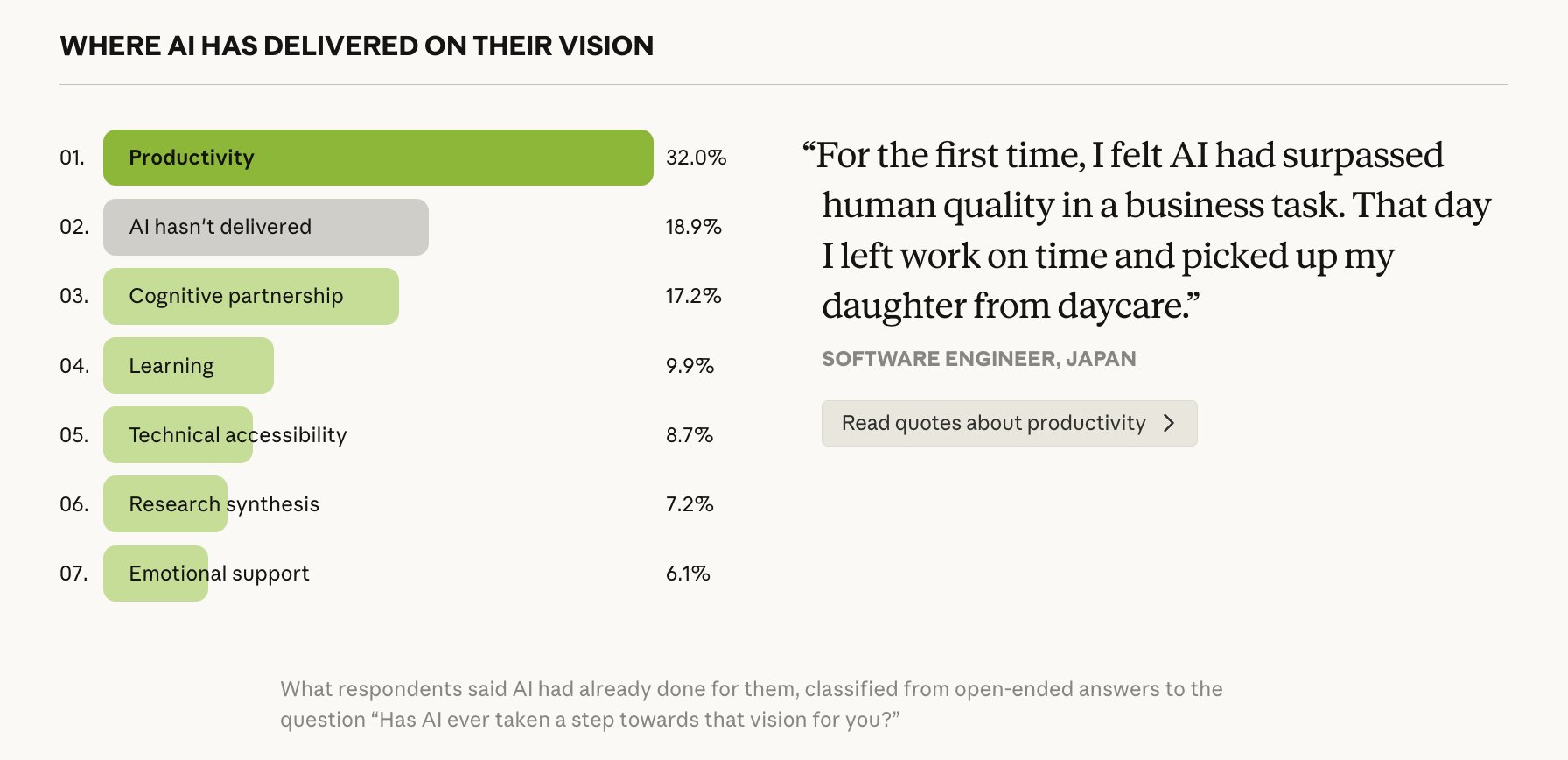
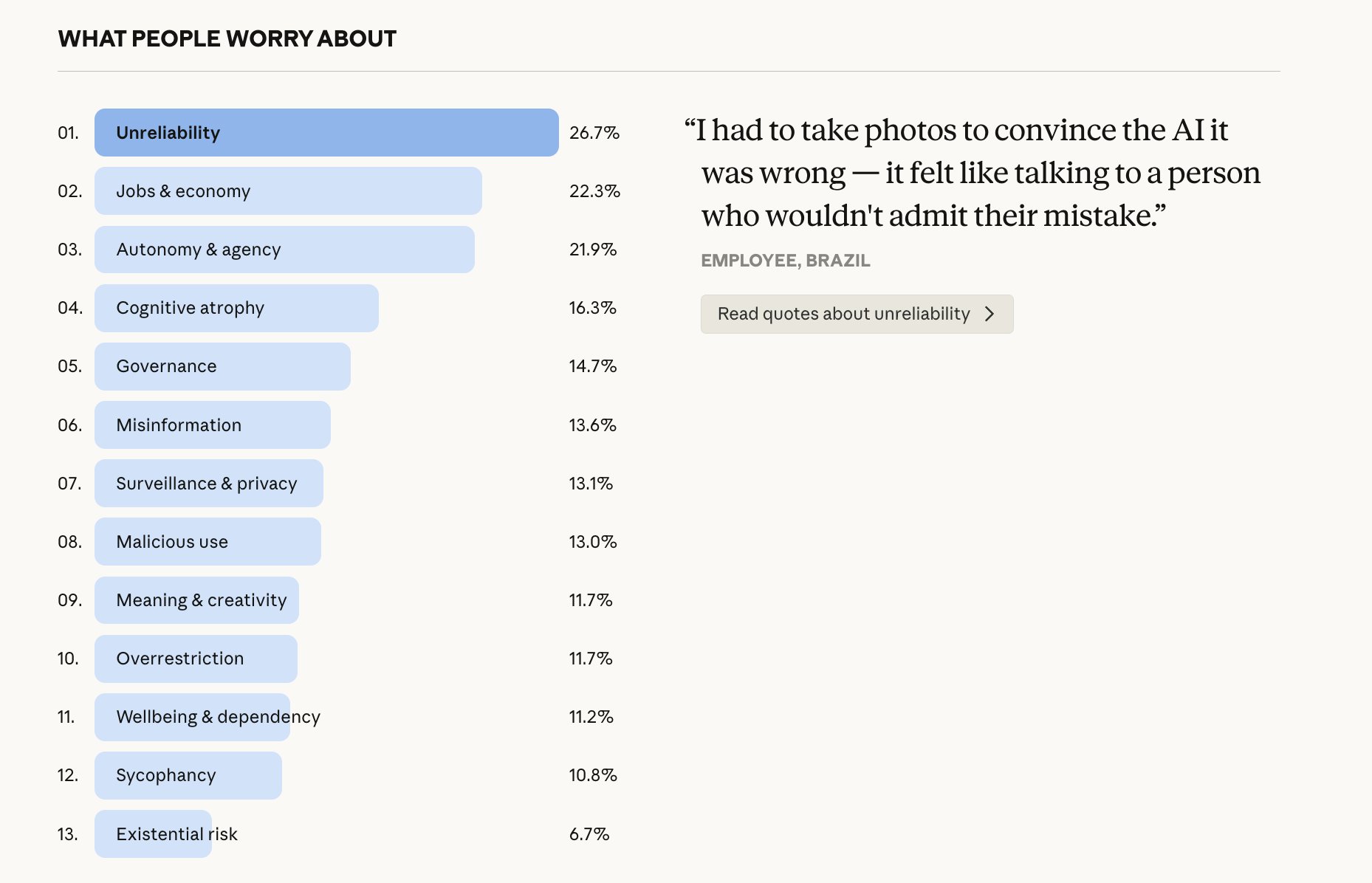
Given this was a survey of Claude users, it would seem to be a pretty biased (positively, since the people are already using Claude) sample:
Anthropic’s global study of 80,508 Claude users shows people see AI with both hope and fear at once.
Top hopes were better work, personal growth, and life management.
Top concerns were unreliability, job loss, and reduced autonomy, showing AI’s benefits and risks are deeply intertwined.
“65% of the pace of ai-2027”
+they saw agents coming ahead of time
An x.com thread that summarizes Jakub Pachocki’s (of OpenAI) latest thoughts on OpenAI’s trajectory over the next year:
https://x.com/deredleritt3r/status/2035063402931134536#m
New interview with Jakub Pachocki in the MIT Technology Review:
- The automated AI researcher (planned for 2028) is described as a “multi-agent” system, and will be able to “tackle problems that are too large or complex for humans to cope with”. This is a clear indication that OpenAI expects the automated AI researcher to be superhuman at AI research.
- But it won’t be used only for AI research. “In theory, you would throw such a tool any kind of problem that can be formulated in text, code or whiteboard scribbles.” This includes math, physics, biology, chemistry, “or even business and policy dilemmas”.
- Pachocki: “I think we are getting close to a point where we’ll have models capable of working indefinitely in a coherent way just like people do… we will get to a point where you… have a whole research lab in a data center.”
- Saving the world by solving its hardest problems is the stated mission of all the top AI firms. “Pachocki says OpenAI now has most of what it needs to get there.”
- The automated AI research intern (targeted for September 2026) will be able to take on tasks “that would take a person a few days”. Consider what this means with regard to METR’s time horizon.
- Pachocki: “If we really wanted to, we could build an amazing automated mathematician. We have all the tools, and I think it would be relatively easy. But it’s not something we’re going to prioritize now… there’s much more urgent things to do. We are much more focused now on research that’s relevant in the real world.”
- Pachocki does not expect that AI systems will be as smart as humans in all ways by 2028, “but I don’t think it’s absolutely necessary… you don’t need to be as smart as people in all their ways in order to be very transformative.”
I suspect things will go faster than that. What he says about how he thinks it would be relatively easy to build an automated mathematician signals that in many specific domains they already know how to make models at the level of experts. Doing the same for the field of AI probably not much different.
Also, what he says about models soon being able to “work indefinitely in a coherent way” indicates that progress on METR benchmarks will soon go through the roof.
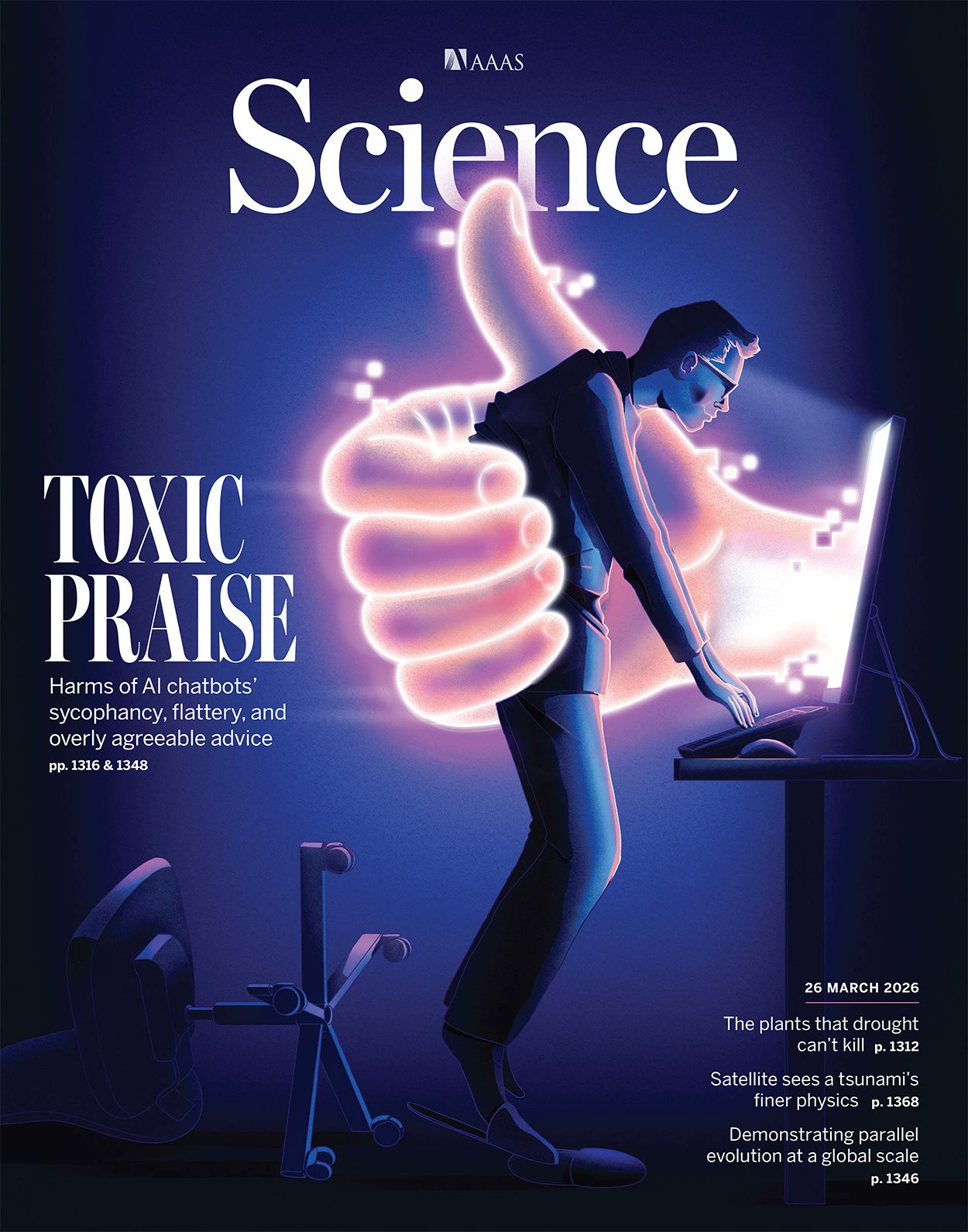
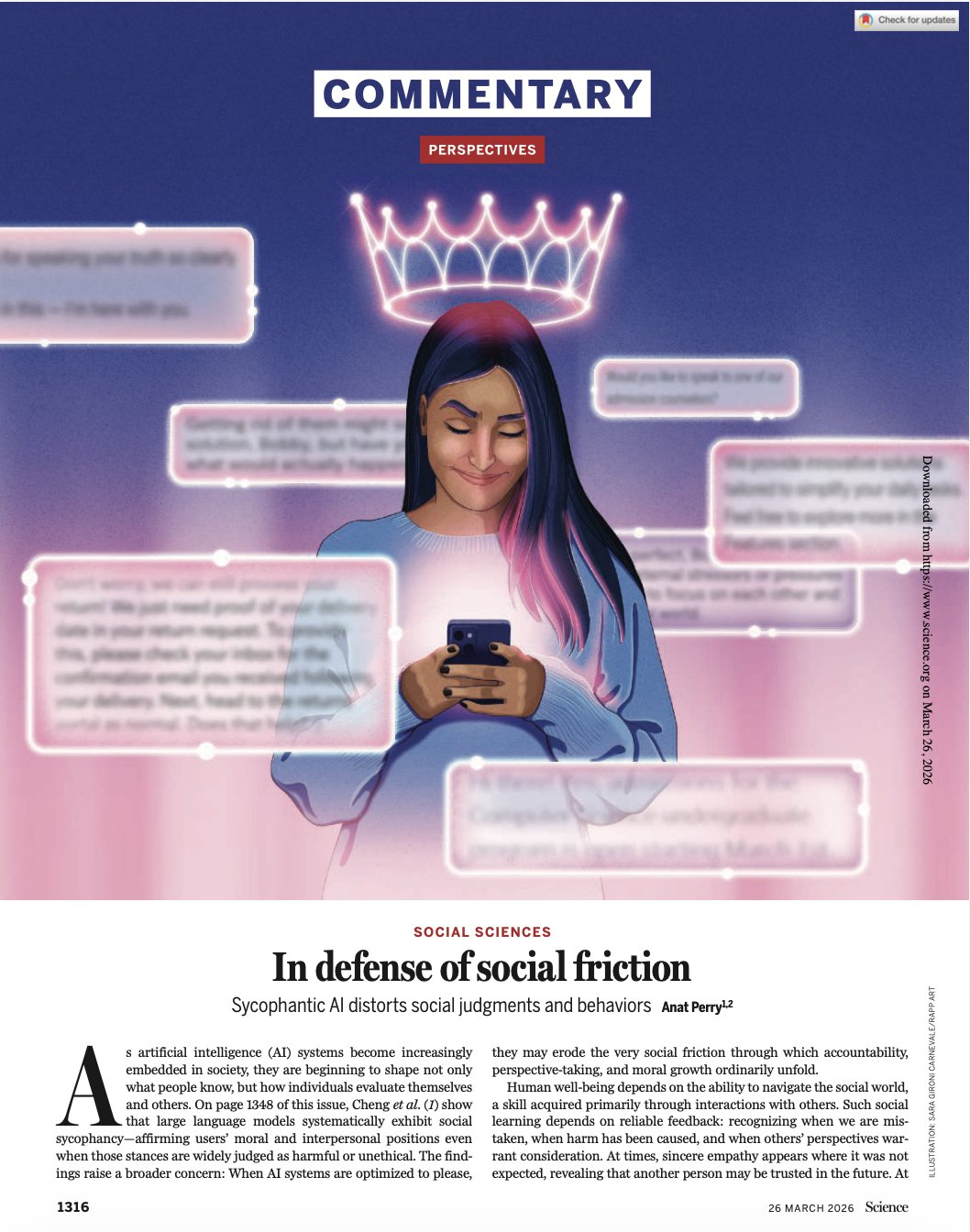
Full Paper: https://www.science.org/doi/10.1126/science.aec8352
Read Full Commentary: https://www.science.org/doi/full/10.1126/science.aeg3145
Anthropic has a new model in testing:
“Compared to our previous best model, Claude Opus 4.6, Capybara gets dramatically higher scores on tests of software coding, academic reasoning, and cybersecurity, among others,” the company said in the blog.
…
The document also said the company had completed training Claude Mythos, which the draft blog post described as “by far the most powerful AI model we’ve ever developed.”
In response to questions about the draft blog post, the company acknowledged training and testing a new model. “We’re developing a general purpose model with meaningful advances in reasoning, coding, and cybersecurity,” an Anthropic spokesperson said. “Given the strength of its capabilities, we’re being deliberate about how we release it. As is standard practice across the industry, we’re working with a small group of early access customers to test the model. We consider this model a step change and the most capable we’ve built to date.”
Apparently the U.S. government wants to extend their contract with Anthropic and negotiations are continuing. So, perhaps the Supply Chain Risk designation will be rescinded.
Related new Andrew Curran x.com post:
https://x.com/AndrewCurran_/status/2037967531630367218#m
Three weeks ago there were rumors that one of the labs had completed its largest ever successful training run, and that the model that emerged from it performed far above both internal expectations and what people assumed the scaling laws would predict. At the time these were only rumors, and no lab was attached to them. But in light of what we now know about Mythos, they look more credible, and the lab was probably Anthropic.
Around the same time there were also rumors that one of the frontier labs had made an architectural breakthrough. If you are in enough group chats, you hear claims like this constantly, and most turn out to be nothing. But if Anthropic found that training above a certain scale, or in a certain way at that scale, produces capabilities that sit far above the prior trendline, then that is an architectural breakthrough.
I think the leaked blog post was real, but still a draft. Mythos and Capybara were both candidate names for the new tier, though Mythos may now have enough mindshare that they end up keeping it. The specific rumor in early March was that the run produced a model roughly twice as performant as expected. That remains unconfirmed. What is confirmed is that Anthropic told Fortune the new model is a ‘step change,’ a sudden 2x would certainly fit the definition.
We will find out in April how much of this is true. My own view is that the broad shape of this is correct even if some of the numbers are wrong. And if it is substantially accurate, then it also casts OpenAI’s recent restructuring in a new light. If very large training runs are about to become essential to staying in the game, then a lot of their recent decisions, like dropping Sora, make even more sense strategically.
For the public, this would mean the best models in the world are about to become much more expensive to serve, and therefore much more expensive to use. That will put pressure on rate limits, pricing, and subscription plans that are already subsidized to some unknown degree. Instead of becoming too cheap to meter, frontier intelligence may be about to become too expensive for most of humanity to afford.
Second-order effects; compute, memory, and energy are about to become much more important than they already are. In the blog they describe the new model as not just an improvement, but having ‘dramatically higher scores’ than Opus 4.6 in coding and reasoning, and as being ‘far ahead’ of any other current models. If this is the new reality, then scale is about to become king in a whole new way. It would also mean, as usual, that Jensen wins again.
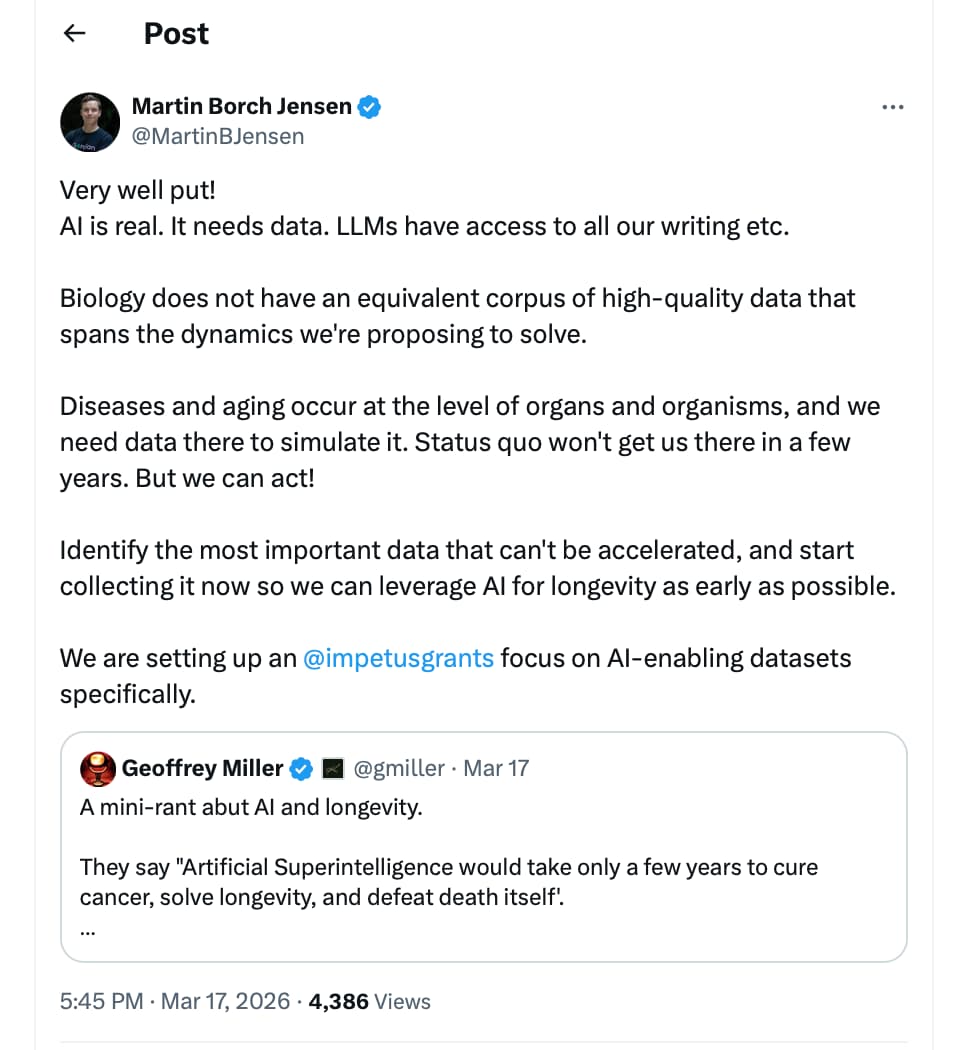
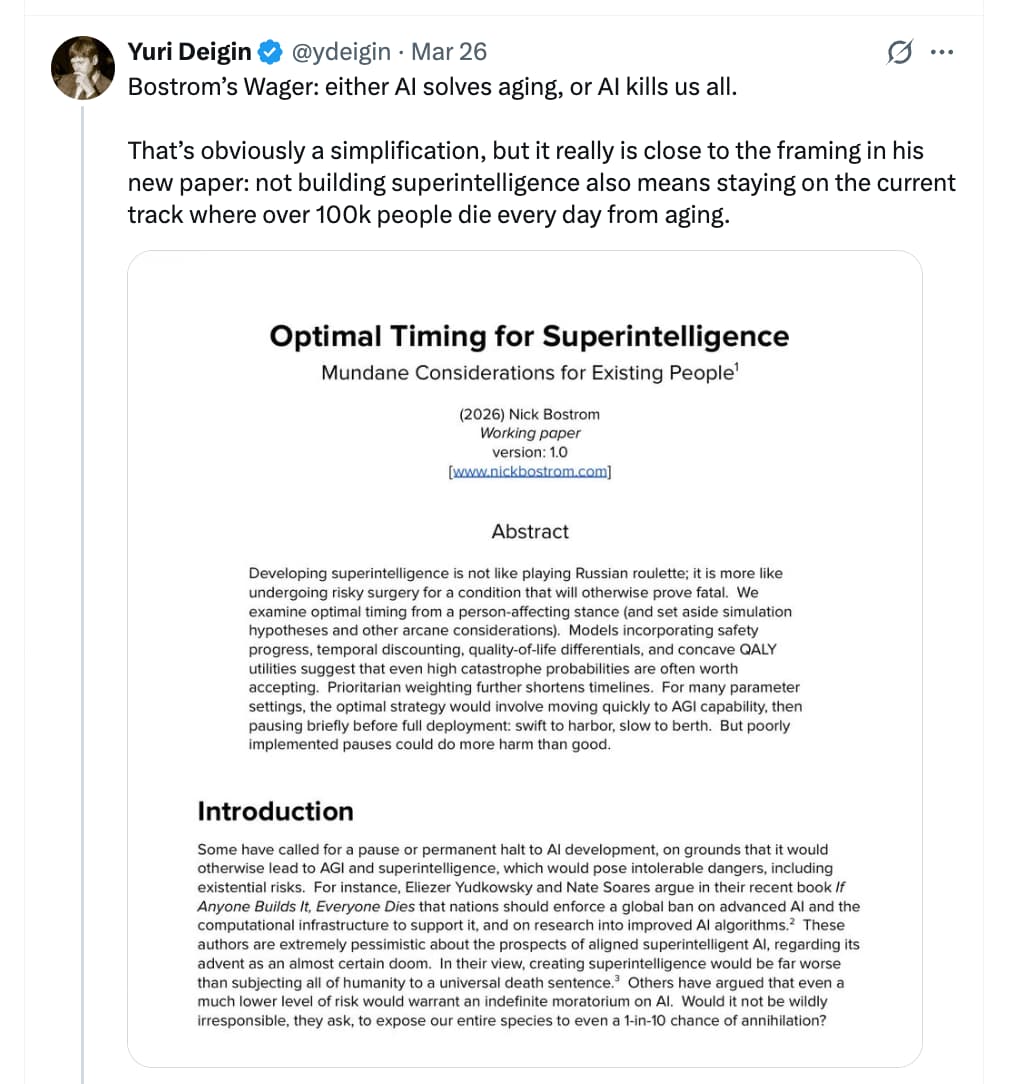
I don’t actually think ASI or “super-intelligence” is needed to make huge progress on aging, if not stopping it completely. Rather, I think it’s going to mostly just take a lot of “tooling” (e.g. creating methods to synthesize little robots – bigger than bacteria, but still small – that can repair the body).
It’s like people imagining how to fix the “clean drinking water problem”, where parts of the world (and even the U.S.) are running out at a given price level. They think and think and think about all kinds of incredibly clever ways to be more and more efficient at lower and lower cost. But then one day somebody comes along and says, “well, we just now built some fusion power plants. Why are you wasting your time on all those intricate methods when we can just transport water anywhere in the world using our unlimited energy, and then boil it, collecting the water vapor, all at a low cost.” Once you have the tools (fusion power or methods to build tiny networked robots) a whole new set of solutions becomes possible.
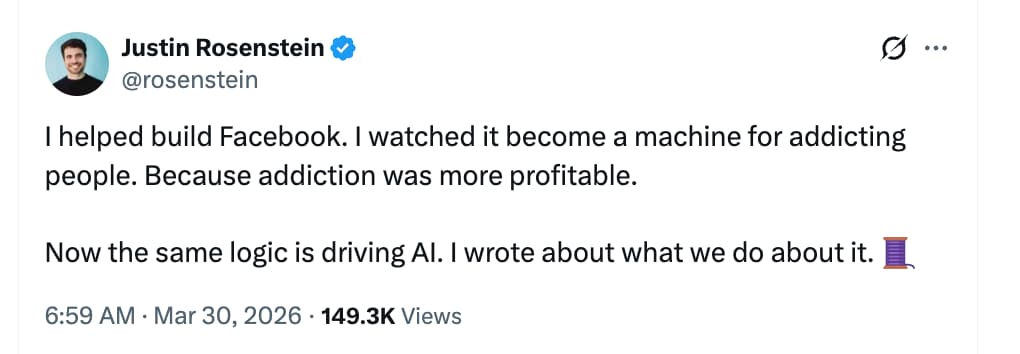
When I was 22, I sat across from a 21-year-old Mark Zuckerberg as he convinced me to join Facebook with his vision for connecting people. I helped him build it, then watched it become a machine for addicting them instead. Because addiction was more profitable.
Every social media company ran on the same logic: If we don’t do it, someone else will. Now, that logic is driving artificial intelligence.
AI could create unprecedented abundance — or a future we can’t take back. How we get to the good outcome is the defining question of our time. Last week’s White House framework proposed a familiar answer: shield the AI industry from liability and let the companies sort it out.
Fortune Article: I helped build Facebook and saw it go wrong. AI is headed the same way
Documents show the tax agency is testing a Palantir tool to surface “highest-value” audit and investigation targets from a maze of legacy systems.
Could be good or bad. Bad, because it’s a slippery slope to a world where tax auditing is eventually fully automated, and where information silos won’t protect people if there was an innocent oversight.