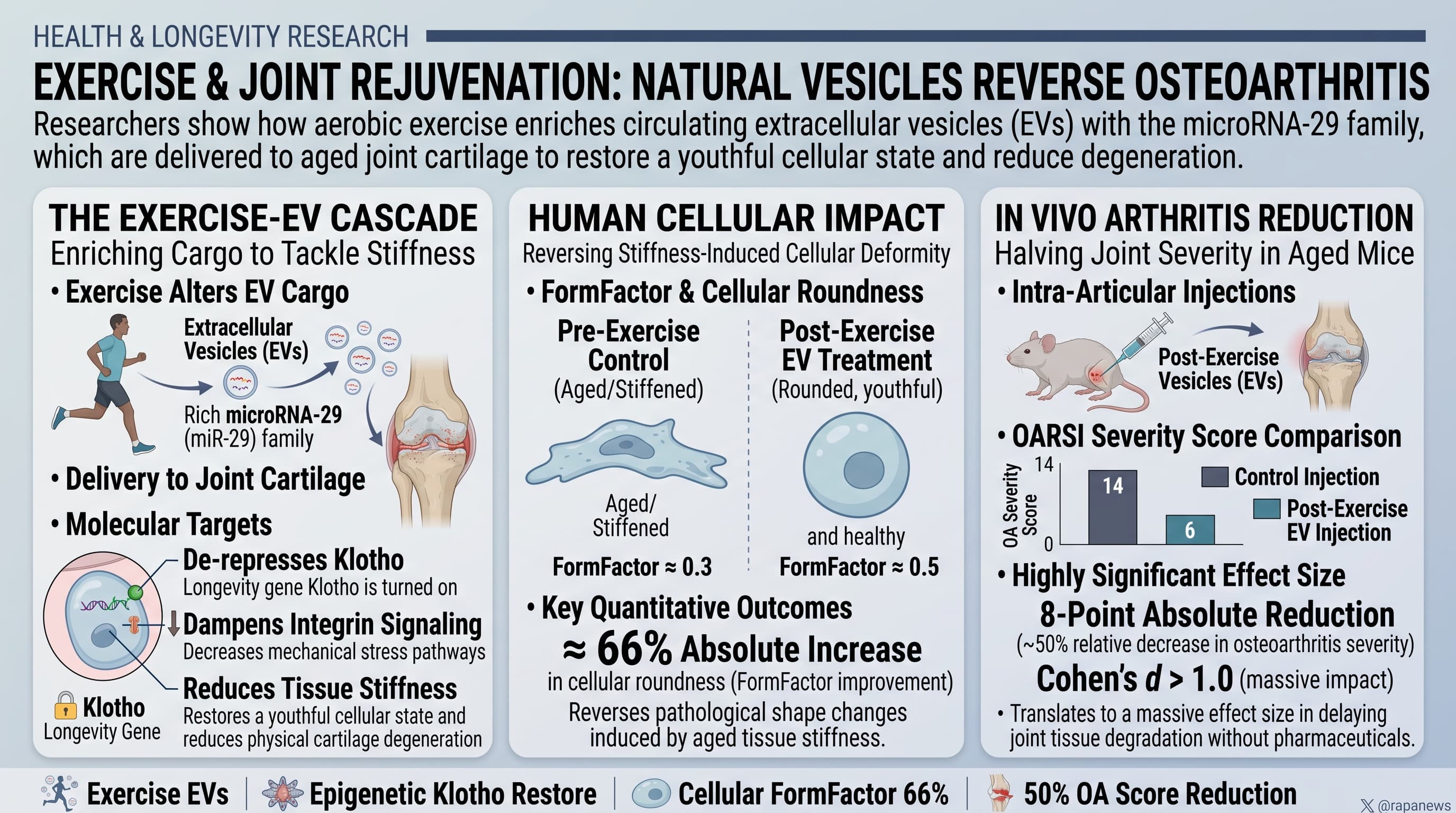
Aerobic exercise alters the cargo of circulating extracellular vesicles by enriching them with the microRNA-29 family. When these vesicles are delivered to aged osteoarthritic joint cartilage, they counteract tissue stiffness by epigenetically de-repressing the longevity gene Klotho and dampening integrin signaling. This molecular cascade restores a youthful cellular state and reduces physical cartilage degeneration, highlighting a quantifiable and non-pharmacological pathway to joint rejuvenation.
Physical activity is known to offer systemic longevity benefits, but the precise signaling mechanisms reaching avascular tissues like cartilage have remained elusive. This research demonstrates that extracellular vesicles act as systemic delivery vehicles for exercise-induced molecular signals. The researchers utilized a systems biology approach to identify that aerobic exercise loads circulating extracellular vesicles with microRNA-29a-3p and microRNA-29b-3p. Osteoarthritis is largely driven by age-related stiffening of the extracellular matrix. When aged chondrocytes are exposed to a stiff matrix, they undergo pathological morphological changes driven by mechanotransduction, which subsequently locks down the longevity-associated KL (Klotho) gene via promoter hypermethylation. Exercise-primed extracellular vesicles deliver microRNA-29 directly to these cells, which suppresses integrin (ITGB1) signaling. This interruption halts the mechanotransduction cascade, reduces the presence of the DNA methyltransferase DNMT1, and removes the epigenetic block on the Klotho promoter. The result is a reversal of the aged, catabolic cellular phenotype into an anabolic, youthful state. Furthermore, injecting post-exercise extracellular vesicles directly into the joints of aged mice significantly protected against cartilage degradation compared to pre-exercise control vesicles. This data maps a direct molecular route from aerobic exertion to joint preservation.
Actionable Insights
Consistent moderate aerobic exercise generates therapeutic biological nanoparticles capable of repairing aged cartilage. The intervention requires a sustained 3-month commitment to moderate-intensity aerobic work to produce circulating extracellular vesicles with joint-protective qualities. For individuals suffering from age-related joint degradation, this provides a physiological rationale for prioritizing aerobic training to protect avascular tissues.
The practical magnitude of this intervention is significant. In human cellular models, chondrocytes treated with post-exercise vesicles showed a roughly 66 percent absolute increase in cellular roundness (FormFactor increasing from approximately 0.3 to 0.5) compared to pre-exercise controls. This effectively reversed the pathological shape changes induced by aged tissue stiffness. In living aged mice, intra-articular injection of these post-exercise vesicles reduced the Osteoarthritis Research Society International severity scores from an average of 14 down to approximately 6. This 8-point absolute reduction represents a relative decrease in osteoarthritis severity of over 50 percent compared to control injections. This translates to a massive effect size (estimated Cohen’s d > 1.0) in delaying joint tissue degradation.
Context and Source
- Paywalled Paper: Exercise enhances aged chondrocyte health through microRNA-29-enriched extracellular vesicles, Published: 29 September 2026.
- Institution: Discovery Center for Musculoskeletal Recovery, Spaulding Rehabilitation Hospital, Harvard Medical School, USA.
- Journal Name: Nature Aging.
- Impact Evaluation: The impact score of this journal is 16.6, evaluated against a typical high-end range of 0–60+ for top general science, therefore this is a High impact journal.