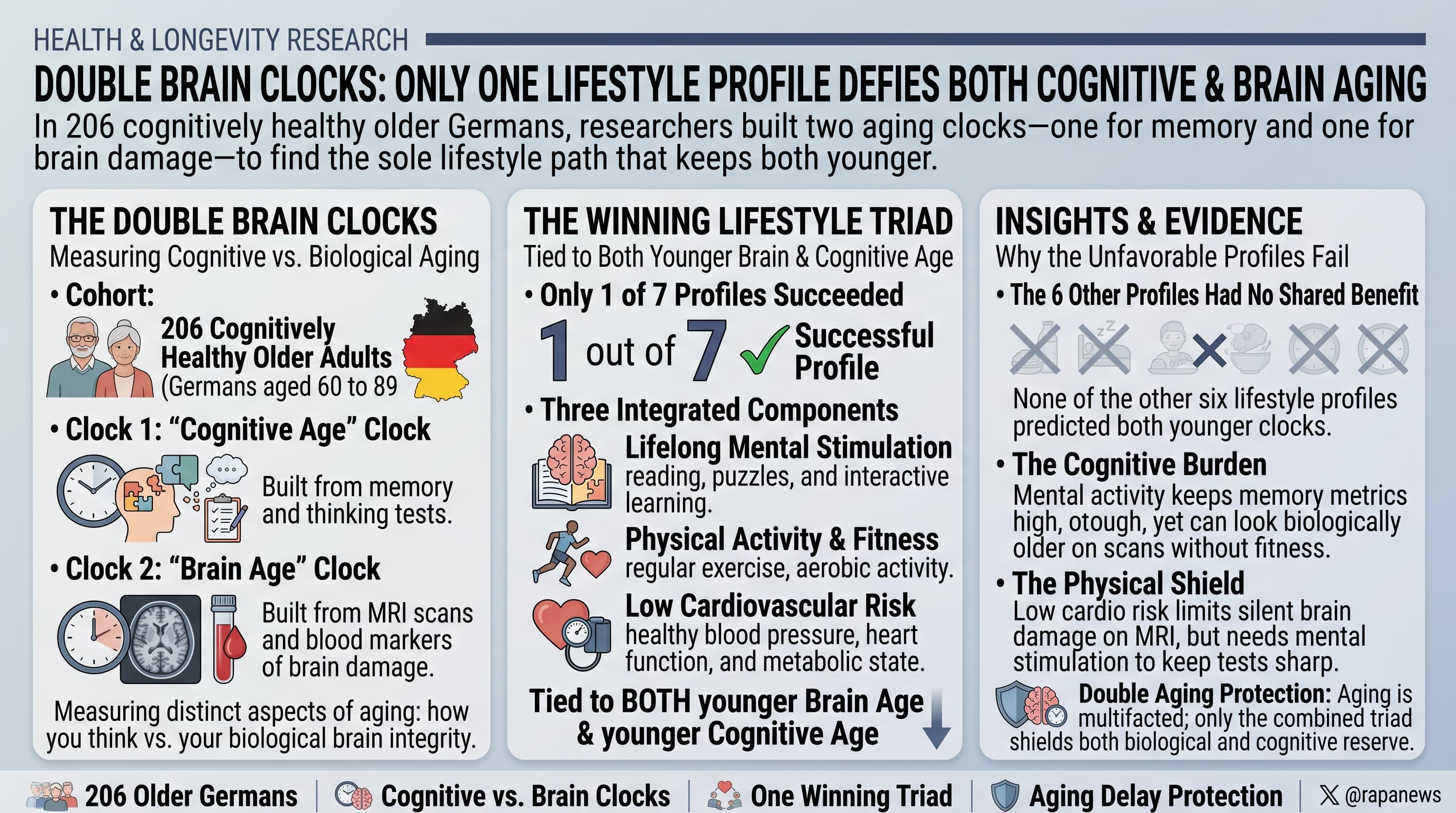
In 206 cognitively healthy Germans aged 60 to 89, researchers built two “clocks”: one from memory and thinking tests, one from MRI and blood markers of brain damage. A lifestyle profile combining lifelong mental stimulation, physical activity and fitness, and low cardiovascular risk was the only one of seven profiles tied to both a younger cognitive age and a younger brain age.
A German study of healthy people in their 60s to 80s has found that those who combine regular exercise, lifelong mental engagement and low cardiovascular risk tend to have brains and thinking skills that look younger than their birth certificates suggest. The link is real but modest, and the study cannot say which came first.
Researchers at the German Center for Neurodegenerative Diseases in Magdeburg enrolled 348 cognitively healthy adults aged 60 to 94. Each had two sessions of memory and thinking tests and a blood test for Alzheimer’s-related proteins. Most also had a 3 Tesla MRI scan, grip strength and mobility tests, and questionnaires on sleep, diet, mood, exercise and how mentally stimulating their lives had been since youth.
From this the team built two clocks. A cognitive clock estimated each person’s age from 19 test scores. A brain clock estimated age from eight markers of damage: shrinkage of the cortex and hippocampus, white matter lesions, enlarged fluid channels around blood vessels, and two blood markers of Alzheimer’s pathology, pTau217 and the amyloid 42/40 ratio. Subtract real age from predicted age and you get a gap. A negative gap means you look younger than expected. Most brain clocks rely on brain volume alone, so adding the pathology markers is new.
The team then let the statistics sort 30 lifestyle and health measures into naturally occurring bundles. Seven emerged. Only one, named “Active Life,” tracked with both clocks. People scoring high on it had more education and more mentally engaging lives in youth and midlife. They also did more sport, walked faster, and had stronger grips, lower BMI, lower blood sugar, fewer blood pressure pills, less smoking history and lower white blood cell counts.
For each standard step up on this profile, cognitive age was about one year younger and brain age about ten months younger. Comparing someone clearly above average with someone clearly below, the difference was roughly two years on each clock. The profile explained about 5 to 7 percent of the person-to-person differences. The clocks themselves miss true age by about three years on average, so much of the rest is noise.
Two further patterns stand out. Bundles marked by poor mood and sleep, or by low mental stimulation, were tied to older cognitive age but not older brain age. That fits the idea of cognitive reserve, where a well-used mind copes better with whatever damage is present. Carriers of the APOE4 Alzheimer’s risk gene had slightly older-looking brains but normal cognitive age, a borderline result that needs confirmation.
A statistical test suggested that roughly one sixth of the lifestyle link with younger cognition runs through a healthier brain. The plausible range for that figure stretches from almost nothing to more than half.
The caveats are substantial. Everything was measured once, so sharper people may simply find it easier to stay active. Only 5.8 percent of those invited took part, and the volunteers were healthy, well educated and almost all white East Germans. The cohort is being followed, and later data should show whether an active life actually slows the clocks.
Actionable Insights
This is an association study, not a trial, so treat these as informed bets rather than proven prescriptions.
- Think in bundles. The benefit was tied to a combined profile: mentally demanding activities across life, regular sport, good walking speed and grip strength, lean body weight, normal blood sugar and blood pressure, and little or no smoking. No single habit carried the result.
- The size of the link is modest. Moving up one standard step on the profile (roughly from the 50th to the 84th percentile) corresponded to a cognitive age about 1.1 years younger and a brain age about 0.8 years younger. From the bottom sixth to the top sixth of people, the gap is about 2 years. The correlations were -0.26 and -0.23, a small-to-medium effect.
- Mental stimulation (music, languages, reading, travel, social visits) tracked with younger cognition even after accounting for years of schooling.
- Poor mood and sleep tracked with older cognitive age, about 0.7 years per standard step.
- The authors report alcohol as the strongest single correlate of an older brain age, although the alcohol-heavy profile itself only reached trend level.
Context and Source
- Open Access Paper: A physically and mentally active lifestyle relates to younger brain and cognitive age
- Institution: German Center for Neurodegenerative Diseases (DZNE) and Otto von Guericke University, Magdeburg
- Country: Germany
- Journal: GeroScience, published online 7 July 2025
- Impact evaluation: The impact score of this journal is 6.0, evaluated against a typical high-end range of 0 to 60+ for top general science and medicine, therefore this is a Medium impact journal.