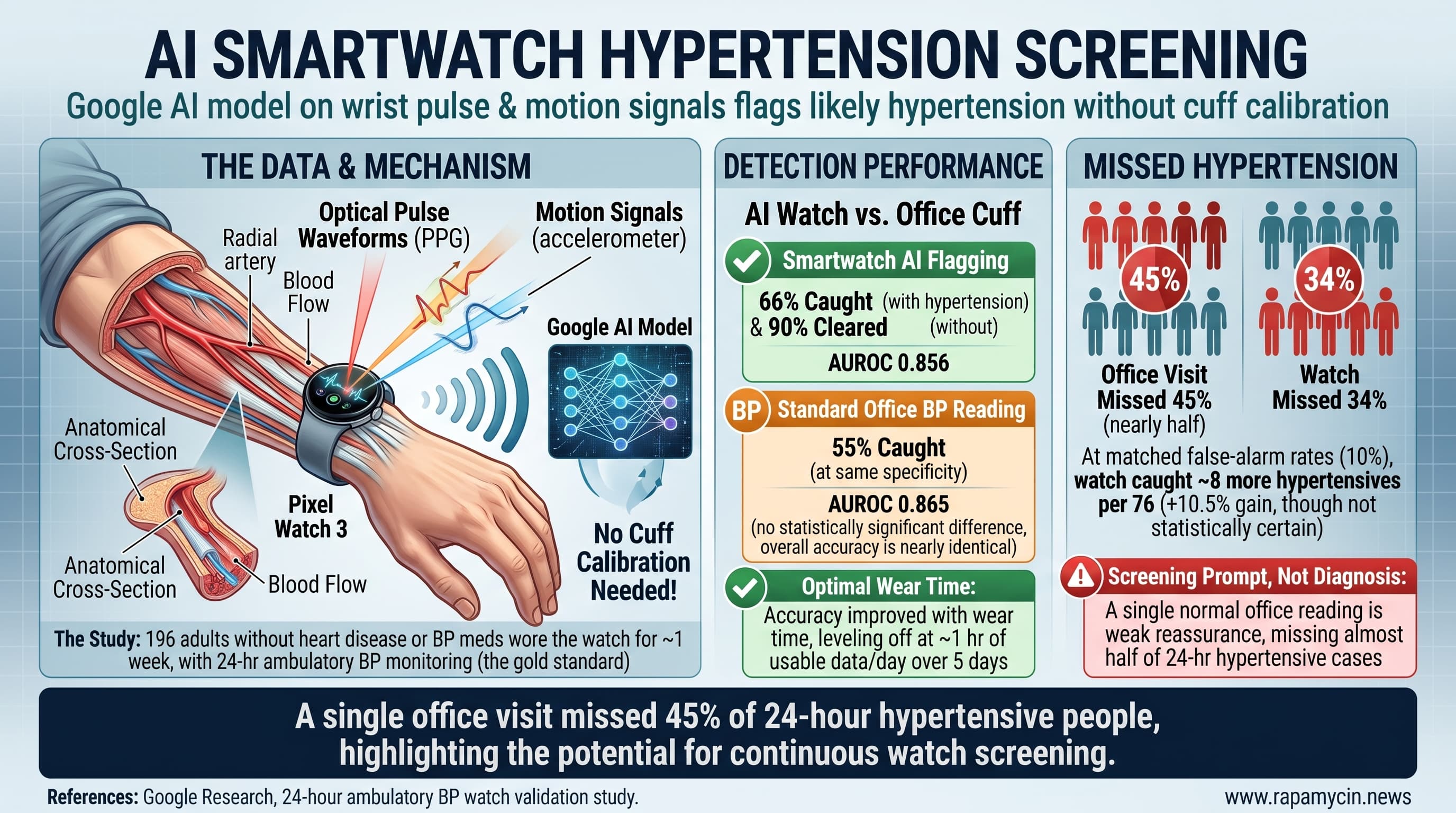
Google researchers trained an AI model on wrist pulse waveforms (photoplethysmography) and motion signals from a Pixel Watch 3 to flag likely hypertension without any cuff calibration. In a prospective five-site US study, 196 adults without heart disease or blood pressure medication wore the watch for about a week and completed 24-hour ambulatory blood pressure monitoring, the clinical gold standard. The watch correctly flagged 66% of people with hypertension and correctly cleared 90% of those without it. A standard office reading caught 55% at the same specificity, but the difference was not statistically significant, and the overall accuracy of the two methods was nearly identical. Performance improved with wear time and leveled off at about an hour of usable data per day over five days. The system is meant as a screening prompt, not a diagnosis, and it was built and tested by the company that plans to sell it.
Roughly half of adults with high blood pressure have no idea they have it. The condition has no symptoms, and the standard way to find it, a cuff reading at a doctor’s office, is both infrequent and surprisingly unreliable. Office readings miss about half of people whose blood pressure is elevated across a full day, partly because some people relax in the clinic and spike everywhere else.
Google’s team took a different approach. Instead of trying to make a watch measure blood pressure directly, which has frustrated engineers for years, they asked a simpler question: does the shape of your pulse, recorded thousands of times over a week, carry a lasting signature of hypertension?
The watch’s green optical sensor records a pulse waveform with every heartbeat. Its accelerometer, during still moments, picks up the faint recoil of the body as the heart ejects blood into the aorta. The researchers first trained a neural network on nearly half a million hours of unlabeled watch data, teaching it to recognize what makes one person’s signals distinctive. They then trained a simple classifier to link those patterns to hypertension in 663 people who had worn a 24-hour blood pressure monitor.
The real test came in 196 new volunteers at five US sites, deliberately diverse in skin tone and age, and enriched for people with borderline readings. Each wore the watch for about a week, wore a 24-hour cuff monitor, took home readings, and had office readings taken. By the 24-hour standard, 39% had hypertension.
The watch caught 66% of them and wrongly flagged 10% of people without it. A single office visit caught 55% with the same false-alarm rate. Overall accuracy was essentially the same for both. The watch did better than a model using only age, sex and body mass index.
What the AI noticed fits known physiology. People it rated as high risk had pulse waves with a slower upstroke and altered reflected-wave timing, which are classic features of stiffer arteries. Their accelerometer traces showed a deeper dip corresponding to blood decelerating in the aorta.
The two methods also missed different people. About half the hypertensives missed in the office were caught by the watch. These are cases of so-called masked hypertension, which are especially easy to overlook.
There are important caveats. The study cohort had far more hypertension than the general population, which makes the device look more precise than it will be in everyday use. Almost all authors work for Google, which has already announced blood pressure features for its newer watches. The model has not been shown to track changes in blood pressure over time, so it cannot tell you whether a new diet or supplement is working. And because a third of the participants had already been flagged once, real-world sensitivity may be closer to the 50% seen during development.
Still, this is the first wrist-based hypertension screen validated against 24-hour monitoring rather than home cuffs. For people who never see a doctor, it could provide a nudge they would otherwise never get.
Actionable insights
The main message is that one normal office reading is weak reassurance. In this study, a single office visit missed 45% of people who were hypertensive over 24 hours. The watch missed 34%.
At matched false-alarm rates (10%), the watch caught about 8 more hypertensives per 76 than the office reading, a 10.5 percentage point gain. That gain was not statistically certain. Overall discrimination was similar: AUROC 0.856 for the watch versus 0.865 for office BP. Both correspond to a standardized separation of about 1.5, which is a large effect.
In a population where 20% have hypertension, a watch alert would raise your probability of having it from 20% to about 62%. No alert would lower it to about 9%. So an alert means “get a cuff,” and no alert does not mean “you’re fine.”
Practical steps:
- If you are flagged, or if you want to rule out hypertension, do 7 days of home readings (morning and evening, seated, two readings each time) or a 24-hour ambulatory study. Home monitoring over 3 or more days had 89% sensitivity in this study’s subgroup.
- Wear the watch at least an hour a day with good fit for 5 or more days; accuracy plateaued there.
- Do not use this feature to judge whether an intervention lowers your blood pressure. That has not been tested.
Context and source
- Paywalled Paper: Opportunistically Detecting Signs of Hypertension on a Consumer Smartwatch
- Institutions: Google Research (Cambridge MA, Mountain View CA, Seattle WA); University of Washington; Beth Israel Deaconess Medical Center/Harvard Medical School
- Country: United States
- Journal: Nature, published online 5 November 2026
- Funding: Alphabet Inc.; 14 of 16 authors are Alphabet employees; patent application filed
Impact evaluation: The impact score of this journal is 56.1 (Clarivate JIF 2025), evaluated against a typical high-end range of 0 to 60+ for top general science journals, therefore this is an Elite impact journal.