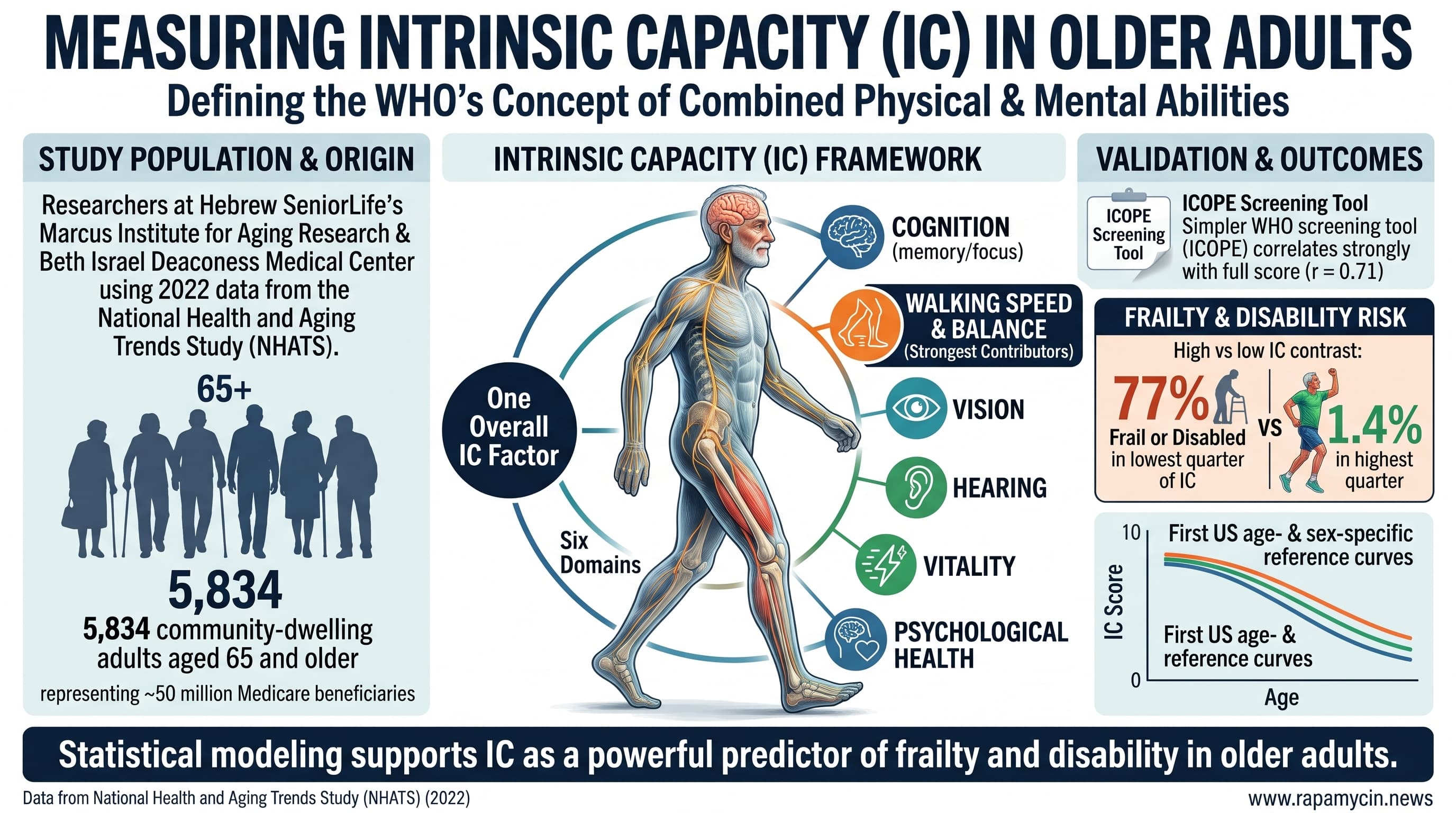
Researchers at Hebrew SeniorLife’s Marcus Institute for Aging Research and Beth Israel Deaconess Medical Center used 2022 data from 5,834 community-dwelling adults aged 65 and older in the National Health and Aging Trends Study (NHATS), representing about 50 million Medicare beneficiaries. They built and validated a measure of intrinsic capacity (IC), the World Health Organization’s concept of a person’s combined physical and mental abilities. Statistical modeling supported a structure with one overall IC factor plus six domains: cognition, locomotion, vision, hearing, vitality and psychological health. Walking speed and balance were the strongest contributors to the overall score. The model fit very well. A simpler WHO screening tool, ICOPE, correlated strongly with the full score (r = 0.71). People in the lowest quarter of IC were far more likely to be frail (77% vs 1.4% in the highest quarter) or disabled.
Medicine has traditionally tracked aging through diseases: diabetes, heart disease, dementia. The World Health Organization has pushed a different approach. Its concept of intrinsic capacity asks how much physical and mental reserve a person has, regardless of diagnoses. The idea is that declining function can be spotted and treated before it becomes disability. WHO’s ICOPE program offers a short screening tool for primary care. Both have been tested in Europe, China and Latin America, but until now not in a nationally representative US sample.
This study fills that gap using NHATS, a long-running federal survey that visits Medicare beneficiaries at home. In 2022, interviewers measured balance, walking speed, chair rises, grip strength, lung function, hearing and vision, and gave memory and thinking tests and mental health questionnaires. The researchers asked which of these measures cluster together and whether they reflect one underlying capacity.
The answer was a clear yes, with nuance. The data fit a “bifactor” model best: every measure reflected a single general IC factor plus one of six specific domains. Walking speed (loading 0.73) and balance (0.66) were the strongest markers of overall capacity, followed by memory and orientation tests. Hearing and vision formed their own separate domains, supporting WHO’s six-domain screening approach over the older five-domain version. Lung function, measured as peak expiratory flow, turned out to be a better marker of vitality than body weight or waist size, both of which dropped out. Sleep also dropped out. Loneliness stayed in as part of psychological health.
The score behaved as expected. It was lower in older people, women, those with less income and education, and those living alone or socially isolated. Among people in the lowest quarter of IC, 77% were frail and 40% needed help with basic daily activities such as bathing or dressing. In the highest quarter, those figures were 1.4% and 2.2%. The WHO’s quick screening tool, which scores six domains from 0 to 12, tracked closely with the full measure.
The team also produced reference curves showing how IC typically declines with age for men and women. The spread widens dramatically at older ages: some people in their 90s score like average 70-year-olds, while others fall far below. That variation is exactly what the IC concept is meant to capture.
There are limits. The study is a single snapshot, so it cannot yet show that a low score predicts future disability, hospitalization or death. Some validation is partly circular, because the dementia classification used in NHATS draws on the same memory and orientation tests built into the IC score. The study excluded people in nursing homes, the group with the lowest capacity.
For clinicians and older adults, the practical message is that a handful of quick tests capture a meaningful picture of overall health. Walking speed, balance, chair rises, grip, lung function, hearing, vision, memory and mood are all measurable and many are modifiable.
Actionable Insights
- Walking speed and balance carry the most information about overall capacity. Gait loaded 0.73 on general IC. Track your usual walking speed and single-leg or tandem balance over time.
- Don’t overlook hearing and vision. They formed distinct domains with strong loadings (hearing 0.86 to 0.87). Hearing aids and cataract surgery are among the most effective fixes available.
- Peak expiratory flow, a cheap handheld test, is a useful vitality marker. Respiratory muscle training and aerobic exercise can improve it.
- The contrast between quarters is very large. Frailty was 77% in the lowest IC quarter vs 1.4% in the highest, roughly a 55-fold difference. ADL disability was 39.5% vs 2.2% (about 18-fold). These are cross-sectional associations.
- Loneliness belongs in health checkups. It loaded on psychological capacity (0.42).
- The WHO ICOPE screen (scored 0 to 12) is a practical proxy. A score of 9 or less identified the group with a 58.5% frailty prevalence.
Context and Source
- Paywalled Paper: Intrinsic Capacity in a Nationally Representative US Population
- Institutions: Marcus Institute for Aging Research, Hebrew SeniorLife, Boston; Beth Israel Deaconess Medical Center; Kyung Hee University Medical Center, Seoul
- Countries: United States, with South Korea
- Journal: The Journals of Gerontology, Series A: Medical Sciences
- Impact evaluation: The impact score of this journal is approximately 4.6, evaluated against a typical high-end range of 0 to 60+ for top general science, therefore this is a Medium impact journal.