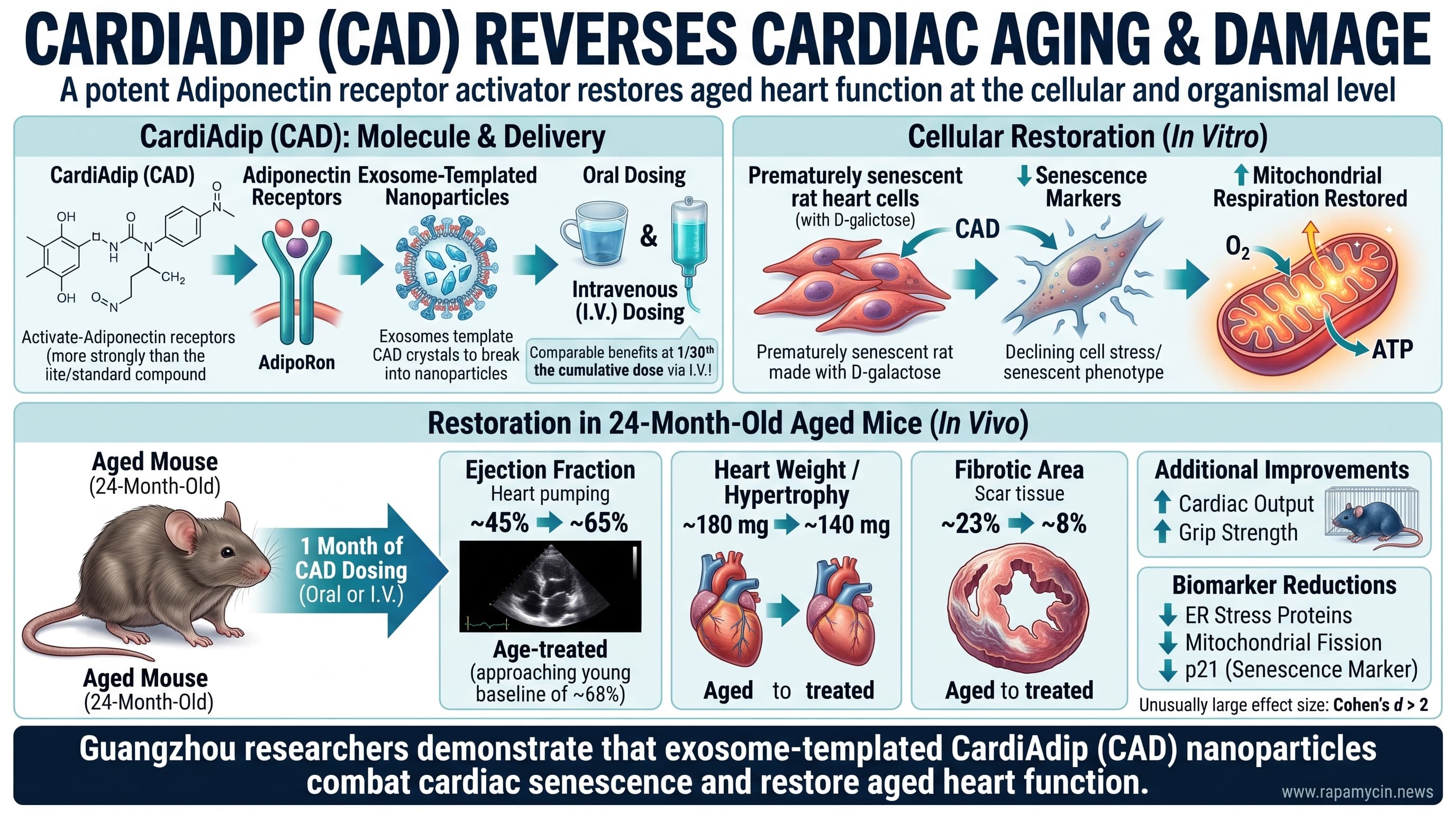
Researchers in Guangzhou designed CardiAdip (CAD), a small molecule intended to activate adiponectin receptors more strongly than the existing compound AdipoRon. In cultured rat heart cells made prematurely senescent with D-galactose, CAD lowered senescence markers and restored mitochondrial respiration. In 24-month-old mice, one month of oral CAD improved ejection fraction, cardiac output, heart size, fibrosis and grip strength, while reducing endoplasmic reticulum stress proteins, mitochondrial fission proteins and the senescence marker p21. Because CAD dissolves poorly in water, the team used exosomes as templates to break CAD crystals into nanoparticles, enabling intravenous dosing. Intravenous dosing at roughly one-thirtieth the cumulative oral dose produced comparable cardiac benefits.
Adiponectin is a hormone released by fat tissue that acts something like an internal exercise signal. It activates AMPK, the cell’s energy sensor, improves insulin sensitivity and supports mitochondrial function. Curiously, leaner people tend to have more of it, and higher levels track with better metabolic health. For two decades, researchers have tried to build a drug that mimics it. The best-known attempt, AdipoRon, works in animals but dissolves so poorly in water that it has never advanced far.
A team at Guangzhou Medical University and the University of Macau set out to improve on both problems at once: a better molecule and a better way to deliver it.
Their compound, CardiAdip, was built by modifying AdipoRon’s chemical skeleton. Computer docking predicted that it binds more tightly to the three main adiponectin-binding proteins on cell surfaces. A protease protection assay supported the idea that the molecule physically engages those proteins. When the researchers silenced all three receptors at once, CAD’s protective effects largely vanished, which argues that the drug is working through the intended target.
The animal results are striking on their face. Twenty-four-month-old mice, roughly equivalent to people in their seventies, showed the expected signs of a failing heart: lower ejection fraction, an enlarged and stiffened left ventricle, extensive scarring and dying heart muscle cells. After one month of daily oral treatment, nearly all of those measures moved substantially toward the values seen in young mice. The animals also hung onto a wire longer, climbed down a pole faster and gripped harder.
Underneath, the molecular story is coherent. Aged hearts showed elevated levels of proteins that signal stress in the endoplasmic reticulum, and elevated DRP1 and FIS1, which fragment mitochondria. They also had more oxidative damage and less cellular energy. CAD reversed each of those, and restored the mitochondrial master regulator PGC-1-alpha. In cells, CAD restored AMPK activation, and blocking AMPK undid much of the benefit.
The formulation work is the paper’s most original contribution. Instead of packaging the drug inside exosomes, where it would have to escape before reaching surface receptors, the team used exosomes and ultrasound to shatter the drug crystals into nanoparticles that stay on the outside. That kept the drug accessible to its membrane targets while making it dispersible in water. The practical payoff was substantial: intravenous dosing at about 8 mg per kilogram per week matched daily oral dosing at 20 mg per kilogram.
The caveats are equally substantial. Binding affinity was predicted by software rather than measured in a binding assay, and the predicted differences from AdipoRon are small enough to fall within docking’s noise. No head-to-head comparison with AdipoRon was run in animals, so there is no evidence that CAD is actually better. Groups contained five mice. Nothing was measured beyond one month, and no survival data exist.
The big idea is that pharmacologically mimicking adiponectin might restore function to an aged heart, and that clever formulation can rescue a drug class that has been stuck on solubility problems. Both deserve attention. Neither is proven in anything other than mice.
Actionable Insights
This is a mouse and cell study. No human has taken this compound.
- CardiAdip does not yet exist outside this lab, and AdipoRon is a research chemical not approved for human use.
- The pathway it targets is already accessible. Adiponectin levels rise with aerobic exercise, weight loss, fish oil and fiber intake. These remain the only human-validated ways to engage this axis.
- The downstream pathway is AMPK. Blocking AMPK abolished the drug’s effect in cells. Exercise, caloric restriction and metformin all activate AMPK, though in humans metformin can blunt gains from training.
- How big were the effects? Reading from the figures, ejection fraction in aged mice rose from roughly 45 to 65 percent, back toward the young value of about 68 percent. Fibrotic area fell from about 23 to 8 percent, and heart weight from about 180 to 140 mg. These correspond to effect sizes well above Cohen’s d of 2, which is unusually large and typical of small-group animal studies.
- Watch the adiponectin paradox. In humans, high circulating adiponectin predicts worse outcomes in established heart failure, likely reflecting resistance to the signal. Whether a receptor agonist helps or is simply overwhelmed in that setting is unknown.
Safety Data Absent beyond one month in mice.
Context and Source
- Paywalled Paper: An Adiponectin Receptor Agonist Dispersed via Nonencapsulative Exosomes Alleviates Aging-Associated Cardiac Dysfunction, Published 2026 Sep 2.
- Institutions: Guangzhou National Laboratory and the First Affiliated Hospital of Guangzhou Medical University (lead), with the University of Macau, Jinfeng Laboratory Chongqing, and the Shenzhen Center for Disease Control and Prevention
- Country: China
- Journal: ACS Applied Materials and Interfaces (American Chemical Society)
- Funding: National Natural Science Foundation of China (82500480 and 82471629), Guangzhou National Laboratory R&D Program, Yu-Yue Scientific Research Center for Pathology. No competing financial interests declared.
- Impact evaluation: The impact score of this journal is 8.2 (2025 Journal Impact Factor; CiteScore 14.4), evaluated against a typical high-end range of 0 to 60+ for top general science, therefore this is a Medium impact journal.