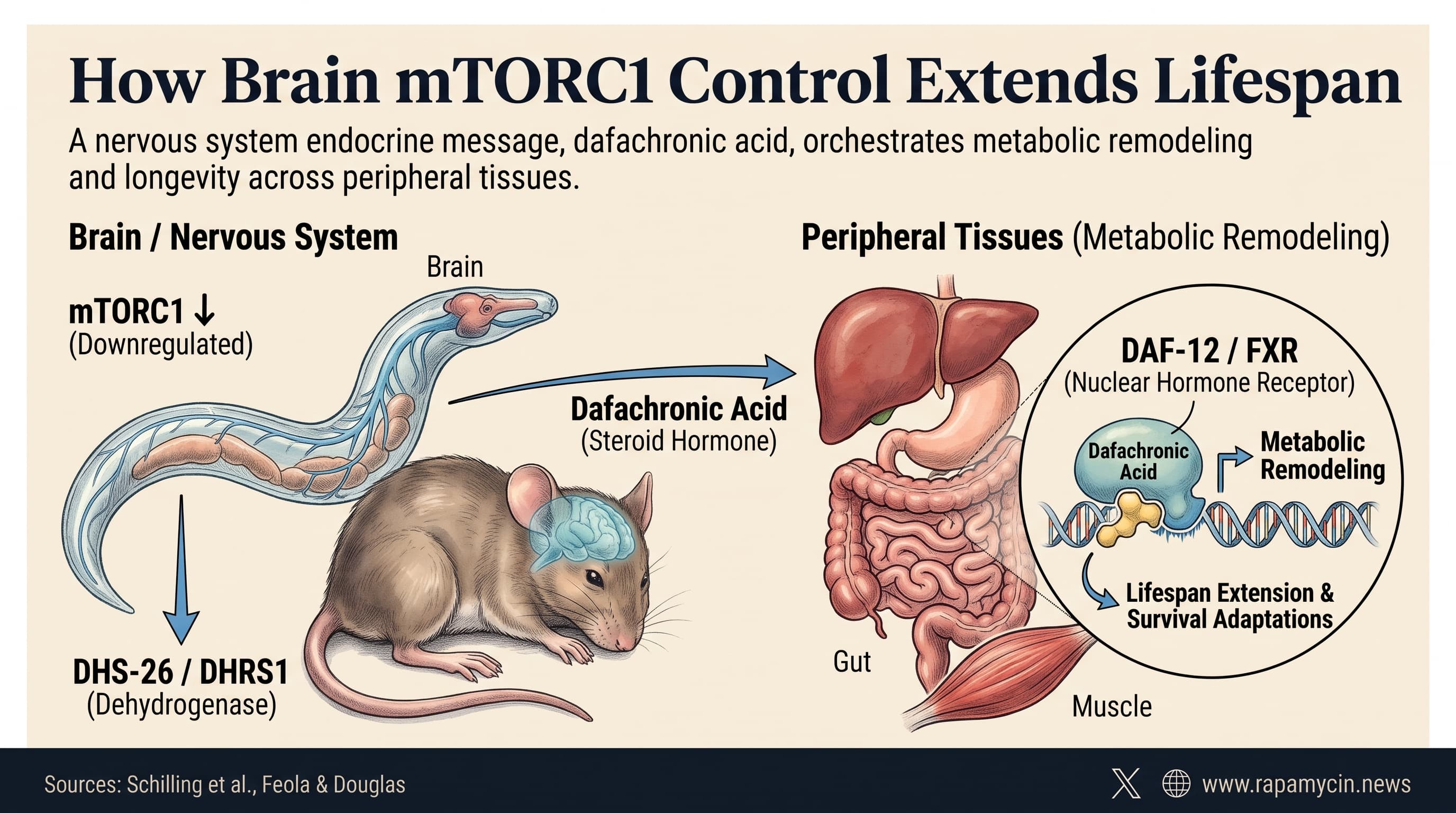
Working in the nematode C. elegans, researchers at the Max Planck Institute for Biology of Ageing showed that the 20 to 30 percent lifespan extension caused by reducing TORC1 activity (via deletion of raga-1) completely depends on dafachronic acid, a bile acid-like steroid hormone, and its nuclear receptor DAF-12, a relative of mammalian FXR and the vitamin D receptor. Low mTOR raised hormone levels by about 20 percent, and supplementing the hormone restored longevity in worms that could not make it, but not in worms lacking its receptor. A screen of 185 genes identified DHS-26, an enzyme expressed mainly in two canal-associated neurons, as essential for the effect. Its mammalian ortholog, DHRS1, shows correlative regulation by rapamycin and FXR in reanalyzed mouse datasets. Feola and Douglas summarizes the work as evidence that mTOR controls aging partly through organism-wide hormonal signaling.
Few interventions in aging biology are as reliable as dialing down mTOR, the nutrient-sensing kinase that tells cells whether to grow or conserve. Block it with rapamycin, restrict calories, or delete one of its upstream sensors, and yeast, worms, flies, fish, mice and monkeys tend to live longer. The catch is that mTOR also runs growth, immunity, fertility and tissue repair, so blunt inhibition carries costs. The field keeps returning to one question: which downstream outputs actually deliver the longevity, so they can be targeted without any collateral damage or side effects?
A study from Adam Antebi’s group in Cologne offers a candidate, and it is not confined to the cells where mTOR is switched off. Working in C. elegans, Klara Schilling and colleagues show that the lifespan gain from deleting raga-1, part of the amino acid sensing machinery that activates mTOR complex 1, depends on a steroid hormone called dafachronic acid and its nuclear receptor, DAF-12. Dafachronic acid is chemically a cousin of the bile acids mammals use as hormones, and DAF-12 is related to the mammalian bile acid receptor FXR and the vitamin D receptor.
The genetics are clean. Worms lacking raga-1 lived 20 to 30 percent longer than normal worms. Knocking out the enzymes that make dafachronic acid, or its receptor, erased that advantage entirely. Feeding the hormone back restored the extra lifespan in worms that could not make it, but not in worms lacking the receptor, which is the textbook signature of a hormone acting through a dedicated receptor. Worms with low mTOR activity also carried about 20 percent more of the hormone.
The team then searched for genes switched on by this circuit that are needed for the lifespan gain. Of 185 candidates tested, one stood out: dhs-26, an enzyme with no previously known physiological role. Deleting it barely affected normal worms but abolished the longevity of raga-1 mutants, and those double mutants had less dafachronic acid. Hormone supplementation rescued them. Because the hormone also boosts dhs-26 expression, the authors propose a self-reinforcing loop that could convert a local nutrient signal into a sustained, body-wide program.
The most intriguing detail is where dhs-26 is active. It is expressed mainly in two canal-associated neurons, cells that run alongside the worm’s excretory canal and are required for development. A gene active in just two neurons governing whole-animal lifespan points to a neuroendocrine relay, consistent with earlier work showing that lowering raga-1 in neurons alone extends worm lifespan.
The human ortholog, DHRS1, is abundant in liver and adrenal glands. Reanalysis of published mouse data showed its expression rose in the brains of rapamycin-treated mice and fell in the livers of mice lacking FXR. Those links are correlative and rest on small datasets, one from a mitochondrial disease model.
What the study does not show matters as much. Nobody has tested whether extra dafachronic acid lengthens the life of normal worms, what DHS-26 actually does chemically, or whether disabling DHRS1 changes aging in a mammal. For now, the work reframes mTOR from a purely cell-internal switch into a sender of hormonal messages, a shift worth watching.
Insights
This paper is a worm genetics study with correlative mouse data, so it needs to be duplicated in mammals or humans. What it does and does not imply:
- If you use rapamycin or caloric restriction, this work suggests that part of the benefit (in worms) is relayed by a bile acid-like hormone rather than occurring only inside each cell. It does not show that adding bile acids or bile acid drugs enhances the effect.
- Do not self-experiment with FXR agonists based on this pathway. The leading one, obeticholic acid, was withdrawn from the US market in 2025 after serious liver injury in patients.
- Speculative: bile acid sequestrants (cholestyramine, colesevelam) alter bile acid signaling. Whether they interact with rapamycin’s benefits is completely untested. [Confidence: Low]
Context and Source
- Open Access Paper: A hormonal message for a longer life (Insight commentary on: mTOR regulates longevity through a bile-acid like hormonal mechanism), October 22, 2026.
- Institutions: Department of Molecular Biology, University of Texas Southwestern Medical Center (Feola and Douglas); Max Planck Institute for Biology of Ageing (Schilling et al.)
- Countries: United States, Germany, and Austria
- Journal Name: eLife
- Impact Evaluation: The impact score of this journal is 6.4, evaluated against a typical high-end range of 0–60+ for top general science, therefore this is a High impact journal.