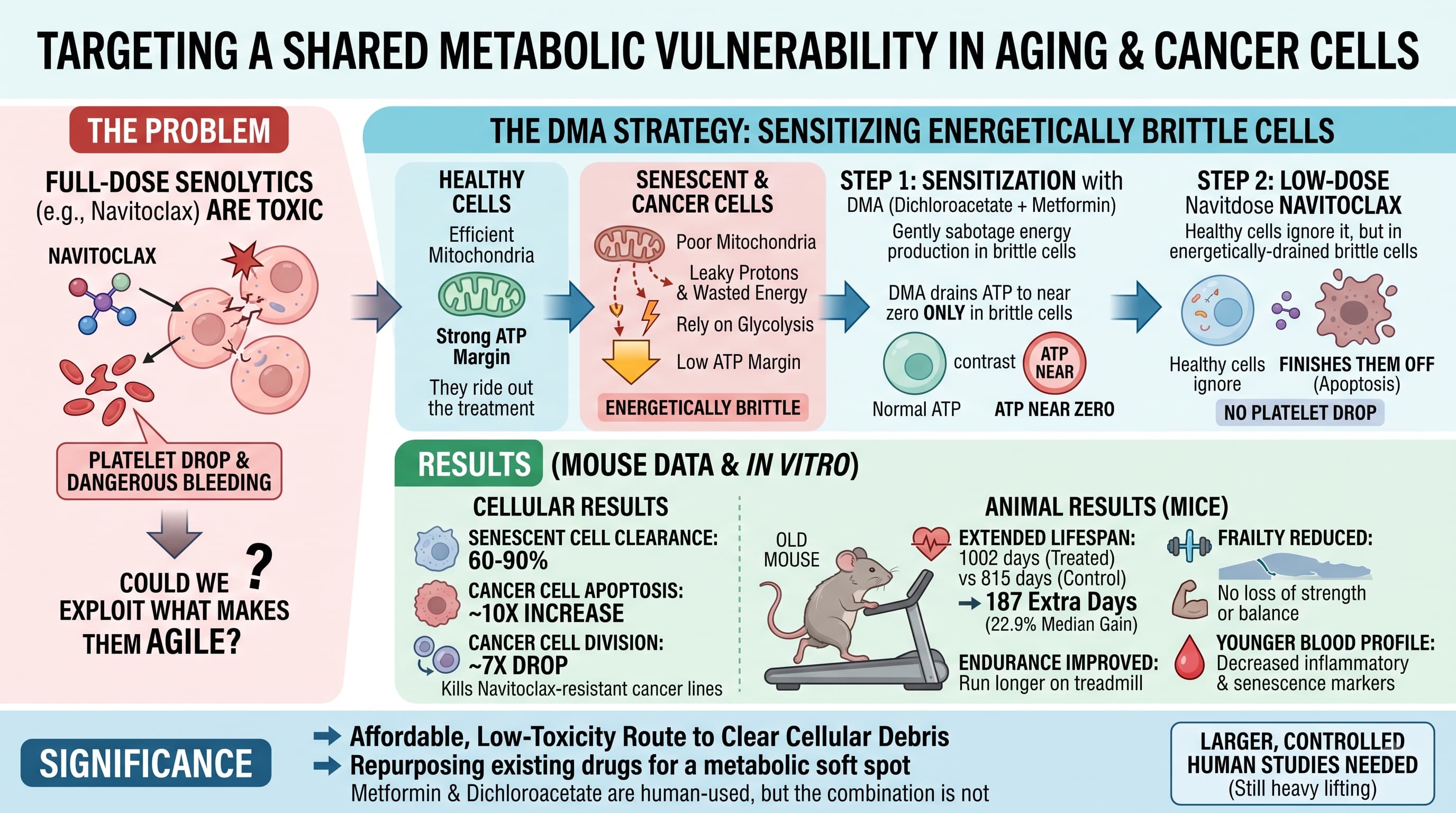
Researchers at UC Berkeley combined two inexpensive, widely available metabolic drugs, dichloroacetate and metformin, with a ten-fold reduced dose of the experimental senolytic navitoclax (ABT-263) to create a three-drug cocktail they call DMA. The core idea is that both cancer cells and worn-out senescent cells share the same metabolic weakness: leaky, inefficient mitochondria and an over-reliance on fragile ATP production. DMA pushes these already-strained cells over the edge into an energy collapse, while healthy cells with robust metabolism shrug it off. In cell culture DMA killed multiple cancer lines and several types of senescent cells, including navitoclax-resistant ones, without the platelet toxicity that has stalled navitoclax in the clinic. In old mice, short courses improved treadmill endurance, and prolonged dosing modestly extended lifespan. The work is preliminary, mechanistically interesting, and comes with significant caveats about sample size and translation.
For years the dream of treating aging and cancer with the same drug has run into the same wall: the drugs that kill senescent cells, the so-called senolytics, tend to be toxic. Navitoclax, one of the most promising, drops platelet counts so sharply that it can cause dangerous bleeding, and many cancers simply ignore it. The Berkeley team asked a different question. Instead of hitting these cells harder, could you exploit what makes them fragile in the first place?
Their answer targets metabolism. Cancer cells and senescent cells both run their mitochondria poorly. They leak protons, waste energy, and lean heavily on glycolysis and a thin margin of ATP to stay alive. The team reasoned that if you gently sabotage energy production with two old metabolic drugs, metformin and dichloroacetate, you could make these cells so energetically brittle that even a small, normally safe dose of navitoclax would finish them off. Healthy cells, with efficient mitochondria and spare capacity, would ride it out.
That is roughly what happened in the dish. The combination, DMA, wiped out senescent lung fibroblasts and killed cancer lines from cervical, breast, and colon tumors, including a breast line that resists navitoclax on its own. It did this by draining cellular ATP to near zero in the sick cells while leaving healthy neurons, liver cells, and muscle precursors largely intact. Crucially, the reduced navitoclax dose no longer crashed platelet counts.
The animal data are more modest but intriguing. Old mice given short courses ran longer on a treadmill and showed no loss of strength, balance, or increase in frailty. Their blood showed a drop in inflammatory and senescence-associated proteins, nudging their molecular profile toward that of younger animals. When dosing continued for life, treated mice lived a median of 187 days longer than controls, and their serum proteome drifted younger.
The significance is conceptual as much as practical. Rather than inventing a new toxic drug, the team repurposed cheap, familiar molecules by aiming at a shared metabolic soft spot. If it holds up in larger, better-controlled studies, it points toward affordable, low-toxicity ways to clear the cellular debris that drives both aging and cancer. That “if” is still doing heavy lifting.
Actionable Insights
The take-home message is that this is a mouse and cell study, so there is nothing here to act on directly. What it offers is a direction and a sense of scale.
The headline benefit is lifespan. Mice that started treatment at old age (around 18 months) and continued for life reached a median lifespan of 1002 days versus 815 days for untreated mice. That is 187 extra days, a 22.9 percent longer median lifespan. Averaged across all animals the gain was smaller, roughly 12 to 14 percent. Measured only over the time after treatment began, survival stretched by about 41.7 percent, but that larger-sounding number is inflated by starting the clock late in life.
The functional benefit was endurance. Old treated mice improved their month-over-month treadmill running time significantly more than controls, without losing grip strength or gaining frailty. In cells, the effect sizes were large: senescent cells were cleared by roughly 60 to 90 percent, cancer-cell apoptosis rose about tenfold, and cancer-cell division dropped about sevenfold.
Two of the three ingredients, metformin and dichloroacetate, are already human drugs, which is why this line of work matters. But the third is not benign, the doses and delivery were tuned for mice, and no human has taken this combination. Treat it as a research signal, not a protocol.
Context and Source
- Open Access Paper: Selective targeting of cancer and senescence via shared metabolic shifts extends lifespan of old mice.
- Institution and country: Department of Bioengineering and QB3 Institute, University of California, Berkeley, USA. Senior author Irina M. Conboy. Note a declared conflict of interest: the senior author is co-founder and Chief Scientific Officer of Generation Lab, though the paper states the work was conducted independently of the company.
-
Journal: Aging (also known as Aging-US), published by Impact Journals
Impact evaluation: The most recent Journal Impact Factor is about 3.9 (2023 edition), trending down to roughly 3.2 in the 2024 edition, from a historical peak near 6.4 in 2014. Using the current figure: The impact score of this journal is approximately 3.9, evaluated against a typical high-end range of 0 to 60+ for top general science journals, therefore this is a Low-to-Medium impact journal. Two reputational caveats belong alongside that number: the journal appeared on Beall’s list of potentially predatory open-access journals in 2015, and it has faced criticism over self-citation practices. This does not invalidate the science, but it lowers the prior on stringent peer review.