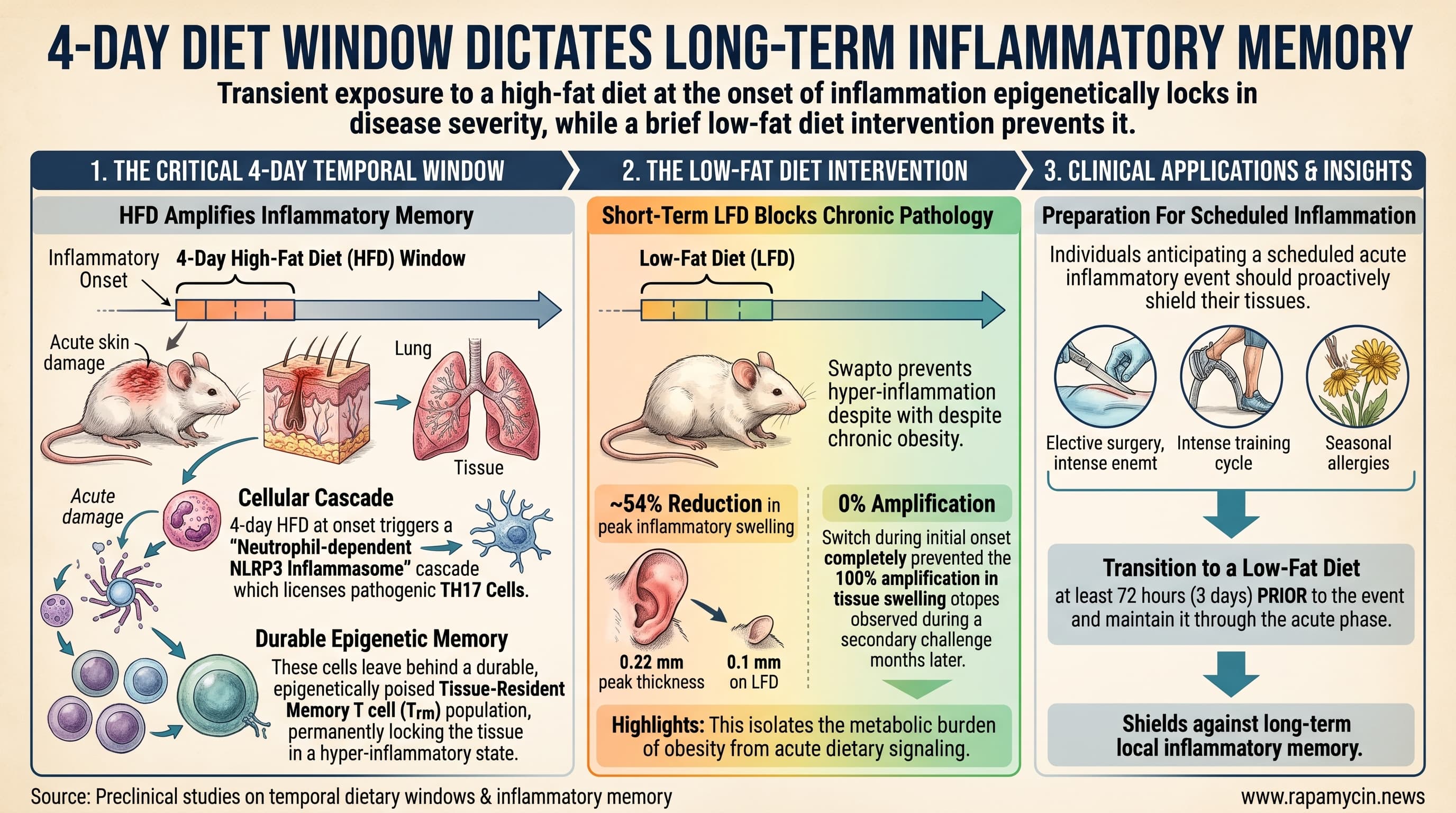
Transient exposure to a high-fat diet for just four days surrounding the onset of inflammation radically and permanently exacerbates disease severity. Using murine models of skin and lung inflammation, researchers demonstrated that this brief dietary window amplifies tissue pathology to levels matching chronic obesity. The damage is mediated by a neutrophil-dependent NLRP3 inflammasome cascade that licenses pathogenic TH17 cells. This acute event leaves behind a durable, epigenetically poised tissue-resident memory T cell population. Crucially, switching to a low-fat diet strictly during this four-day inflammatory trigger window prevents the hyper-inflammatory response entirely, even in chronically obese subjects. These findings isolate the metabolic burden of adiposity from acute dietary signaling, highlighting a precise temporal window where short-term nutrition dictates long-term local inflammatory memory.
The medical consensus has long maintained that the immunological detriments of a poor diet are driven by chronic accumulation of adipose tissue and systemic metabolic dysfunction. This research overturns that assumption by isolating the exact temporal window where dietary fat intersects with an immune trigger. A high-fat diet (HFD) does not require months to compromise tissue immunity; a mere four days of HFD exposure perfectly timed with an acute inflammatory insult doubles the severity of the disease.
Researchers utilized topical imiquimod to induce acute type 17 skin inflammation in mice. Lean mice fed a HFD for just one week exhibited identical pathology to obese mice maintained on a HFD for ten weeks. When the researchers narrowed the dietary exposure window, they discovered that simply eating a HFD for four days (three days prior to the insult and one day after) was sufficient to drive the exaggerated response. Conversely, obese mice that were switched to a low-fat diet strictly during this four-day window were completely protected from the exacerbated inflammation, despite remaining morbidly obese. Administration of the GLP-1 agonist semaglutide improved systemic metabolic markers in HFD mice but completely failed to halt the diet-amplified inflammation. This proves the inflammatory amplification is a direct tissue-level response to acute nutrient availability, rather than a consequence of systemic insulin resistance or total body weight.
The mechanism relies on rapid innate immune sensing. Short-term HFD feeding causes a sudden influx of neutrophils into the tissue. Upon encountering an inflammatory trigger, these neutrophils activate the NLRP3 inflammasome to produce IL-1β. This cytokine subsequently binds to IL-1R1 on CD4+ T cells, polarizing them into highly pathogenic TH17 cells.
The most alarming finding is the permanence of this acute event. After the initial flare resolved and all mice were returned to a healthy low-fat diet for a recovery period extending up to 6.5 months, the tissues appeared entirely normal. However, a secondary inflammatory challenge immediately caused an exaggerated disease state in the historical HFD cohort. The transient lipid exposure permanently altered the chromatin landscape of local tissue-resident memory CD4+ T cells, locking them into a hyper-responsive state.
Actionable Insights
Individuals anticipating a scheduled acute inflammatory event (such as elective surgery, initiation of a new intensive training cycle, or the onset of severe seasonal allergies) should strictly transition to a low-fat diet at least 72 hours prior to the event and maintain it through the acute phase.
The clinical magnitude of this intervention is substantial. Switching to a low-fat diet for the four-day peri-initiation window reduced peak inflammatory swelling by approximately 54% (dropping from a ~0.22 mm absolute increase in ear thickness to a ~0.1 mm increase). Similarly, avoiding HFD during the initial inflammatory onset completely prevented the 100% amplification in tissue swelling observed during a secondary challenge months later.
For individuals unable to optimize diet prior to an acute immune insult, prophylactic inhibition of the NLRP3 inflammasome offers a parallel mechanistic intervention. The data demonstrate that topical application of the NLRP3 inhibitor MCC950 during the primary inflammatory event completely abolishes the HFD-induced pathological memory, reducing pathological neutrophil counts by approximately 50%.
Context/Source
Open access Paper: Diet at disease onset determines tissue inflammatory memory, Published: 28 October 2026.
Institution: University of California, San Francisco (UCSF)
Country: USA
Journal: Nature
Impact Evaluation: The impact score of this journal is 50.5, evaluated against a typical high-end range of 0–60+ for top general science, therefore this is an Elite impact journal.